For any inquires on backlink exchange or partnerships please contact thecodex@gmail.com
The Wiki Forums are up! Check them here!
There is an official chat room on the wiki! I'm always AFK here so pull by to say hi!
If you would like to join the discord, please read this page.
Blastoise (Pokkén Tournament)

|
"Under Construction!" |
| This article or section will be subject to revision in the near future. The current statistics or information does not fully reflect our views. |
Blastoise is a Water type Pokémon from the Kanto Region. It is the second battle Pokémon to be added to Pokkén Tournament DX post-launch. It became available on March 23rd, 2018 as part of Wave 2 of the Pokkén battle pack.
| Blastoise | |
|---|---|
.png) | |
| Origin | |
| Origin | Pokkén Tournament |
| Characteristics | |
| Species | Shellfish Pokémon |
| Gender | Unknown |
| Age | Unknown |
| Status | Alive |
| Alignment | True Neutral |
| Occupation | None |
General Information
Name: Blastoise
Origin: Pokkén Tournament
Gender: Unknown
Age: Unknown
Classification: Pokémon
Species: Shellfish Pokémon
Occupation: None
Status: Alive
Alignment: True Neutral (Trainer Pokémon follow whatever their trainer commands or believes, regardless of how good or bad it is, even if the trainers end-goal results in their deaths, they will follow and obey their commands)
Codex Statistics
Tier: 6-A, Higher with Synergy Burst
Cardinality: Finite
Dimensionality: 3-D
Attack Potency: Continent level (Potency) (Fought against and defeated Shadow Mewtwo who shot a blast that destroyed a portion of the Earth), Higher with Synergy Burst
Durability: Continent level, Higher with Synergy Burst
Striking Strength: Continent Class (Potency), Higher with Synergy Burst
Lifting Strength: Unknown, Higher with Synergy Burst
Travel Speed: Massively Hypersonic (Can keep up with Shadow Mewtwo who can fly into space), Higher with Synergy Burst
Attack Speed: Massively Hypersonic (Could fight Shadow Mewtwo), Higher with Synergy Burst
Reaction Speed: Massively Hypersonic, Higher with Synergy Burst
Stamina: Superhuman
Range: Standard Melee, Tens of meters with abilities
Intelligence: Average Intelligence (Pokémon are intelligent creatures capable of communicating with other member of their species[1], even being able to run TV Programs on their own[2]. Pokémon are capable of holding various kinds of jobs such as working at a café[3], construction work[4], customer service, cloth making, power line setting and various others)
Knowledge: Master level (Could fight the champions Pokémon and win multiple tournaments and promotion tests)
Naturally has Pokémon Physiology, which grants:
- Superhuman Physical Characteristics
- Pressure Points (Critical hits are in actuality pressure point strikes, with the Japaense version noting "Hit a pressure point!")
- Helper Call (Pokémon can call for help from other Pokémon, its own species, or higher evolutions[7])
- Non-Standard Interaction
- Spirit Interaction: Every Pokémon through the usage of struggle can harm even ghost type Pokémon[8].
- Non-Standard Damage (All Pokémon have a special attack stat, a stat different from physical attacks that ignores physical defense in place of special defense)
- Non-Standard Defenses (All Pokémon have a special defense stat, a stat different from physical defense made to defend against special attacks)
- Autopilot (Pokémon can avoid attacks even while they're sleeping)
- Evolution (Pokémon under correct conditions can evolve[9] gaining new abilities that their previous form did not have[10])
- Aura (All people and Pokémon have an aura that characters like Lucario can sense[11])
- Acausality
- Supernatural Protection (The luminance light of Arceus guides and protects all Pokémon[13])
- Statistics Boost (When Pokémon use a move that is the same type as they are the move's power is increased by 50 percent[14])
- Pain Tolerance (Pokémon can take their pain being forcibly split without passing out, and can keep fighting despite being stabbed by spikes[15])
- Pierce Resistance
- Standard Pierce Resistance: Pokémon can take constant hits from stabbing attacks without dying, such as horn attack, horn drill, crunch where the Pokémon use their sharp fangs, and more.
- Impact Resistance
- Standard Impact Resistance: Pokémon can recover from being flattened[16])
- Accelerated Development
- Battle & Leveling
- Physical Stats & Abilities: Pokémon doing battle and[6] winning will gain[17] experience and level up becoming stronger[10] and may learn new moves[18].
- Battle & Leveling
- Enhanced Senses (Pokémon are able to sense when the seasons change[19])
- Emotional Empowerment (Pokémon can have their attack greatly raise from anger but doing so may also confuse them[20]. Pokémon can become enraged and greatly increase their stats[5])
- Purification (Pokémon can heal themselves from status effect put on them after several turns[5])
- Consumption (Pokémon can ingest items such as soda pops or eat food to regain health and recover from status effects)
- Chip Damage (Pokémon can chip away at each other's health overtime to eventually defeat the opponent[21])
- Escape Prevention (If a Pokémon becomes agitated[22] one cannot flee[22])
- Size Manipulation (It is mentioned by Laventon that each and every Pokémon is able to shrink itself down to minuscule size[23]).
- Limited Resistance to
- Absolute Zero (The move sheer cold causes Pokémon to only faint instead of die[24], which is noted to be a blast of absolute zero cold)
- Fire Manipulation (Pokémon can take being burned and only faint from it[25])
- Poison Manipulation (Pokémon will eventually cure itself of poison after being brought down to 1 HP or lose the poison status after fainting. Many poison type attacks such as Malignant Chain only has a chance of poisoning the user)
- Resistance to
- Pressure Points (Pokémon can generally still keep fighting even after taking a critical hit[5])
- Sealing (Pokémon normally require to be damaged or inflicted with status conditions[26] to attempt to be caught[6] only working after multiple attempts[6])
- Sense Manipulation (Pokémon can eat Nomel Berries which are so sour that makes one bite impossible to taste for three days)
- Ice Manipulation (It's noted to be difficult to freeze a Pokémon[27])
- Acid Manipulation (Pokémon take no damage from moves like Gastro Acid and instead just have their abilities suppressed[28])
- Emotion Manipulation (If a Pokémon becomes agitated, the ranger cannot convey their feelings of friendship as well[22], where the Capture Styler is a device Rangers can use to communicate their feelings to Pokémon to befriend them[29] making them no longer dangerous[30])
- Gravity Manipulation (Pokémon can still fight and perform moves while under intense gravity, only being restricted from flying and levitating)
- Spirit Manipulation (Spirit Break at worst only makes a Pokémon faint[31] where the move is made to break a Pokémon's spirit, lowering their special attack stat. Pokémon can take hits from Final Flicker[32], a burst attack where Chandelure consumes one's spirit)
- Spatial Manipulation (Spacial Rend at worst only makes a Pokémon faint[33], where Palkia tears the foe along with the space around them being able to land critical hits more easily)
- Time Manipulation (Roar of Time at worst only makes a Pokémon faint[34] where Dialga blasts the target with power that distorts even time itself, though it cannot move on the next turn)
- Black Hole Manipulation (Pokémon at worst faint from Gardevoir's black hole attacks[35], it is even noted in all of Gardevoir's Pokedéx entries that they will create a small black hole to protect her trainer[36])
- Distortion World (Pokémon can naturally exist and fight within the Distortion World[37]). The Distortion World gives a resistance to the following:
- Law Manipulation & Physics Manipulation (Cynthia describes the distortion world as "A world where the rules are broken"[37]. When describing the Reverse World in an interview, concepts such as E=mc^2, matter, and anti-matter where brought into the mind of Junichi Masuda[38])
- Space-Time Manipulation (Cyrus likens the Distortion World to existing on the other strand of DNA[37], where time doesn't flow and space isn't stable[37] being opposite to the universe[37])
- Superhuman Physical Characteristics
- Martial Arts (Can fight against martial artists like Machamp in combat)
- Summoning (Pokémon can summon Support Pokémon)
- Forcefield Creation (Pokémon can create a shield to block attacks)
- Non-Standard Interaction (Blastoise can harm Gengar a ghost type)
- Transformation (With Synergy Burst he turns into Mega Blastoise)
- Water Manipulation (Blastoise is a water type along with being able to use Water Gun, Water Spout, Bubble and Water Pluse)
- Aura (Via Aura Sphere)
- Darkness Manipulation (Via Dark Pulse)
- Energy Projection (Via Dragon Pulse)
- Resistance Bypassing (Can harm Gardevoir, a Fairy Type with Dragon Pulse)
- Statistics Amplification (Can increases his defense with Withdraw)
- Ice Manipulation (Seen here)
- Shockwave Generation (Seen here).
- Resistance to
- Electricity Manipulation (Emolga and Rotom can use Electric type moves)
- Fire Manipulation (Fennekin, Ninetales, Victini, Reshiram, and Litten can use Fire type moves)
- Plant Manipulation (Snivy can use Grass type moves)
- Water Manipulation (Lapras, Frogadier, and Popplio can use Water type moves])
- Earth Manipulation (Quagsire can use Mud Bomb)
- Healing (Eevee, Togekiss, Victini, Sylveon, and Espeon can heal Pokémon)
- Statistics Amplification (Frogadier, Mismagius, Litten, and Popplio can increase attack, Jirachi and Victini can restore Synergy Burst, Togekiss can increase speed, and Sylveon can increase defense)
- Power Nullification (Yvetal can seal opponent's Synergy Burst and Latios can restrict the opponent's movement)
- Air Manipulation (Mismagius can use Ominous Wind)
- Self-Destruction (Electrode can use Explosion)
- Statistics Reduction (Emolga and Rotom can lower speed, Ninetales can lower attack, and Croagunk lowers defense)
- Poison Manipulation (Croagunk can use Toxic)
- Burrowing (Diglett can use Dig)
- Status Effect Inducement (Magneton and Mimikyu can inflict status moves)
- Purification (Espeon and Cresselia can cure status moves)
- Absorption (Umbreon and Yvetal can absorb Synergy from the opponent)
| Emolga and Fennekin | |
| |


| Snivy and Lapras | |
| |


| Frogadier and Eevee | |
| |


| Jirachi and Whimsicott | |
| |


| Ninetales and Mismagius | |
| |


| Farfetch'd and Electrode | |
| |


| Rotom and Togekiss | |
| |


| Dragonite and Victini | |
| |


| Croagunk and Sylveon | |
| |


| Pachirisu and Magikarp | |
| |


| Cubone and Diglett | |
| |


| Magneton and Quagsire | |
| |


| Espeon and Umbreon | |
| |


| Reshiram and Cresselia | |
| |


| Yveltal and Latios | |
| |


| Litten and Popplio | |
| |


| Mega Rayquaza and Mimikyu | |
| |


| Mew and Celebi | |
| |


Notable Techniques
-
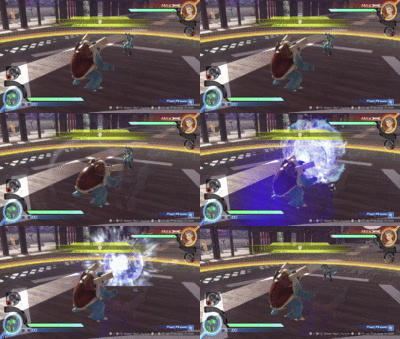 Water Gun
 -
 Water Gun + Aura Sphere
 -
 Water Gun + Dark Pulse
 -
 Water Gun + Dragon Pulse
 -
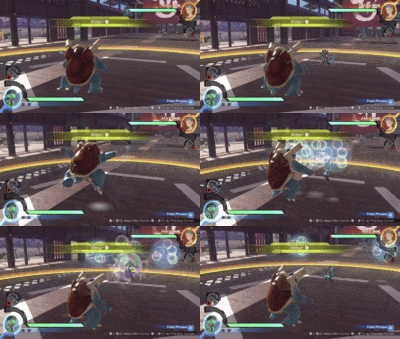 Bubble
 -
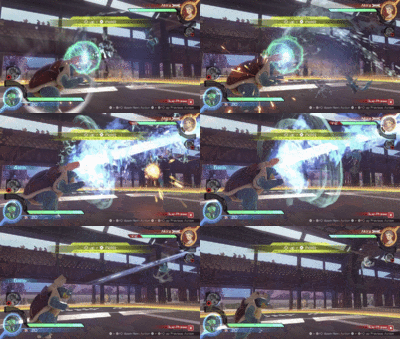 Hydro Pump
 -
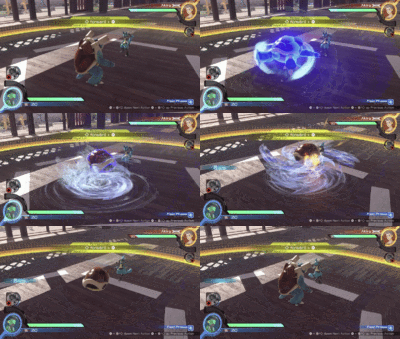 Rapid Spin
 -
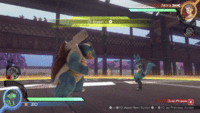 Water Pulse
 -
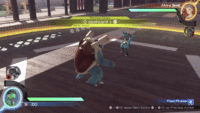 Water Spout
 -
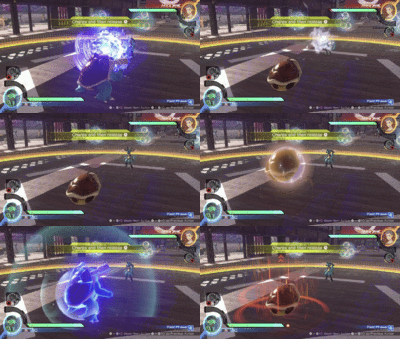 Withdraw


Other
Standard Tactics: Balstoise attacks his opponent physically while also using his large assortment of moves
Weaknesses
- Standard Pokémon Weaknesses: Pokémon being greatly angered causes them to be confused[39]. The usage of struggle makes the Pokémon take recoil damage, even if they've barely damaged an opponent[8]. Pokémon become too scared to move when dealing with an entity[40] that cannot be ID'd[40]. One Hit KO Moves do not work if the opponent is higher leveled[41]. Startling a Pokémon in the middle of its evolution will cause it to not evolve[42].
- Support Pokémon/Synergy Burst Weaknesses: Support Pokémon and Synergy Burst wastes synergy.
- Water Type Weaknesses: As a water type, he is weak to Electric and Grass type moves.
Explanations
Status Effects
The following is an explanation of the various status effects of Pokémon
| Status Effects | |||||||||||||||||||||||||||||||||||||||
| |||||||||||||||||||||||||||||||||||||||
Battle Records
None.
None.
None.
References
- ↑ Hey You, Pikachu!
- ↑ Pokémon Channel
- ↑ Pokémon Café ReMix
- ↑ Timburr Pokedéx Entry Pokémon White
- ↑ 5.0 5.1 5.2 5.3 Pokémon Legends Arceus
- ↑ 6.0 6.1 6.2 6.3 Pokémon Fire Red
- ↑ Pokémon Sun & Moon SOS Encounters
- ↑ 8.0 8.1 Pokémon Move: Struggle
- ↑ Pokémon Legends Z-A
- ↑ 10.0 10.1 Pokémon Emerald
- ↑ Pokémon Lucario Pokedéx Entires
- ↑ Pokémon Masters Sabrina and Olympia Conversations
- ↑ Pokémon Legends Arceus Pokedex Entry "It is the heavenly fount from which pours the light that shines across Hisui. Its luminance guides and protects all Pokémon. Hisuian mythology states that Arceus is the creator of all things."
- ↑ Pokémon Scarlet & Violet Naranja Academy Types and Moves I "You may be familiar with Pokémon that are Grass, Fire, or Water type. There are eighteen such types in all, and every Pokémon species has at least one type-some have two. When Pokémon use a move that is the same type as they are, that move's power is increased by 50 percent. For Pokémon that have two types, moves of either type will receive this increase."
- ↑ Pokémon Move Spike
- ↑ Pokémon Lets Go Pikachu Lets go Eevee
- ↑ Pokémon Legends: Z-A
- ↑ Pokémon Crystal
- ↑ Pokémon Go Look forward to autumn-themed Pokémon, Berry bonuses, and Deerling coming as the seasons change! "Pokémon can sense when the seasons change! You can expect to see the following Pokémon appearing more often in the wild: Oddish, Vulpix, Bayleef, Hoothoot, Sudowoodo, Yanma, Pineco, Zigzagoon, Seedot, Shroomish, Plant Cloak Burmy, and Foongus."
- ↑ Pokémon Move: Swagger
- ↑ Pokémon Origins File 1: Red Red vs. Brock's Onix
- ↑ 22.0 22.1 22.2 Pokémon Ranger: Guardian Signs Agitated Pokémon Tutorial
- ↑ Pokémon Legends Arceus Intro Segment
- ↑ Pokémon Move: Sheer Cold
- ↑ Pokémon Move Will O Wisp
- ↑ Pokémon Scarlet & Violet Naranja Academy Status Conditions and Catching Pokémon "Dealing damage to a wild Pokémon makes it easier to catch in a Poké Ball, and inflicting status conditions on the Pokémon can make it easier still."
- ↑ Pokémon X & Y Snowbelle City Top-Left Most House
- ↑ Pokémon Move: Gastro Acid
- ↑ Pokémon Ranger Intro Capture
- ↑ Pokémon Ranger Guardian Signs Dolce Island Ukulele Pichu Battle
- ↑ Pokémon Move: Spirit Break
- ↑ Pokkén Tournament: Chandelure Final Flicker
- ↑ Pokémon Move: Spacial Rend
- ↑ Pokémon Move: Roar of Time
- ↑ Pokkén Tournament Gardevoir Burst Attacks
- ↑ Pokémon Gardevoir Pokedéx Entries
- ↑ 37.0 37.1 37.2 37.3 37.4 Pokémon Platinum Distortion World
- ↑ Pokémon Creators on Platinum Giratina Reverse World "IGN: What was the inspiration for the new concepts in Pokémon Platinum? Do you think the process for coming up with new concepts has changed since the first Pokémon games were developed?
Junichi Masuda: We created Platinum with a new method of determining the game's direction that was based on the image of one Pokémon - Giratina. When I imagined Giratina, the idea of a "reversed world" came to my mind. I thought of concepts such as "E=mc2" and matter and antimatter. There is no top or bottom, no left or right. We increased the number of developers for Diamond and Pearl, so we wanted to clarify the game concepts for the team before we started the project Its better to hammer out the overall vision of the game first, and then all the team members will work towards that vision by throwing out ideas. The concept of "ultimate" was what we started out with for this title." - ↑ Pokémon Move: Swagger
- ↑ 40.0 40.1 Pokémon Yellow Pokémon Tower Without Silph Scope
- ↑ Pokémon One Hit KO Mechanics
- ↑ Pokémon Ruby Route 116 Trainer Tip Sign
Versus Threads
None.
None.
None.
- Pages using Tabber parser tag
- Profile under revisions
- Templates
- Characters
- Gender Ambiguous Characters
- Pokémon
- Pokémon Characters
- Video Game Characters
- Playable Characters
- Nintendo Characters
- Fighting Game Characters
- Superhumans
- Martial Arts Users
- Summoning Users
- Forcefield Users
- Non-Humans
- Non-Standard Interaction Users
- Transformation Users
- Water Users
- Aura Users
- Darkness Users
- Energy Projection Users
- Resistance Bypassing Users
- Statistics Amplification Users
- Ice Users
- Shockwave Users
- Electricity Users
- Fire Users
- Plant Users
- Earth Users
- Healers
- Nullification Users
- Power Nullification Users
- Air Users
- Self-Destruction Users
- Statistics Reduction Users
- Poison Users
- Status Effect Users
- Purification Users
- Absorption Users
- Tectonic Tier
- Tier 6
- 6-A
- True Neutral Characters
- Burrowing Users
- Superhuman Physical Characteristics Users
- Superhuman Speed Users
- Human Achievements Users
- Pressure Point Users
- Accelerated Development Users
- Autopilot Users
- Sheer Will Users
- Heat Users
- Helper Call Users
- Non-Standard Damage Users
- Non-Standard Defenses Users
- Evolution Users
- Acausality Users
- Divine Protection Users
- Statistics Boost Users
- Pain Tolerance Users
- Pierce Resistance Users
- Impact Resistance Users
- Enhanced Senses Users
- Rage Power Users
- Rage Users
- Consumption Users
- Chip Damage Users
- Escape Prevention Users
- Size Users

