For any inquires on backlink exchange or partnerships please contact thecodex@gmail.com
The Wiki Forums are up! Check them here!
There is an official chat room on the wiki! I'm always AFK here so pull by to say hi!
If you would like to join the discord, please read this page.
Konngara
Konngara, described as an astral knight, appears as the final boss along the Hell route of Highly Responsive to Prayers. Reimu Hakurei encounters them at Hell's Silent Shrine. Due to Konngara's complete lack of dialogue, little is known about them, including their gender.
| Konngara | |
|---|---|
 | |
| Origin | |
| Origin | Touhou |
| Creator | ZUN |
| First Appearance | Touhou Project - Highly Responsive to Prayers |
| Characteristics | |
| Species | Hell Resident |
| Gender | Unknown |
| Pronouns | They/Them |
| Sexuality | Unknown |
| Age | Unknown |
| Birthday | Unknown |
| Height | Unknown |
| Weight | Unknown |
| Ethnicity | Japanese |
| Status | Alive |
| Alignment | Neutral Evil |
| Archetype | Black Knight |
| Occupation | Astral Knight |
| Time Period | Non-linear |
| Language | Unknown |
| Combat Style | Magical Combat |
| Homeworld | Hell |
| Relationships | |
| Affiliations | Hell |
| Enemies | Reimu Hakurei |
Background
| This dropdown contains the synopsis of Sariel’s story. Read at your own risk as you may be spoiled otherwise! | ||||||||||||
|---|---|---|---|---|---|---|---|---|---|---|---|---|
|
Highly Responsive to Prayers
A shrine located in the Far East, the Hakurei Shrine, houses a powerful seal that has begun to deteriorate. As a result, numerous non-human entities have started to emerge. Reimu only encounters Konngara if she chooses the Hell route, where Konngara is the final boss that ends up being defeated by Reimu. Konngara has not been seen again, but due to Reimu rarely killing any of her adversaries unless they directly broke the laws of Gensokyo, it is very likely Konngara is still alive. ZUN has made word too that characters from PC-98 games are still alive and are just "retired". |
Name Meaning
There is no official kana for Konngara, though it can be unofficially written as "矜羯羅". This may reference an attendant of Fudoo Myoo-oo, the Japanese name for the Wisdom King Acala (Sanskrit: अचल) in Shingon Buddhism. Fudoo Myoo-oo is a violent figure who burns away material desire with his flames. He is often depicted with fire, a sword, and the attendants "Konngara Dōji" and "Seitaka Dōji", who are sometimes considered part of Fudoo Myoo-oo's "Eight Great Youths". This connection relates to Konngara's pose.
Appearance
General Description: Konngara is a figure wearing red robes with white trim and grey sleeves. They have black hair and red eyes. They carry a large sword in one hand and what appears to be a cup in the other.
Facial Features: Their hair is black. Their eyes are red. They have what appears to be either a horn or a spike impaled through their forehead. They wear a red ribbon in their hair.
Clothing/Outfit:
- Primary Outfit (Highly Responsive to Prayers): Red robes with white trim and grey sleeves. A red ribbon is worn in their hair.
Items:
- A large sword held in one hand.
- A cup-like object held in the other hand.
Special Features: Konngara is one of the few PC-98 characters whose hair and eyes are not the same color, a trait shared only with Elis and SinGyoku's male form. This is due to the 16-color hardware limitation imposed on other PC-98 characters. They also have a distinctive horn or spike protruding from their forehead.
Alternate Forms/Disguises: This character does not have other widely recognized alternate forms.
Personality
Konngara has no spoken dialogue or narrative exposition in Highly Responsive to Prayers. Their actions and motivations are not explained or referenced within the game.
Goals
- Not known, other then possibly defeating Reimu (Failed).
General Information
Title: Astral Knight[2]
Origin: Touhou
Overall Series: Touhou Project
First Appearance: Touhou Project - Highly Responsive to Prayers
Latest Appearance: Touhou Project - Highly Responsive to Prayers
Company: ZUN Soft
Creator: ZUN
Actor: N/A
Gender: Unknown
Sexuality: Unknown
Pronouns: They/Them (As their gender is unknown)
Handedness: Likely Left-Handed (They are shown wielding their sword in their left hand, which is normally one would use their dominant hand to hold a weapon)
Age: Unknown
Birthday: Unknown
Time Period: The world of Gensokyo itself is in a non-linear time period
Timeline: Main Timeline
Homeworld: Hell
Residence: Hell
Story Role: Final Boss
Legacy: Unknown Legacy
Influence: No Influence
Language: Unknown
Ethnicity: Japanese (Their design heavily looks of Japanese origin)
Religion: Likely Buddhism (Their name is likely a reference to a Japanese Name for the Wisdom King Acala in Shingon Buddhism)
Classification: Astral Knight 'Konngara'[3]
Species: Hell Resident
State of Being: Regular
Physiology: Humanoid Physiology
In-Universe Creator: Unknown
Occupation: Astral Knight[4]
Combat Style: Magical Combat
Affiliations: Hell
Enemies: Reimu Hakurei
Height: Unknown
Weight: Unknown
Status: Alive (Noted by ZUN that characters from the PC-98 games have probably retired and are warmly watching over things from various places nowadays[5])
Alignment: Likely Neutral Evil (As a resident from Hell, was likely going to cause trouble around Gensokyo)
Threat Level: Global Threat (Noted to be pouring out of the broken seal from the Hakurei Shrine, being an overall threat to the world outside of Hell)
- Type(s) of Potential: Fixed Potential
- Level of Potential: Fixed
- Description: Hasn't had any real statements to showcase anything beyond the standard potential.
- Limitations: Standard limitations.
Archetype: Black Knight
Codex Statistics
Grade: A
Tier: At least Low 8-C, Far Higher with Spiritual Power
Cardinality: Finite
Dimensionality: 3-D
Attack Potency: At least Small Building level (Size) (Their size vastly eclipses Reimu, putting them at least around this size[6]), Far Higher with Spiritual Power (Spiritual Power is the main power source for how characters are able to fight, all of their attacks normally drain spirit and even blocking attacks drains spirit[7], where if they're out of spirit they cannot use bullets, special moves, or spell cards[8], where spiritual power is in the same layer as magic[9]. Noted how even Yumemi Okazaki's scientific magic truly pales in comparison with the real thing[10], which Yumemi noted to not make light of the power of her science as she could blow up the planet at any moment[11]). Can ignore conventional durability with Magic (Magic exists outside of the Grand Unified Theory[12], a theory with any model that merges electromagnetic, weak, and strong forces into a single force at high energies, unifying gravity with the electronuclear interaction, providing a more comprehensive theory of everything. Yumemi explains that on her world, all power can be explained by the Grand Unified Theory, however she posits an existence of a power not covered by the Theory: the power of magic[13]. Yumemi also explains that in the world of Gensokyo, magic unifies everything[14]. Magic is noted by Yumemi to have close ties with religion[15]. The second layer of reality is spirit and magic, while the first layer is where all things within the laws of physics presides, putting attacks with magic outside of the conventional laws of physics[9])
Durability: At least Small Building level, Far Higher with Spiritual Power (Spiritual Power is what protects fighters from other spiritual attacks[16], where if they're out of spirit they cannot use bullets, special moves, spell cards or block attacks[17], where spiritual power is in the same layer as magic[9]. Characters with their spiritual powers[18] have survive minature[19] suns exploding[20]). Their existence as a non-human makes them difficult to kill (It's noted that one cannot defeat spirits or devilish powers without a weapon with an unnatural amount of spiritual power such as the Yin-Yang Orb[21])
Striking Strength: At least Small Building Class (Size)
Lifting Strength: At least Superhuman
Travel Speed: Unknown: True level (As they don't move during the boss fight[22])
Attack Speed: Superhuman (Capable of tagging Reimu Hakurei with her attacks[23]). Magic Attacks lack a defined speed (Magic exists outside of the Grand Unified Theory[24], a theory with any model that merges electromagnetic, weak, and strong forces into a single force at high energies, unifying gravity with the electronuclear interaction, providing a more comprehensive theory of everything. Yumemi explains that on her world, all power can be explained by the Grand Unified Theory, however she posits an existence of a power not covered by the Theory: the power of magic[25]. Yumemi also explains that in the world of Gensokyo, magic unifies everything[26]. Magic is noted by Yumemi to have close ties with religion[27])
Reaction Speed: Superhuman
Stamina: Superhuman (They do not at all seem to get tired[28], despite them shooting out[29] a multitude of[30] attacks all[31] over the screen[32])
Range: Tens of Meters through sheer size. At least Dozens of Meters with Attacks (Shoots out[33] energy attacks[34] that reach[35] around[36] and[37] across the battlefield[38])
Intelligence: Unknown Intelligence
Knowledge: Unknown level
- Regeneration
- Types: Passive
- Source: Metaphysical Regeneration
- Capabilities: Non-Humans within Gensokyo do not have much demand for medicine for physical illnesses as they are comprised mostly of spirit, thus they can always regenerate from their spirit[39].
- Non-Standard Defenses (Reimu realized that only the Yin-Yang Orb was effective against non-human creatures[40], with it being noted that Reimu using her ofuda, her spirit power, and her martial arts all prove to be useless against her enemies[41], meaning Non-Humans cannot really be harmed by regular or standard weaponry. It's noted that one cannot defeat spirits or devilish powers without a weapon with an unnatural amount of spiritual power such as the Yin-Yang Orb[42]. In the world beyond (Gensokyo), physical form has no meaning for all non-human entities[43])
- Acausality
- For Their Physiology
- Magic (Magic exists outside of the Grand Unified Theory[44], a theory with any model that merges electromagnetic, weak, and strong forces into a single force at high energies, unifying gravity with the electronuclear interaction, providing a more comprehensive theory of everything. Yumemi explains that on her world, all power can be explained by the Grand Unified Theory, however she posits an existence of a power not covered by the Theory: the power of magic[45]. Yumemi also explains that in the world of Gensokyo, magic unifies everything[46]. Magic is noted by Yumemi to have close ties with religion[47])
- Extrasensory Perception (Noted by Patchouli that those who use magic are sensitive to changes in temperment[48])
- Transferal (Magic users can transfer their magic into a tool, having the tool change depending on the user[49])
- Transmutation
- Acausality
- For their Magic
- Irregular Causality
- Unknown: Magical power exists outside of the Grand Unified Theory[50], a theory with any model that merges electromagnetic, weak, and strong forces into a single force at high energies, unifying gravity with the electronuclear interaction, providing a more comprehensive theory of everything. It's further explained that magic is a force that cannot be explained by the Grand Unified Theory, with Yumemi even proposing a "Non-Unified Magic World" theory[51]. Yumemi explains that on her world, all power can be explained by the Grand Unified Theory, however she posits an existence of a power not covered by the Theory: the power of magic[52]. Magic does not exist in Yumemi's world, which is a Probability World, a different world, but in the same dimension[53].
- Irregular Causality
- For their Magic
- Holy Manipulation (Magic is noted by Yumemi to have close ties with religion[54])
- Spirit Manipulation (The bombs used are referred to as spiritual attacks[55], being directly called spiritual attacks[56])
- Explosion Manipulation (When bomb users are cornered from attacks they cannot repel with regular attacks they can release a massive spirit explosive that destroys all objects on screen[57], along with killing all enemies on screen[58])
- Magnetism Manipulation (When using a bomb[59], all items on screen will be attracted towards the user[60])
- Perception Manipulation (When using a bomb the screen flashes white and an image of the bomb user can be seen[61])
- Logic Manipulation (The Great Hakurei Barrier is a boundary of common sense, which things with high spiritual power in the cause to waver[62])
- Nullification & Erasure
- Projectile Nullification & Physical Erasure: Bomb users can use a bomb to nullify & erase all projectiles on screen[63]. This makes the enemy incapable of[64] shooting out any further projectiles until the bomb's duration is done[65].
- Invulnerability
- Link Manipulation (Strong Emotions can be contained in objects that can connect between the main world and the netherworld[67]).
- Resistance to
- Observation & Subjective Reality (Once a youkai/non-human enters Gensokyo or if a youkai/non-human is a native, they are liberated from the spell of human imagination and obtain true freedom, being able to develop their own characteristics, though the observations of the humans from within Gensokyo can have some effect on them to a degree[68])
- Probability Manipulation (Yumemi explains that on her world, all power can be explained by the Grand Unified Theory, however she posits an existence of a power not covered by the Theory: the power of magic[69]. Magic does not exist in Yumemi's world, which is a Probability World, a different world, but in the same dimension[70])
- Madness Manipulation (Unaffected from the affects of the Lunarian Full Moon, a hypnosis that drove the humans who came to the Moon insane[71], further being noted by Reisen that the moon drives people insane[72])
- Disease Manipulation (Non-Humans within Gensokyo do not have much demand for medicine for physical illnesses as they are comprised mostly of spirit, thus they are always fit and robust with no diseases[39])
- Matter Manipulation & Physics Manipulation (Gensokyo is a brane world dominated by particles with different properties, not following the standard physics of the real world[73], with the grand unified theory being the reason for all pheneomna in the human world, which does not apply to Gensokyo[74])
- Gravity Manipulation (Noted by Maribel that in the world of Gensokyo, they the gravitons likely have a different structure and the world's properties are likely different too, likening it to being one of the brane worlds[75])
- Superhuman Physical Characteristics
- Weapon Mastery
- Sword Mastery: Wields a sword that[76] they use for some attacks[77].
- Large Size
- Breaking the Fourth Wall ( Touhou characters constantly acknowledge being a stage boss[79])
- Cartoon Physics (Gensokyo is a world that lacks and defies common sense[80], where characters can explode[81], this is even acknowledged with ZUN roleplaying as the characters in-universe that they explode upon defeat[82]. Despite this they will still come back, even human characters that do not have regeneration)
- Non-Standard Interaction
- Metaphysical Interaction: As a non-human that can only be truly harmed from powerful spiritual attacks, they should also be able to harm other non-humans.
- Non-Standard Damage (Konngara attacks mainly with magical attacks, which are innately spiritual and go beyond conventional attacks)
- Energy Manipulation
- Electricity Manipulation (Causes a surge of electricity from their sword while shooting out a multitude of energy projectiles[84])
Sword

- Description: A sword used by Konngara, likely apart of their Astral Knight occupation.
- Appearance: It carries the appearance of a typical katana.
- Usage: While used it charges electricity, allowing it to shoot out a various amount of energy bullets at the opponent, some being fully solid lines.
- Function: It seems to function off of magic and spiritual energy, as it's noted that magic users can transfer their spiritual/magical energy into objects.
Notable Techniques
Phase 1


Expression: Neutral (Spreadshot + Random Bullets)
Konngara maintains their starting expression. They fire an aimed spreadshot followed by pellets spawning from the walls. Spreadshot configuration scales with difficulty:
- Easy: 2-way spread
- Normal: 3-way spread
- Hard: Wide 5-way spread
- Lunatic: Narrow 5-way spread
Wall pellet spawn speed increases slightly on higher difficulties. Most bullets form a vague, unaimed stream, but a sparse few track the opponent directly.
Expression: Eyes Closed (Double Lane)
Konngara closes their eyes. They fire a double lane that subsequently splits into two additional double lanes, curving both outward and inward. At higher difficulties the speed increases.
Expression: Angry (Trapping Homing Projectiles + Semicircles)
Konngara adopts an angry expression. They fire two invincible homing projectiles at the opponent's position, designed to trap movement within a specific region of the battlefield. These projectiles correct their aim mid-flight and follow erratic trajectories, making misdirection significantly more challenging than standard evasion. On Lunatic, the second projectile remains high when pellet fire commences.
Immediately following the projectiles, Konngara fires double semicircles of pellets from three positions in sequence: their face, their dish, and their sword. Each semicircle contains ten pellets. Firing timing accelerates with difficulty:
- Lunatic: Pellets fire almost immediately after the invincible projectiles, with nine total volleys (three from each position).
- Hard: One position cycle is skipped.
- Normal: Additional cycles are skipped.
- Easy: The first full cycle is omitted entirely.
Phase 2


Expression: Neutral (Moving Spawner)
Konngara maintains their starting expression. A spawner moves side to side while descending, firing aimed pellets. Firing frequency increases slightly on higher difficulties, and each successive pellet moves marginally faster than the previous one.
Expression: Eyes Closed (Aimed Spray)
Konngara closes their eyes. They release a spray of energy bullets that does not aim directly at the opponent, but instead the entire battlefield.
On higher difficulties, spray density becomes more closed.
Expression: Angry (Four Homing Invincible Projectiles)
Konngara adopts an angry expression. They fire four invincible homing projectiles similar to those in Phase 1, but without the accompanying semicircle pellets.
Expression: One Eye Closed (Ray + Falling Pellets)
Konngara closes a single eye. They fire a ray across the walls from left to right and back, causing pellets to rain down. The pattern is chaotic, with pellet count scaling significantly on higher difficulties.
Phase 3


Expression: Both Eyes Closed, Facing Center (Falling Sword Bullets)
Konngara closes both eyes and faces toward the center. They move their sword, leaving behind bullets that fall straight downward.
Expression: One Eye Closed (Lasers + Aimed Spreadshot)
Konngara closes one eye. They sweep the battlefield with lasers while firing an aimed 3-way spreadshot from their sword. Laser placement targets specific points rather than tracking the opponent. Higher difficulties increase laser count.
Expression: One Eye Closed, Facing Center (Outward Sword Bullets)
Konngara closes one eye and faces toward the center. They move their sword, leaving behind bullets that spread outward. The attack covers most of the screen.
Phase 4


Semicircle Lanes + Top Drop
Konngara closes one eye while maintaining opponent tracking. They throw lanes of energy bullets in a semicircular arc, followed by pellets dropping from the top of the screen.
Aimed Sword Slash
Konngara closes one eye and faces toward the center. They fire completely aimed, high-speed energy bullets from their sword.
Other
Standard Tactics
- Phase 1: Konngara cycles through three distinct attacks, shooting out spread-shots, double lanes, and homing projectiles.
- Phase 2: Konngara employs four attacks in this phase, attacks that from side to side, releasing a spray of energy bullets, shooting four homing invincible projectiles, and a falling energy bullet spam.
- Phase 3: Konngara employs three attacks in this phase, all involving her sword. These include falling sword energy bullets, lasers and aimed spreadshots, and outward sword energy bullets.
- Phase 4: Konngara gains access to all attacks from previous three phases while introducing two new patterns. Those being a semicircle energy bullet attack and aimed sword slashes.
Weaknesses
- Magic Weaknesses: Magic users taking too much damage will cancel out their attacks[85]. If a magic users spirit is depleted they enter a state of "Guard Crush" where they can't use bullets, special moves, or spell cards at all[86]. Repeatedly attacking red glyphs will break one's defenses[87].
- Unique Weaknesses: Nothing notable.
Note
- Any translations from en.tohouwiki.net are considered fine to use as they all fall under Project Translations, a fan translation team that have translation guuidelines and rulesets, along with moderators that directly overlook and proofread English translations to check for machine translations.
- Yumemi's statements can be taken with credibility, not only do the science from her world surpass the main one by 500 years[88] where she notes the science of the main world is much more primitive then hers[89], but her world has already fully proven the existence of Grand Unified Theory and Yumemi herself notes that her theory was proven right by seeing magic.
- Despite Gensou Narratograph being directly noted to be an "unofficial Touhou tabletop RPG", ZUN has directly participated in the RPG and noted the way Reimu acts during his session is how canon Reimu would act[90], thus character actions done by him and mechanics are fine to use.
- Even if characters have not showcased using a bomb, they should all be able to use bombs, as bombs are realistically just spiritual attacks[55] and to even be able to fight the non-human entities, requires a weapon with an unnatural amount of spiritual power such as the Yin-Yang Orb[91], meaning everyone that is non-human or is fighting non-humans is using spiritual energy.
Special Notes
- Many spell card images and descriptions along with translations are heavily helped by the Touhou Wiki.
Explanations
Canoncity of Touhou Project
The Touhou Project franchise canoncity mainly falls under any media worked on by ZUN are official and canon to the overall lineup.
There are various aspects constantly debated about within the canon:
PC-98
Media like PC-98, has been noted by ZUN to be ignored as one can ignore derivative works[92]. He has also said that anything prior to Embodiment of Scarlet Devil can for the most part be ignored and one can think of Embodiment of Scarlet Devil as the starting from a clean slate and starting a new series[93], he's also referred to Highly Responsive to Prayers as a study product[94]. With this in mind, one would assume that PC-98 is thus non-canon to the Windows continuity of games.
However, ZUN has also directly stated PC-98 games are the same world as the Windows Games, stating that any contradictions that exist from PC-98 can be ignored from the retcon in Windows Era[95]. While one argues ZUN noting the works are derivative works to be ignored and Embodiment of the Scarlet Devil should be seen as the starting point, these statements are moreso telling a fan to not worry about having to play PC-98 games or learn more about their stories.
It's also been noted in Embodiment of Scarlet Devil's おまけ.txt that the game chronologically is not too far from the previous title, which would be Mystic Square, the PC-98 title[96]. ZUN has also directly brought back characters from PC-98 games, noting he wanted to bring back characters from before Embodiment of Scarlet Devil and notes any of the other older characters that don't appear have probably retired by now and are warmly watching over things from various places nowadays[97]. When asked where Mima from PC-98 has gone, ZUN notes that he doesn't bring them back due to making things complicated and having potentially angry fans ask where she has been the entire time, he has also noted that there's not much use for characters like Genji as Reimu can fly now and also notes he is not dead[98]. ZUN has also made mention to Genji probably living in the lake in the back of the shrine[99]. In Touhou Sangetsusei ~ Strange and Bright Nature Deity, Reimu and Marisa were talking about glowing moss with Reimu saying it would be nice to transfer it to the pond in the back of the Hakurei Shrine and Marisa saying that she could make it grow there on the turtles' back, referencing Genji[100].
In Touhou 07 Perfect Cherry Blossom, when Alice meets Reimu, she tells her long time no see, noting that they've met before calling her "old friend"[101]. In Yuuka's mode in Touhou Project - Phantasmagoria of Flower View, Reimu directly references defeating Yuuka back in PC-98[102]. If Yuuka defeats Marisa in the same game, she will note that Marisa has grown up quite a bit, when the last time she's seen her has been in PC-98[103].
Seeing as ZUN himself has directly said both PC-98 and Windows are in the same world and that characters directly acknowledged PC-98 events and reference characters from it, PC-98 is completely canon and any contradictions PC-98 have can be ignored.
Side Games Time Placements
Touhou 7.5 - Immaterial and Missing Power takes place between Perfect Cherry Blossom and Imperishable Night[104].
Multiple Playable Routes
In the series, there are multiple playable character routes, including some where the characters fight Reimu herself and defeat her, calling question into what route is canon. ZUN has elaborated that canonically, anytime Reimu and the gang are defeated, they challenge again however many times they want, but on the youkai side, they do not challenge again after being defeated and are not attached to the results of winning or losing[105].
In terms of how playable routes have went, some examples of canonically noted routes:
- In Reimu's profile on Perfect Memento in Strict Sense, it's noted that Reimu resolved the Scarlet Devil Mansion Incident alone[106].
- Reimu is also acknowledged to have resolved the Spring Snow Incident in Perfect Cherry Blossom, though it is not noted if she did this alone[107].
- Reimu claims she solved the Eternal Night incident, however if one asks her about the cause or the perpetrator, she'll only respond with ambiguous answers, it is also not noted if she did this alone[108].
With some of these examples, it is normally assumed that in some way Reimu has some part in resolving every incident and other routes are dubiously canon depending on what transpired.
Spell Card Rules
There are many cases of weaker humans beating stronger Yokai or vice versa within the Touhou series, this has been elaborated on in Reimu's profile on Perfect Memento in Strict Sense. Reimu introduced the spell card rules as the youkai had no way to defeat the Hakurei shrine maiden, making many youkai feel that their meaning to exist have dissapeared[109]. The rules incoporate the following:
- Spell cards are techniques specially-named by the individual, and they must be declared upon use.
- The number of each party's spell cards must be determined in advance of a duel.
- The first party to have all of their spell cards beaten must admit defeat.
- The victor is entitled only to what was agreed upon before the duel. If they're not interested in what their opponent has to offer, they can refuse a duel.
- Winners should generally allow losers a rematch.
- Always prepare for the unexpected.
The original draft held these rules[110]:
- Combatants will give names and meanings to the duel for the benefit of beauty.
- Combatants will declare the number of named duels before beginning.
- Combatants may not repeat attacks by relying on stamina.
- Combatants may not deliver attacks that do not have meaning. The meaning itself becomes the attack's power.
- In the case that a combatant loses a named duel, that combatant will admit defeat, even if he or she has strength remaining. No combatant may kill a human, even upon victory.
- Combatants will write the duel's name on paper in the format of a contract. By doing so, the above-mentioned rules become absolute. These papers will be called spell cards.
These rules allows for duels that feel almost like sport rather then a match, and have allowed for weaker fighters to challenge stronger ones, due to this though, it also has become possible for youkai to freely defeat Reimu without worrying about the consequences.
Due to them being written into cards and essentially affecting the ability and power of an attack, the spell cards are likely the thing binding attacks to specific properties.
Parallel Worlds
Parallel Worlds is a topic brought up at some points in the Touhou Project franchise, they are worlds called "Probability Worlds" by Yumemi, stating that those and parallel worlds are one and the same[111]. This essentially means that parallel worlds in Touhou are based on the concept of probability. Yumemi and Chiyuri use a "Probability Space Hypervessel" in order to travel to alternate worlds and time periods[112], further showcasing that probabiliy serves an importance.
Magical vs. Physical Strength
There[113] are[114] multiple[115] occasions[116] of[117]characters[118] commenting[119] on[120] humans like[121] Reimu[122] being strong[123]. Despite this Reimu showcases physical strength that isn't superhuman, such as the fact that she cannot cut a bamboo stick while Fujiwara direclty does in front of her.
This is due to the difference between magical and physical strength.
In works like Symposium of Post-mysticism, Yuugi Hoshiguma's profile has Suika directly state that Yuugi is weaker then her in magical powers, but stronger than her physically[124], lining a clear difference between magical and physical strength.
While one can be physically stronger then another, such as how Onis are physically the strongest, magic users are still able to keep up with them due to using a different form of attack.
An example can be found with Yuugi herself, when Reimu fights against her in Subterranean Animism[125], with her acknolwedging her strength[126], something Yuugi only does to those who are truly strong[124]. This establishes even with spellcard rules, Yuugi considers Reimu a strong fighter. Reimu herself is very clearly not at an oni's physical strength, as she cannot do the things they can, however, her magical strength allows her to keep up with them.
To defend against magical based properties requires Non-Standard Defenses as it is acknowledged as not being something of standard physicality.
The Three Layers of Reality
In Chapter 27 of Curiosities of Lotus Asia, Reimu proceeds to explain how reality works to Rinnosuke and Marisa, where she explains in-depth the three layers of reality.
This conversation started from discussing the mechanism of fortune, where Rinnosuke attempted to posit that the future is predetermined and that Reimu's luck was her being able to calculate in an instant the predetermined future, however Reimu had a different explanation requiring her to lecture on the mechanisms of probability[127], in her explanation, the world is made up of three layers: the physical layer that moves in accuracy with the laws of physics, the second layer that moves with the spirit, and the third layer of memory which is the recollection of events that lies within all things[9]. The memory layer rejects the loop of the physical and mental layers, the two layers the youkai conceive of the world which is why they believe history repeats itself and the future is predetermined. Since it's only possible to add to the memory layer, it's possible to completely recreate the past.
While the physical layer follows the laws of physics, the mental layer interprets the outcomes and the memory layer alters the probability, essentially creating the future, since it's impossible for memories to raech the same state as a point in the past, the future is not predetermined, thus when Reimu is able to predict how the dice will fall, she's not predicting the fall of the dice, the dice members the fact that she predicted how the dice would fall, thus due to this, Reimu entering the memory of the die-face greatly skews the results in Reimu's favor, where the results side with Reimu[128].
Thus the memory layer is essentially the most important layer that rejects the notion of loops from the previous two layers.
Dream vs. Reality
In the Touhou Project series, it is made very apparent that dream and reality are in truth one and the same.
In Changeability of Strange Dream, Maribel Hearn has a conversation with Renko Usami about how she is bringing objects out of her dreams[129], which Maribel posits that truth exists within subjectivity, if one can see the same sights over and over again then that's the kind of place it is as such dreams are nothing like the antonym of reality[130], where much longer ago people did not draw a distinction between dreams and reality[131], with Maribel reiterating that dreams and reality are the same[132].
In Legacy of Lunatic Kingdom it is shown that the Dream World is a separate plane[133], that in games like Antinomy of Common Flower are shown to have influence[134] on reality[135].
In the Urban Legends in Limbo finale, Sumireko notes that she is able to travel between the human world and Gensokyo whenver she sleeps, where her dream self enters Gensokyo[136] making her innately unable to be interacted with[137].
Trivia
- At least one source identifies the figure known as Konngara Dōji as a yaksha—a class of quasi-deities typically benevolent in nature, though occasionally malevolent, which may explain why such a being could be banished to Hell. (See JAANUS link for reference.)
- Konngara and Meira share notable similarities in design. Their names also contain a common kanji (羅), which can signify "silk," "gauze," or serve as a phonetic element for "Latin."
- Among PC-98 era characters, Konngara is unique in displaying multiple distinct facial expressions over the course of a boss fight.
- During the battle with Konngara, repeatedly pausing and unpausing the game will cause any red elements on screen to momentarily shift to green.
Gallery
-
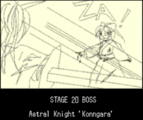 Konngara's sketch art in the good ending credits
 -
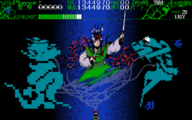 Konngara's sprite color change after a bomb is used


Misconceptions
Characters Have Flown Through Outerspace
One example of this is believed to be in Touhou 02's Stage 3 Scarlet Dream ~ Scarlet Dream where it displays stars and a space-like effect in the background[138], however this is actually the World of Fantasies, the world that lies between Makai and the human world, with Genji confirming this is definetely not outerspace as Reimu can breathe just fine there[139].
All Characters are Children
This is an argument that spawns from how small the characters look in different works, though this is moreso due to the "moe" artstyle Touhou tries to capture, in many of the manga characters look far older.
Majority of characters in the series are outright shown to drink alcohol on a daily basis[140], where one needs to be at least 20 years old under Japanese law to drink, where Japanese law requires no underaged characters to be shown drinking. This is even acknowledged in the series itself with a note saying alcohol is only for those over 20 years old[141]. Thus if a character is ever seen drinking alcohol in the series, they are an adult.
The only direct non-adults in the series are Sumireko Usami, Chiyuri Kitashirakawa, and Hieda no Akyuu in her first appearance.
Youkai Control the world through both the mental and physical layer
This statement comes from a fan translation that says this in Curiosities of Lotus Asia[142].
While the statement seems clear cut, there is another translation used instead that makes more sense with the sentence.
It instead notes that most youkai concieve of the world through these two layers, which is why they believe the future is pre-determined and history repeats itself[143]. This falls in line with the earlier disucssion of Rinnosuke claiming that he believes the future to be predetermined and Reimu needing to explain to him why that's not the case[127].
|
Song: |
|
Battle Records
0 - 1 - 0
References
| Expand here. |
|---|
|
Versus Threads
None.
None.
None.
- Pages using Tabber parser tag
- Templates
- Characters
- Gender Ambiguous Characters
- Asian Characters
- Japanese Characters
- Indie Characters
- Indie Game Characters
- Doujin Characters
- Doujinshi Characters
- Doujin Soft Characters
- Video Game Characters
- Non-Playable Characters
- Humanoid Characters
- Evil Characters
- Neutral Evil Characters
- Alive Characters
- Mysterious Characters
- Unknown Characters
- Large Sized Characters
- Primary Antagonists
- Antagonists
- Villains
- Humanoids
- Superhumans
- Swordsmen
- Game Enemies
- Game Bosses
- Final Bosses
- Knights
- Global Threats
- ZUN
- ZUN Soft
- Touhou Project (PC-98)
- Touhou Project
- Urban Tier
- Tier 8
- Low 8-C
- Higher Tier Ability Users
- Regeneration Users
- Non-Standard Defenses Users
- Acausality Users
- Magic Users
- Extrasensory Perception Users
- Transferal Users
- Transmutation Users
- Holy Users
- Spirit Users
- Explosion Users
- Magnetism Users
- Perception Users
- Logic Users
- Nullification Users
- Erasure Users
- Invulnerability Users
- Link Users
- Superhuman Physical Characteristics Users
- Weapon Masters
- Weapon Users
- Sword Users
- Breaking the Fourth Wall Users
- Cartoon Physics Users
- Non-Standard Interaction Users
- Non-Standard Damage Users
- Curtain Fire Users
- Energy Users
- Energy Projection Users
- Electricity Users


