Dracula's Castle
| "Mature Content" | |
| This character or verse has mature themes and concepts, thus those of young age are ill-advised to look through these. |
Background
Dracula's Castle, also known as Demon Castle or Castlevania, is Count Dracula's lair and symbol of his magic, being one of the most primary areas in the Castlevania series. It houses an army of his supernatural minions and tends to collapse when Dracula is defeated. Yet, it can restore itself and reappear intact in later games, even those where Dracula has not yet revived himself.
The castle’s exact location is impossible to pinpoint since it’s an entity of chaos that can appear in various places whenever it reemerges. Most often, though, it has appeared in Europe, specifically in Transylvania.
If one considers the events in the original 1897 novel and historical locations linked to Vlad III Drăculea, the castle in the series may have once been situated in Transylvania or northern Wallachia, near Poenari Castle, one of Vlad's known residences.
Nevertheless, as a supernatural structure linked to Dracula's powers, the castle does not exist as a typical physical landmark but rather as a spiritual realm layered over another dimension. This explains why, after Dracula’s death, the castle usually collapses without a trace, aside from a rare exception in the late 1600s when only part of it fell.
The castle’s appearance changes frequently:
- In the original Castlevania, it is atop a mountain.
- In Symphony of the Night, it is by a lake.
- In Curse of Darkness, it is near an ocean (possibly the Black Sea).
Characters like Maria Renard and Alucard note that it’s different each time, with Alucard suggesting it’s “a creature of chaos,” hinting at its shifting, unstable nature.
Some speculate that the castle once belonged to Walter Bernhard, whose stronghold shared features with Dracula’s. If true, Castlevania may date to the 11th century. However, the Lament of Innocence story leaves it unclear whether Dracula ever returned to Walter’s original castle, and the Japanese guide for Castlevania: The Adventure suggests Dracula built his own castle near Transylvania.
After Dracula’s defeat in 1999, his castle was sealed within a solar eclipse. It nearly returned in 2035, only to be resealed when Soma Cruz rejected his destiny to become Dracula. In 2036, a cult created a replica of the castle to summon a new Dark Lord, but it collapsed when their plans failed. The castle briefly returned through a new Dark Lord but was quickly sealed away by Arikado to prevent its reappearance.
General Information
Name: Castlevania[1] (The castle has been directly called this in some games such as Order of Shadows[2]), Dracula's Castle, Walter's Castle
Origin: Castlevania
First Appearance: Castlevania NES (Game release wise it's first appearance), Castlevania: Lament of Innocence (Chronologically its first appearance)
Latest Appearance: Castlevania: Grimoire of Souls
Company: Konami
Creator: Hitoshi Akamatsu, Koji Igarashi
Gender: None
Sexuality: None
Pronouns: It
Age: Over thousands of years old
Time Period: Irrelevant (As Dracula's Castle is an immortal, it has been through every time period in the Castlevania franchise after the 1000s)
Timeline: Main Timeline, Legends Timeline, & Circle of the Moon Timeline
Homeworld: Earth
Address: Unknown
Story Role: Exploration Area for the Hero, Home for Demons
Legacy: Worldwide Legacy (Dracula's Castle is famously known throughout the world, even to those who view Dracula as mere myth[3])
Influence: Cultural Influence (Dracula's Castle acts as a safe haven for those who turn their backs against God[4])
Language: None
Classification: Creature of Chaos[5], Castle of Hell[6], Child of the Night[7]
Species: Living Castle
State of Being: Regular
Physiology: Castle Physiology
In-Universe Creator: Dark Lords, most notable Dracula
Wielders: Walter Bernhard (Formerly), Richter Belmont, Shaft, Dracula, Maxim Kischine, Dracula Wraith, Graham Jones, Kid Dracula, Galamoth, Olrox
Size: Varies (The castle is a creature of Chaos, where with each rebirth it takes a new form[8])
Weight: Varies (The castle is a creature of Chaos, where with each rebirth it takes a new form[9])
Environment: Varies on area in castle
Resources: Endless amount of resources due to the infinite magic[10], along with an infinite supply of monsters and drawing it with their magic, spreading chaos across the world[11]
Status: Other (The Castle has been sealed within a Solar Eclipse by the year 1999, prior it would fall when Dracula dies and come back when a new Dark Lord comes)
Date of Seal: 1999
Alignment: Chaotic Evil (The castle is a creature of Chaos[12], creating an infinite supply of monsters and drawing it with their magic, spreading chaos across the world[13])
Threat Level: Global Threat (Creates an infinite supply of zombies and monsters drawn by the Castle's magic[14], all used by it's Dark Lord to rule the world)
Codex Statistics
Cardinality: Finite
Dimensionality: 3+1-D
Range: Varies through sheer size (The castle is a creature of Chaos, where with each rebirth it takes a new form[15]), up to Multi-Universal (The castle is directly steered by Mathias' power[16], which exist on top of another dimension[17]. The castle is directly steered by Dracula's power[18]. The Castle can summon creatures of chaos to spawn and attack whoever enters a room through enemies spawning from glyphs[19]. The castle can make glyphs that teleport one outside of the castle by standing over it[20]. A lot of these creatures are summoned from Hell[21]. The castle has magic energies that seal the gateway to hell[22])
Stamina: Limitless (The Castle has an infinte supply of zombies drawn by the castles magic[23])
Intelligence: Unknown Intelligence
Knowledge: Unknown level
Effects
Is a Creature of the Night, which gives:
- Superhuman Physical Characteristics (Even the smallest creatures of the night can destroy a bridge[24], one of Dracula's bats easily destroyed a stone ground block[25])
- Intimidation (Creatures of the nights appearances can cause one to have their body's cells cry out in terror[26])
- Immortality
- Ageless: The biggest hindrance to humans when attempting to accomplish something is their limited lifespans, a limitation that cannot be overcome, however, dwellers of the darkness do not apply to the laws of the human world, ignoring such limitations[27].
- Immortal Metaphysical Aspect: Creatures of the Night can continue to exist even as a spirit and use their spirit form to form bodies out of inanimate material around them[28].
- Acausality (Causality Immunity; All immortal beings disrupt the flow of time according to Aeon[29], along with ignoring the very passage of time[30]. With their souls being completely free from time[31]. The biggest hindrance to humans when attempting to accomplish something is their limited lifespans, a limitation that cannot be overcome, however, dwellers of the darkness do not apply to the laws of the human world, ignoring such limitations[32])
- Free Will (Creatures of the Night do not follow the hand of God and instead choose of their own free will[33])
- Empowerment (Creatures of the night are empowered by the night[34], becoming stronger when it's night time[35])
- Evolution (Creatures of chaos can inherit evil natures[36] awakening into stronger enemies with new abilities and less weaknesses[37])
- Resurrection (Self-Resurrection; Creatures of chaos can be brought back to life from the power of hate[38]. This has also been shown with slain heads reviving as an angry wraith[39])
- Regeneration
- Type: Cyclical (Creatures of chaos are in a state of a "regeneration cycle"[40]).
- Source: Unholy Regeneration
- Capabilities: Even the castle from Castlevania is a Creature of Chaos[41], where they are always rebirth from Chaos with each rebirth, the creatures takes a new form[42]. Rebirth for creatures seem to their aspects, as the castle itself in every game essentially crumbles or fades away yet comes back in a new form[43].
- Invisibility (Creatures of Chaos possess a natural aura of darkness, which makes one unable to see those with an aura of darkness by the naked eye[44])
- Time Manipulation (1-T, Passive; All immortal beings disrupt the flow of time according to Aeon[45])
- Darkness Manipulation & Subjective Reality (Creatures of chaos very existence causes dark powers to flow beyond the control of the Elgos' grimoires, due to them collecting documented information on Dracula and his castle. Causing their power to materialize in the real world in the form of monsters[46]. With the real world and world of grimoires being considered the same or "equal"[47], compared to the like of Brauner's painting worlds that are quantum multi-layered spaces requiring understandings of theories such as "Curse Amplification"[48])
- Text Manipulation & Plot Manipulation (Passive; Creatures of the night's dark powers allowed them to rewrite the Grimoires to strengthen their dark powers greatly[49]. It is noted by Lucy that the "vital soul" of a monster is the cause of the grimoire chaos[50]. Their vital souls are causing the grimoires contents to be overwritten changing history to things such as Jonathan Morris is now at a disadvantage in battle[51], or Charlotte fading from existence due to them messing with the history of the Grimoires[52], Maria starting to fade because Richter's history is being rewritten[53], where if the contents of the book change the creatures magic will keep growing and eventually overflow into reality, causing the grimoire to fall into chaos and even more monsters materializing into the real world[54]. The text alterations also make the monsters stronger[55]. With the real world and world of grimoires being considered the same or "equal"[56], compared to the like of Brauner's painting worlds that are quantum multi-layered spaces requiring understandings of theories such as "Curse Amplification"[57])
- Law Manipulation (Creatures of Chaos can alter grimoires, which do not adhere to the laws of reality[58])
- Power Modification (Creatures of the night alterations of the Grimoire can greatly limit the powers of those far stronger than them, such as Jonathan Morris' power being limited due to the alterations[59]. The Chaos of the Grimoire destabilized the magic of the others[60]).
- Resistance to
- Ice Manipulation & Absolute Zero (All enemies in Castlevania III: Dracula's curse can eventually break out of being frozen from Sypha's ice magic[61]. Along with this to protect against ice attacks in series, one normally wears rings that help them resist against absolute zero[62])
- Time Manipulation (1-T; All immortal beings disrupt the flow of time according to Aeon[63], with their souls being completely free from time[64]. With time in Castlevania being so potent that not even eternity can withstand time[65], along with even artificial life being subject to the laws of time[66]. Some creatures of chaos are immune to time stop, normally being boss-level creatures[67])
- Fate Manipulation (Temporal Fate; All immortal beings disrupt the flow of time according to Aeon[68], with their souls being completely free from time[69], with fate being a truth wound by time[70])
- Magic (Through utilizing magic, one has to have a deep understanding of Quantum Physics to utilize it to its fullest, requiring understandings of theories such as "Curse Amplification"[71])
- Non-Standard Interaction (Extra-Planar Interaction; Magic is able to interact with beings such as Camilla Fernandez[74], Physical attacks are difficult to land as Camilla lives in the Astral plane, and her earthly body is completely ethereal[75])
- Limited Immersion & Dimensional Travel (3+1-D; Magic users can align their magic with the magic of another to enter into painting worlds[76])
- Summoning (Magic can be used in order to summon weapons and items inscribed in grimoires[77])
- Soul Manipulation (Yoko through the use of magic discovered a new ability to draw the monster souls out and use them[78])
The castle is directly steered by Dracula's power[79], and has these effects:
- Magic (The castle pulses with dark magical power[80]. The castle uses magic to do things like re-animate corpses[81], along with skeletons[82])
- Reality Warping (The Castle does not work on standard logic, where changing rooms can have one view a completely different background[83], such as room with a blue sky that is reflecting up and downwards and having the clouds rotate at a fast speed[84])
- Transmutation (Beings that come near are subject to the castle's influence, such as a local barnyard owl which was mutated just from flying near it[85])
- Save and Load (The castles magic has rooms where one can sit on a chair and is enveloped in the angelic wings of light, allowing them to save their progress[86], with these chairs being acknowledged in rooms in the castle with a description[87])
- Possession (The castle possesses objects with its magic, such as a ouija table[88])
- Bestowal (The castle enables one to keep their mind after dying, becoming a ghost[89])
- Mind Bestowal (The castle can bestow a mind through its magic[90])
- Soul Bestowal (The castle can bestow a soul through its magic[91]. Imbued the Mud Man with a tormented soul[92])
- Power Bestowal (The castle grants enemies to attack under the power of magic[93]. The magic of Dracula's power that empowers the owl enemy[94])
- Resurrection (Resurrection of Multiple Targets; The castle uses magic to return creatures of chaos back to life[95])
- Sealing (Dracula's magic captured Aguni, a primitive god of fire[96]. The Castle has doors sealed off without solving puzzles[97]. This can extend to walls being sealed off where explosions will not affect it until the seal is gone[98])
- Telekinesis (The Castle can lift parts of levels apart[99]. The castle has blocks that float and levitate up and downwards to crush opponents or send them into spikes[100])
- Immersion (Can bring paintings to life and have them attack[101])
- Mimicry (Physiology Mimicry; The castle contains mirror worlds where perfect clones of oneself can fight[102]. The Castle can also do this without mirror worlds[103], where they make a perfect copy that have all of their moves and sub-weapons, and can freely switch to a different person to copy their abilities[104])
- Teleportation (The castle has access to the teleporter seat, the seat of a device that allows instant movement across Valachia[105]. The castle has objects that fade in and out while trying to platform on them[106])
- Invisibility (Parts of Dracula's castle are invisible such as invisible stairs[107], and invisible platforms[108])
- Necromancy (The castle can raise the dead to attack whoever enters a room[109]. The castle reanimates human bones as monsters by its evil magic[110]. The Castle created the Executioner from numerous dead bodies[111])
- Fusionism (The Castle can create an abomination made from numerous dead bodies[112])
- Mind Manipulation (Everything that enters the castle is under the control by the power of Dracula's castle[113], the ghost of Eric Lecarde needed to cast a magic barrier to bind himself so he could be free from the control of the castle[114]. The Castle corrupts the minds of those who enter it, such as making Maxim Kischine feel strange ever since coming to it[115]. It also corrupted the mind of Hugh turning him against Nathan with Nathan noting he's being controlled by Dracula[116]. The castle increases one's dark desires, allowing Dracula to easily control them[117]. The magic of Dracula's power that empowers the owl enemy also spurs it to violence[118])
- Madness Manipulation (The Castle warped Gergoth, a once-gentle beast and drove it mad[119])
- Elemental Manipulation & Chaos Manipulation (The castle infuses some enemies with chaos, giving it all elemental properties[120])
- Blood Manipulation (The castle imbues blood all over a skeleton, making them always return to life no matter what damage is done to them[121]. The Castle has areas where its blood can form new enemies[122])
- Acid Manipulation (The castle has areas of acid rain falling[123])
- Size Manipulation (Magically enlarged a toad through the use of demonic baptism[124])
- Fear Manipulation (Even while far away, Curtis and Michelle felt malicious intent from the castle where their bodies seemed to squeal "run away"[125]. Michelle even being at the entrance to the castle had her body telling her to not go in and her leg muscles being petrified like stone[126])
- Perception Manipulation (The Castle is able to warp the users perceptions, making a room where it is split into three parts that do not operate under standard spatiality and directionality[127])
- Poison Manipulation (The very waters of the castle are poisonous, killing one in an instant if they fall into it[128])
- Gravity Manipulation (3-D; The castle has rooms with reverse gravity[129])
- Curse Manipulation (The Curse status that spirits inflict[130] comes from them absorbing the magic power around the castle. The Castle cursed a human to turn into a lizard man[131])
- Life Manipulation (The castle can bring inanimate statues to life to attack[132]. Can cause the glass murals to come to life and attack[133])
- Soul Manipulation (Those that die in the castle become one of the floating spirits that wander the halls of the castle for eternity[134])
- Plant Manipulation (The castle can cause even the trees to attack[135]. The castle can cause the plants and leaves to form a wraith[136])
- Forcefield Manipulation (The castle set up a barrier seal outside of it to make people unable to enter[137]. Evil energy can create barriers blocking one until they defeat all enemies[138])
- Fire Manipulation (Can cause fire across an entire room just from causing a chandelier with candles to fall, setting everything, even people on fire[139])
- Portal Manipulation & Battlefield Removal (Application Based; The castle can create portals that send one to another dimension, where time is stopped[140]. Brought a wandering merchant in through swallowing him into a dense fog[141]. The castle has magic energies that seal the gateway to hell[142])
- Summoning & Glyph Creation (The Castle can summon creatures of chaos to spawn and attack whoever enters a room through enemies spawning from glyphs[143]. The castle can make glyphs that teleport one outside of the castle by standing over it[144]. A lot of these creatures are summoned from Hell[145])
- Water Manipulation (The Casles Waters seem to be very hazardous, as it instantly kills enemies upon touching them[146])
- Spatial Manipulation (3-D; The castle can shift the room to make it where Trevor needs to escape upwards that will instantly kill him if it reaches him[147]. The castle can make blocks disappear and re-appear, making it difficult for one to traverse around the castle[148]. The Castle made it, where the stairway Soma was walking up with Mina, went longer hen usual, trying to keep Soma from going to the Shrine and instead bringing him to the castle[149])
- Sense Manipulation (Caused Soma's senses to dim even entering the chaotic darkness near the Castle[150])
- Weather Manipulation & Electricity Manipulation (The Castle is the reason for a massive cloud that covered the entire sky[151]. Can conjure thunderstorms around itself that can summon enemies during it's flashes of lightning[152]. Can summon enemies through the lightning bolts it makes[153])
- Dark Matter Manipulation (The castle contains dark matter within it that beings can use for weapon creation)
- Abstract Manipulation & Hell Manipulation (The castle can create a core of evil made from hatred, envy, anger and other dark emotions[154])
- Text Manipulation & Plot Manipulation (The vital souls are noted to be apart of the Castle's power[155], where is noted by Lucy that the "vital soul" of a monster is the cause of the grimoire chaos[156] where creatures of the night's dark powers allowed them to rewrite the Grimoires to strengthen their dark powers greatly[157], along with their vital souls causing the grimoires contents to be overwritten changing history to things such as Jonathan Morris is now at a disadvantage in battle[158], or Charlotte fading from existence due to them messing with the history of the Grimoires[159], Maria starting to fade because Richter's history is being rewritten[160], where if the contents of the book change the creatures magic will keep growing and eventually overflow into reality, causing the grimoire to fall into chaos and even more monsters materializing into the real world[161]. The text alterations also make the monsters stronger[162]. With the real world and world of grimoires being considered the same or "equal"[163], compared to the like of Brauner's painting worlds that are quantum multi-layered spaces requiring understandings of theories such as "Curse Amplification"[164]. Death was going to use Dracula's magic to rewrite Dracula's defeat to Trevor making it where Dracula defeats Trevor Belmont instead where Dracula would go on living in the rewritten grimoire with each grimoire being its own world and the grimoires influence extends into reality[165])
- Law Manipulation (The vital souls are noted to be apart of the Castle's power[166], which alter grimoires, which do not adhere to the laws of reality[167])
- Power Modification (The vital souls are noted to be apart of the Castle's power[168], which the vital souls cause alterations of the Grimoire that can greatly limit the powers of those far stronger than them, such as Jonathan Morris' power being limited due to the alterations[169]. The Chaos of the Grimoire destabilized the magic of the others[170]).
- Resistance to
- Time Stop (1-T; Areas in the Castle are unaffected by time being stopped, and blocks and objects will still fall[171]. Noted that the stop watch has no effect on moving platforms in the castle[172]. Christopher stopping time on an elevator does not stop the elevator from moving[173], machinery still moves along[174], and floating objects still float[175]. With time in Castlevania being so potent that not even eternity can withstand time[176], along with even artificial life being subject to the laws of time[177])
Notable Features
Inhabitants
An infinite supply of zombies and monsters drawn by the Castle's magic[178], Olrox, Death, Medusa, The Creature,
Areas
Rooms and features
The Castle's interior constantly shifts between games due to being a creature of chaos, some of the rooms include:
- Entrance
- Bridges
- Castle Keep
- Ceremonial Room
- Chapel
- Clock Tower
- Courtyard
- Guest Rooms
- Great Stairway
- Halls
- Kitchen and Storage Area
- Mansion/Villa
- Marble Corridor
- Outer Wall
- Throne Room
- Top Floor
- Towers
Recreation
- Arena
- Ballroom
- Garden
- Library
- Theater
Research
- Laboratory
Underground
- Armory
- Catacomb
- Caves
- Dungeon
- Waterway
Objects
- Fountains
- Hallways
- Waterfalls
- Ferries
- Stairs
Other
Issues
- Creature of the Night Weaknesses: Creatures of the night become weaker when exposed to the morning sun[179]. Garlic significantly weakens creatures of the night[180], and causes demons to die if its placed on the ground[181]. If a vital soul is defeated, the grimoire will revert back to its original content[182].
- Unique Issues: The Castle collapses if its Dark Lord dies.
Explanation
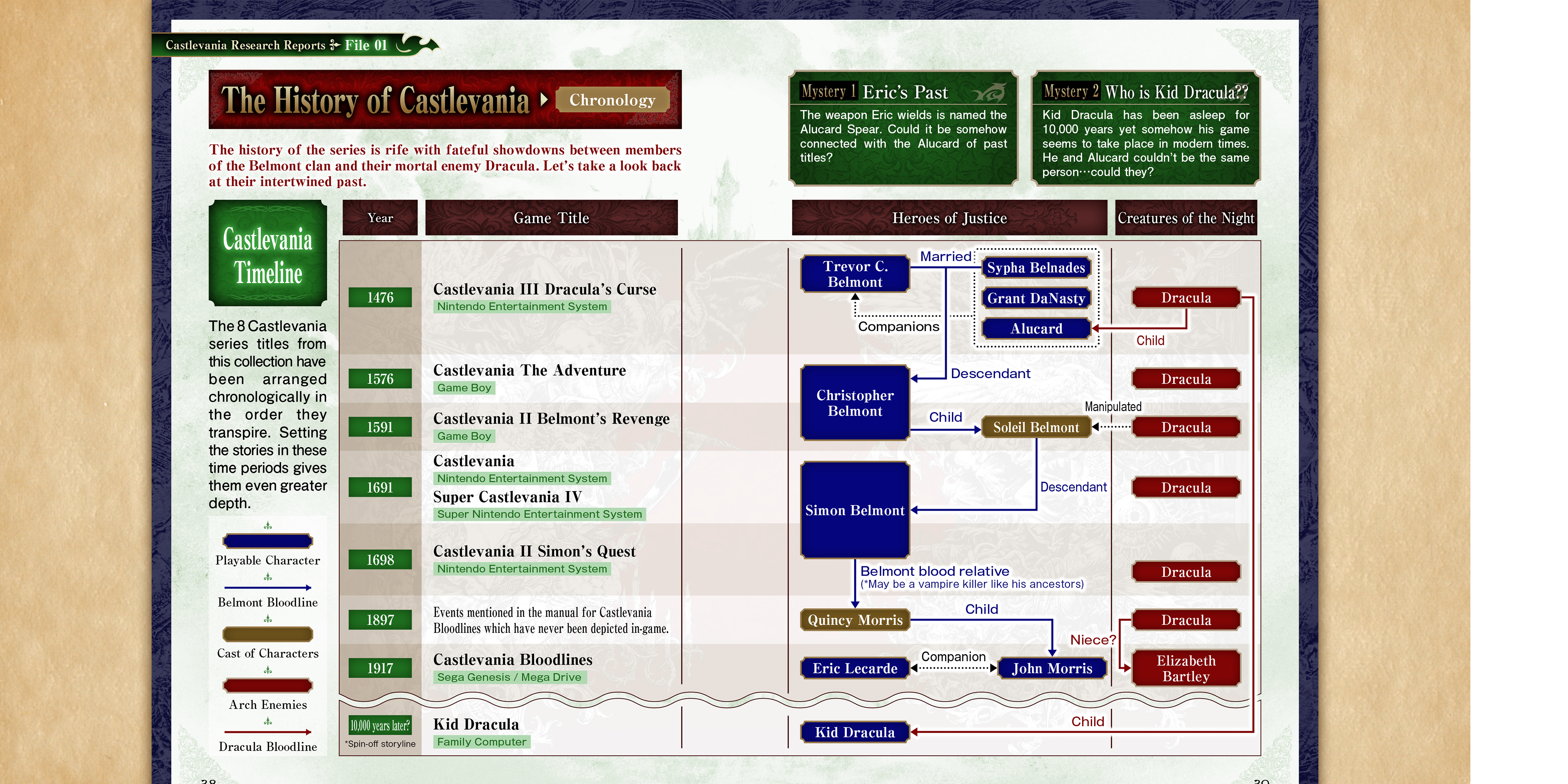
Usage of games like Castlevania Legends & Castlevania: Circle of the Moon
Castlevania Legends
The game was originally meant to be a prequel to all the other games in the Castlevania series, this can be seen with Sonia's boss fight against Dracula serving as the first time Dracula ever encountered a Belmont along with the ending of the game saying "this story marks the beginning of the Belmont family legend that has been passed on through many ages". Along with this, Sonia shared a relationship with Alucard, heavily implying that her child is between her and Alucard. The existence of Lament of Innocence already greatly messes with this. The game manual even mentions that Sonia was the first of the Belmont family to leave her name to posterity as a vampire hunter[183]. Despite Leon Belmont being the one to start the legend of the Belmont Hunters being vampire hunters. Along with this, Trevor is canonically the first Belmont to defeat Dracula. Iga has gone out of his way to note too that Castlevania Legends was intentionally redacted from the timeline so that it doesn't conflict with the timing used in other titles.
Castlevania: Circle of the Moon
Although it was in the original 2006 timeline, it was removed by Iga from the timeline, along with Castlevania (N64), Legacy of Darkness, and Legends.
Why abilities from them are still usable for main timeline
These games were at one point officially a part of the original timeline before ultimately being removed, making them hypotheticals that could be done. This is further supported by an interview in the History of Castlevania - Crescent of the Moon book, where executive producer of Castlevania Netflix Adi Shankar noted that even the "non-canon" games are parallel timelines in the overall multiverse, sharing the same spirit and lore[184]. While one could argue his statement shouldn't be used, it comes from a book titled, "History of Castlevania - Crescent of the Moon", where it wouldn't make much sense if his statement was wrong and there was no correction over it. The book even has asterisks to give further context, yet they never claim him wrong. Along with this, it's consistent with the fact that most of the Castlevania games that are "non-canon" now were originally a part of the timeline. Thus this statement is usable. Thus abilities and the likes from these games can carry over to the main timeline games.
Trivia
- The word "Castlevania" was created by Emil Heidkamp, Konami of America's senior vice president at the time, who believed the game's Japanese name was translated as "Dracula's Satanic Castle", and therefore he chose to change it out of potential religious sensibilities[185].
- In the first game, only the keep portion of the castle collapses, while later games had the entire castle collapsing. This was because it was originally intended that the keep area (more specifically the clock tower gears) acted as Dracula's metaphorical heart and could only remain standing as long as Dracula himself remained alive[186].
- Several real life castles have served as inspiration in Dracula's design over the games[187]:
- Neuschwanstein Castle: On the cover of Perfect Selection Dracula album and for Symphony of the Night's intro cutscene. It also appears on an early Pack-In poster of the first Castlevania.
- Alcázar of Segovia: On pages 2-3[188] of the Akumajō Dracula (X68000) instruction booklet, and on page 8[189] of the Symphony of the Night instruction booklet.
- Bran Castle: In the background of the Rondo of Blood cover and the American Dracula X cover.
- Mont-Saint-Michel: On the American Symphony of the Night cover and for the design of Castlevania (N64).
- In real life, Poenari Castle was Vlad Ţepeş' most prominent outposts. Poenari was chosen for its strategic location: built high atop a precipice to gauge properly the lands of southern Romania all around, with a bottlenecked path in and out of its domain, making it hard to infiltrate, and large enough to accommodate a small army, making it difficult to siege. Long after his reign, Poenari Castle is reported to have hauntings and unusual phenomena within its grounds by visitors. While based upon more lavish and grandiose real world castles, Castlevania itself appears to take its geographical and even strategic aspects from Poenari, from its seaside/lakeside position, elevation upon natural mountains and structures, and to be used as a fortification for an army.
- The castle is referred to as "Dracula's Tower" in an American commercial for Super Castlevania IV.
- Aside from the Demon Castle that frequently acted as the setting of the series, Soma Cruz in Aria of Sorrow twice alluded to a castle that Count Dracula owned in Europe[190][191], which was presumably referring to either Bran Castle, Poenari Castle, Hunyad Castle, or Mount Izvorul Câlimanului from the novel.
- The stage Big Battle from Contra: Hard Corps (also from Konami), when seen from the outside, bears a resemblance to Dracula's Castle, with the ending of the stage emulating the classic 'castle crumbling while the hero stares at a distance' ending from Castlevania titles. The interior also bears a long walkway upward to the base's center.
- The Dark Castle from the Boktai series (also by Konami) is probably a reference to Dracula's Castle. It is a castle that can travel in space by the combined powers of the Count and Carmilla (themselves also being Castlevania references), along with other enemies.
- The castle itself bears some resemblance to the Reverse Castle from Castlevania: Symphony of the Night, mainly from the cutscene where it is introduced.
-
Big Battle base from Contra: Hard Corps.
-
Dark Castle from Boktai.
Misconceptions
"Gaiden" means "Non-Canon" or "Alternate Timeline"
This stems from the belief that when Iga or a producer calls a Castlevania game a "Gaiden" it is therefore non-canon or an alternate timeline and can be dismissed. This, however, is not the case.
The term "Gaiden" merely just means a side story, spin-off, or a separate tale. The term "Gaiden" does not determine the canonicity of a work, it just lets you know if the game is a spin-off/side-story or if it's a main story. Take, for instance, the Kingdom Hearts series. Kingdom Hearts: Chain of Memories would be considered a gaiden, as it's a side-story and spin-off title that isn't a mainline numbered title, however, it is in all manners canon and important to play to understand Kingdom Hearts II.
The same can be applied to Castlevania itself, Castlevania Symphony of the Night is a gaiden game. Yet it is very obviously canon and pretty important to play to understand more of Alucard's backstory. The idea of a Gaiden game for the Castlevania series itself would be any game not dealing with one of Dracula's main 100-year-resurrections, which in this case, even Castlevania 2: Simon's Quest is in a way a gaiden, despite being completely canon.
This is all to say that Gaiden does not at all mean "non-canon" or "alternate timeline" and should never be treated as such, the term itself has nothing to do with the canonicity of a product.
IGA Statements Quoted by a Fan
Any statements Iga has made about Judgment that don't come from this IGN interview or a sourced and reputable article are not usable. This is, of course, referring to the popular statements used when discussing Judgment's Canoncity about a fan asking IGA about the game's Canoncity on Facebook, here are some of them below:
- Fan: You mentioned Legend of Cornell was an alternate continuity. However, Cornell appears in Castlevania Judgment, which I believe is not an alternate continuity. How does that work? is he from a different universe than the other characters? It is not really explained in the game itself so I was hoping you could give some clarification on the issue.
- IGA: Judgment is a work that surpasses space and time and brings them together.
- Fan: I get it. So, is the explanation I suggested in the previous reply possibly correct?
- IGA: I don't think it's exactly correct. Judgment is a work born of thinking it would be fun to remove all the hedges and bring characters that appeared throughout the series together. I think that you need to view it as an event from another world which does not consider things like timelines or parallel dimensions at all.
Now these seem like pretty clear-cut statements until you start to try to find where these come from.
They come from both a timeline archive discussion on the Castlevania Wiki back on January 15th, 2012 and from a forum post from the same user as the wiki article.
There is no way to find anything sourced or verifiably proven that this person spoke to Iga. Trying to look up the person didn't get any real results either.
Some other issues fall under the inconsistencies within these Iga talks, the person claims that Iga confirmed that Order of Shadows and the Arcade are non-canon because they were intended from the very beginning to be such, however, an officially sourced interview has the lead game designer of Order of Shadows state that Iga was actively involved with ensuring the game was consistent with the current canon, this would be a weird thing to do if he intended it to be non-canon from the very beginning.
He also claims that Iga said Super Castlevania IV was an alternate continuity, when the wiki also notes Iga saying that the games are all legitimate and the same scenario of defeating Dracula, however this quote is also unsourced, they just claim Iga says this with no link or anything.
There is another one not related to the user who spoke to Iga, but a user on reddit who claimed that a magazine claimed that Castlevania: Circle of the Moon was stated to be in a "different time axis". Attempting to get it translated got no wording that said anything like that, with it not even mentioning anything about canon, timeline, time axis, or any other wording of the sort in a machine-translated attempt. Do note however that this is a machine translation so it could potentially be that it is there, but until a reputable and verifiable translator can confirm or deny this translation, the jury is out with it and it will not be used for the canoncity of Circle of the Moon.
Thus all of these quotes are merely hearsay until shown or proven otherwise.
Remakes/Remasters Being Non-Canon
This comes from an Iga quote that says:
- "IGA: FC版とX68000版ですが、X68000版はFC版をベースにアレンジを加えたものになっています。ゲームのアレンジは、その時に応じて、色々と施されるものですので、正直どちらも正統であると思ってよいのではないかと思っています。結論として、ドラキュラと戦い勝つというシナリオで、中間部分の切り抜きが違うと考えてもよいのではないかと考えています。スーパーファミコン版も違いますし…。どうしてもと考えるのであれば、FC版を尊重すべきかと考えます。
- Translation: Regarding the Famicom version and the X68000 version, the X68000 version is an arrangement based on the Famicom version. The arrangement of a game is the kind of thing where you add a lot of different things as needed, so honestly speaking, it think they both should be considered legitimate. In conclusion, I think they should be considered as the same scenario of fighting to defeat Dracula, just with a different middle part. The Super Famicom version is different as well... If you simply must have a clear answer, the Famicom version must be given deference."
Now the quote itself doesn't state remakes or remasters are non-canon despite what people believe. It's moreso a quote of Iga stating that all of them are the same scenario, just with differences. However, an interesting point is that Iga says the NES version should be given "deference", as in to defer to the NES version.
Of course, though, this has the same issue as the Judgment quotes, everyone claims Iga said this, but there is no source of him saying this. In fact, in Castlevania Chronicles, there's a reward interview you receive from Iga himself where he talks about the game, Iga pretty much explains how the game came to be and never says anything about the game not being canon or to defer to the original[192], if anything he treats this as just an updated version of the original. Interestingly to note too, the original he's talking about is not Castlevania on NES but instead, he's talking about the computer version of Castlevania[193], though it borrows a lot of elements from Castlevania NES.
Overall due to the quote itself having no source, it is unusable. The way we will treat remakes, remasters, or ports here however is that they are all equally canon unless stated otherwise. Most of these tell the same story with the only real differences being extra background information added, such as Haunted Castle having it be Dracula stole Simon's wife, though the same overall story still applies even here. Iga himself has already expressed that the original Castlevania's story is pretty simple[194] and Simon having a wife does not affect anything in the overall narrative. Super Castlevania IV notes that Simon is a vampire, though this was due to a novel writer making him a vampire in their novel. The novel was originally supposed to be an adaptation of Super Castlevania IV but was then dropped and made its own thing. Super Castlevania IV itself is still canon, but the subplot of Simon being a vampire is not. The most recent timeline even acknowledges it as canon[195].
Iga Only Allows Stuff He Works on To Be Canon
There is a weirdly believed idea in the fandom that Iga only considers works he worked on canon, however, an officially sourced interview has the lead game designer of Order of Shadows state that Iga was actively involved with ensuring the game was consistent with the current canon, along with this Iga did not work on a lot of Castlevania games considered canon, such as the NES trilogy and the Gameboy games. In fact, he has only made 12 Castlevania games, out of the 30 Castlevania games in total, and most of them from the older console eras are still a part of the canon. Thus Iga does not only allow stuff he works on to be canon.
Iga is a Producer of Castlevania: Circle of the Moon
A Nintendo Power magazine calls Iga the producer of Circle of the Moon, with Iga talking like he worked on the game in that interview. However Iga can be found nowhere in the credits of the game. Making this Nintendo Power issue questionable as to if they were talking to Iga or if the game was mixed up. Though we have direct in-game proof that Iga was not a producer of Circle of the Moon.
Elements and Statements can be used from Lords of Shadows for the main continuity
This argument comes from Adi Shankar saying that even "non-canon" games are parallel timelines in the overall multiverse, sharing the same spirit and lore[196]. However, the Lord of Shadow games are directly noted in an interview with the lead developer, that the game has nothing to do with the canon, sharing none of the lore or original stuff for the characters. This directly conflicts with Adi Shankar's statement and it was very likely he was not even thinking of Lords of Shadows when making this statement but moreso games like Castlevania Legends. On top of this, Adi Shankar has no actual position within Konami, and being an executive producer for the Castlevania anime, thus he does not have any true say in terms of how Castlevania canon works and can only be used at most as a supporting piece of evidence.
Codex Statistics Questions
Q: Shouldn't the characters be around Tier 2 for defeating the Time Reaper who would've destroyed the very fabric of time[197], attempted to destroy the specific era of time[198], cause all beings everywhere to disappear, forever[199] and that the age was on the verge of collapse[200]?
A: We actually never get a direct outright method of Time Reaper's plan for doing this, from what Aeon mentions to Golem, if the Time Rift is not erased, all beings everywhere will disappear, forever[201], implying that it's the Time Rift causing this, this is further backed up by the fact that in Time Reaper's boss fight, there is a vortex in the background consuming everything[202], meaning this is an overtime feat that scales to no one physically.
Q: Shouldn't they get tier 2 for Dracula's influence destabilizing the flow of time[203]?
A: This is a potent ability but has nothing to do with Attack Potency, there is no quantification for "destabilizing the flow of time", along with this, even if it was taken as physically, then it would be overtime as the effects are not noticeable throughout most of Curse of Darkness. Thus this is merely potent Time Manipulation.
Q: Shouldn't Dracula and by proxy anyone that scales to him get tier 2 for him being able to sustain his castle?
A: This goes under our Stabilization Feats standards, which treats sustaining feats are non-combat applicable Attack Potency normally, though in Dracula's case the Castle is speficially powered by the existence of a Dark Lord, and doesn't necessarily need their strength to rise. In the Castlevania novel, the castle rose without a Dark Lord as an example. Along with this, no one scales to the collapse of the castle, in Curse of Darkness Hector would've died to the collapse of the castle if[204] Julia didn't come save him, and Isaac died within the castle[205]. In other cases the Castle does not collapse[206], but instead slowly fades away[207]. At the end of Dawn of Sorrow Soma Cruz and Genya Arikado (aka Alucard) must escape the collapsing abyss.
Q: Shouldn't Castlevania characters that scale to Death have Infinite speed due to Death being able to kill distance itself with his attacks?
A: Killing distance to attack is not a speed feat, it's a method of Spatial Manipulation by circumventing and ignoring distance, while one can say the attack spawns on you instantly, this is not really something quantifiable. Along with this, it would only scale to characters comparable to Death during post-Dawn of Sorrow, as Soma notes Death is far faster than he remembered from his fight with him in Dawn of Sorrow[208].
References
| Expand here. |
|---|
|