Galamoth, also referred to as King Garamoth among other name variants, is a boss character in the Castlevania & Kid Dracula series. He is a powerful magical being with a long-term goal of overthrowing the throne of the Netherworld, a plan spanning 10,000 years.
Originally serving as the primary antagonist in the Famicom game Kid Dracula, Garamoth was later introduced into the Castlevania series in the 1997 PlayStation game Castlevania: Symphony of the Night. In this game, he appears as an optional boss found in the Floating Catacombs. Garamoth possesses the ability to unleash powerful electric attacks from his scepter.
This dropdown contains the synopsis of Garamoth’s story. Read at your own risk as you may be spoiled otherwise!
King Garamoth originally served as the main antagonist and final boss of the Famicom game Kid Dracula (as well as its Game Boy adaptation). His appearance in Castlevania: Symphony of the Night presents one of the toughest battles in the game. In this installment, he was renamed simply as Galamoth, which is the name most commonly recognized by Western audiences.
Galamoth also makes a cameo in Castlevania: Aria of Sorrow, appearing as an Ability Soul that grants the power to see through areas blocked by time.
In Castlevania Judgment, Galamoth plays a key role in the plot as the power behind the main antagonist, though he himself does not physically appear in the game. He seeks to claim the throne by eradicating the time period during which Dracula ruled, sending his minion, the Time Reaper, on what is presumed to be an assassination mission.
General Information
Name: Garamoth
Other Names:Garamos[1], Galamoth, Demon Lord Galamoth, Garamoth the Magnificent, King Galamoth
Durability: At least Building level, likely Far Higher | At least Building level, likely Far Higher | At least Building level, likely Far Higher
Striking Strength: At least Room Class (Potency), likely Far Higher | At least Room Class (Potency), likely Far Higher | At least Room Class (Potency), likely Far Higher
Scepter: A Scepter weapon Galamoth uses in Symphony of the Night for combat. It shoots out a variety of different lightning attacks.
Time Reaper: A servant of Galamoth, he is the main antagonist in Castlevania Judgment responsible for the time rift.
Notable Techniques
Black Orb Attack
Galamoth raises his scepter and fires eight black orbs toward his opponent. These orbs deal damage upon contact and have a high attack value (92 ATT).
Lightning Stream
While crouching, Galamoth uses his scepter to unleash a wide area of lightning, covering a broad range in front of him. This attack has an attack value of 98 ATT and is classified as a Thunder attack.
Crescent Lightning
Galamoth fires a crescent-shaped bolt of lightning from his scepter, dealing damage to any enemy it strikes. This attack has an attack value of 98 ATT and is also classified as a Thunder attack.
Kick Attack
Galamoth attempts to kick Alucard, dealing 85 ATT damage with heavy knockback on impact.
Scepter Pound
When Alucard is within range on the ground, Galamoth bends down and quickly pounds the ground with his scepter, dealing damage to any nearby targets.
Other
Standard Tactics
Castlevania: Symphony of the Night: He wields his scepter to unleash a combination of Hit and Thunder attacks in his efforts to defeat Alucard. Galamoth's standard tactics consist of the following:
Raising his scepter to fire eight black orbs, dealing Hit damage (92 ATT).
Crouching to unleash a wide stream of lightning from his scepter, classified as a Thunder attack (98 ATT).
Firing a crescent-shaped lightning bolt from his scepter, also a Thunder attack (98 ATT).
Attempting a powerful kick that deals Hit damage (85 ATT) and causes heavy knockback.
Bending down to perform a swift ground-pound with his scepter when Alucard is within range.
Kid Dracula (NES): Garamoth flies around and shoots out lightning bolts between both of his hands to trap his opponent inward while breathing out fireballs at them.
In both Kid Dracula (NES) and Kid Dracula (Game Boy), after defeating King Garamoth, the player will be awarded a big coin with the face of Ebisumaru, from the Ganbare Goemon series, printed on it.
SobekGalamoth's depiction in Castlevania: Symphony of the Night, having a dragon or crocodile-like head, holding a scepter and bearing an overall Egyptian motif, has some similarities with Sobek, an ancient Egyptian deity who also bears crocodile traits.
His name is possibly correctly translated as "Garamoth", with "Galamoth", the name with which he was introduced to western audiences in Symphony of the Night, likely being a case of Engrish, which oftentimes substitutes the letter "r" for "l".
This is further supported as his name appears as "King Garamoth" in the version of Kid Dracula that is included in the Castlevania Anniversary Collection from 2019, which was officially translated to English by Konami's own localization team.
He was still called "Galamoth" in Castlevania Judgment (2008), which can still be considered to be a relatively recent game, however the most recent version of the name would triumph it.
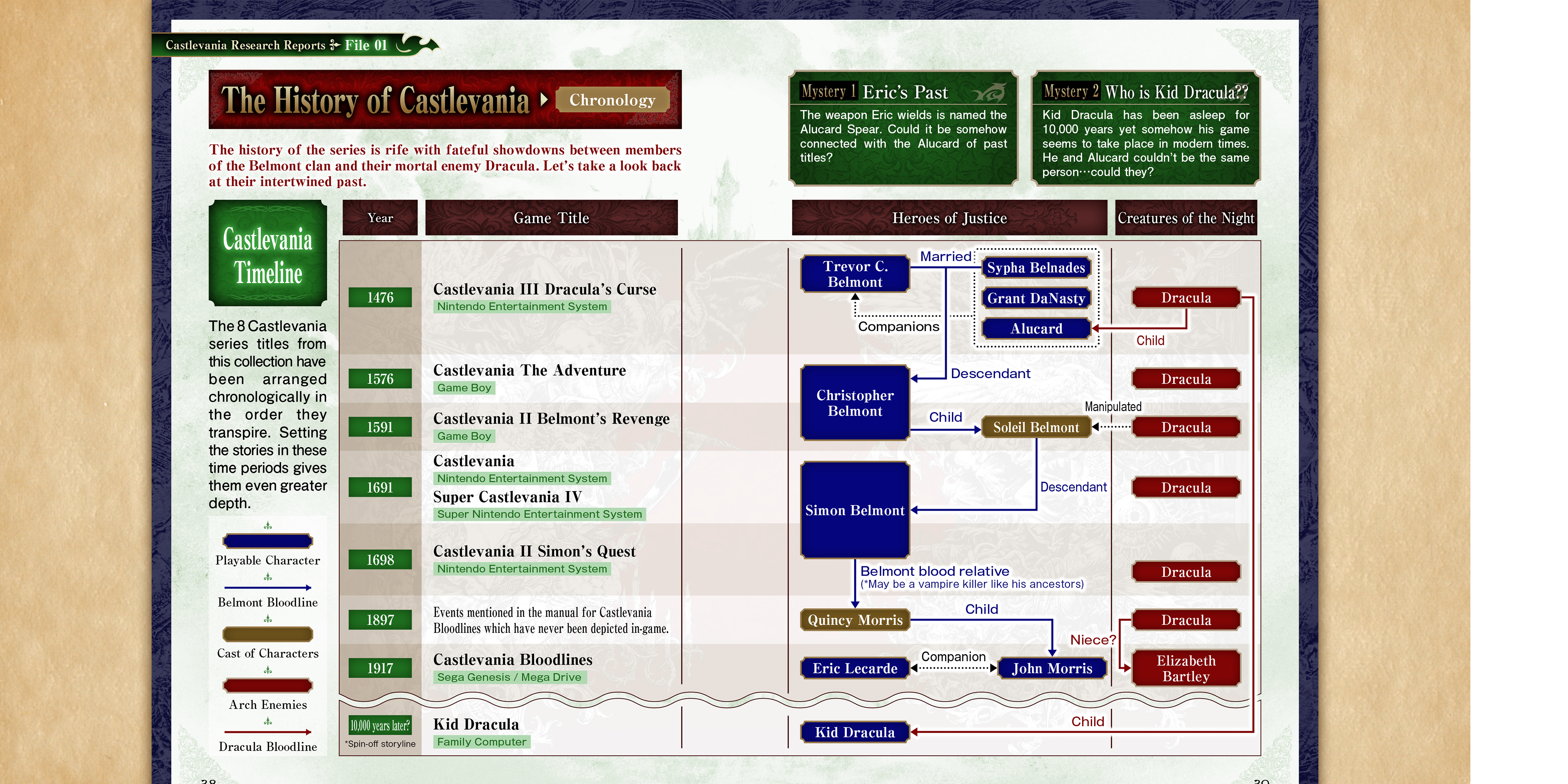
The time when Galamoth sent the Time Reaper that is mentioned in Castlevania Judgment –10,000 years in the future– coincides with how long Kid Dracula was asleep for in Kid Dracula, where Galamoth is originally from.
Upon defeat, one of three lines the Time Reaper can deliver is calling Galamoth's name, revealing who its lord is.
Misconceptions
"Gaiden" means "Non-Canon" or "Alternate Timeline"
This stems from the belief that when Iga or a producer calls a Castlevania game a "Gaiden" it is therefore non-canon or an alternate timeline and can be dismissed. This, however, is not the case.
The term "Gaiden" merely just means a side story, spin-off, or a separate tale. The term "Gaiden" does not determine the canonicity of a work, it just lets you know if the game is a spin-off/side-story or if it's a main story. Take, for instance, the Kingdom Hearts series. Kingdom Hearts: Chain of Memories would be considered a gaiden, as it's a side-story and spin-off title that isn't a mainline numbered title, however, it is in all manners canon and important to play to understand Kingdom Hearts II.
The same can be applied to Castlevania itself, Castlevania Symphony of the Night is a gaiden game. Yet it is very obviously canon and pretty important to play to understand more of Alucard's backstory. The idea of a Gaiden game for the Castlevania series itself would be any game not dealing with one of Dracula's main 100-year-resurrections, which in this case, even Castlevania 2: Simon's Quest is in a way a gaiden, despite being completely canon.
This is all to say that Gaiden does not at all mean "non-canon" or "alternate timeline" and should never be treated as such, the term itself has nothing to do with the canonicity of a product.
IGA Statements Quoted by a Fan
Any statements Iga has made about Judgment that don't come from this IGN interview or a sourced and reputable article are not usable. This is, of course, referring to the popular statements used when discussing Judgment's Canoncity about a fan asking IGA about the game's Canoncity on Facebook, here are some of them below:
Fan: You mentioned Legend of Cornell was an alternate continuity. However, Cornell appears in Castlevania Judgment, which I believe is not an alternate continuity. How does that work? is he from a different universe than the other characters? It is not really explained in the game itself so I was hoping you could give some clarification on the issue.
IGA: Judgment is a work that surpasses space and time and brings them together.
Fan: I get it. So, is the explanation I suggested in the previous reply possibly correct?
IGA: I don't think it's exactly correct. Judgment is a work born of thinking it would be fun to remove all the hedges and bring characters that appeared throughout the series together. I think that you need to view it as an event from another world which does not consider things like timelines or parallel dimensions at all.
Now these seem like pretty clear-cut statements until you start to try to find where these come from.
There is no way to find anything sourced or verifiably proven that this person spoke to Iga. Trying to look up the person didn't get any real results either.
Translation: Regarding the Famicom version and the X68000 version, the X68000 version is an arrangement based on the Famicom version. The arrangement of a game is the kind of thing where you add a lot of different things as needed, so honestly speaking, it think they both should be considered legitimate. In conclusion, I think they should be considered as the same scenario of fighting to defeat Dracula, just with a different middle part. The Super Famicom version is different as well... If you simply must have a clear answer, the Famicom version must be given deference."
Now the quote itself doesn't state remakes or remasters are non-canon despite what people believe. It's moreso a quote of Iga stating that all of them are the same scenario, just with differences. However, an interesting point is that Iga says the NES version should be given "deference", as in to defer to the NES version.
Overall due to the quote itself having no source, it is unusable. The way we will treat remakes, remasters, or ports here however is that they are all equally canon unless stated otherwise. Most of these tell the same story with the only real differences being extra background information added, such as Haunted Castle having it be Dracula stole Simon's wife, though the same overall story still applies even here. Iga himself has already expressed that the original Castlevania's story is pretty simple[154] and Simon having a wife does not affect anything in the overall narrative. Super Castlevania IV notes that Simon is a vampire, though this was due to a novel writer making him a vampire in their novel. The novel was originally supposed to be an adaptation of Super Castlevania IV but was then dropped and made its own thing. Super Castlevania IV itself is still canon, but the subplot of Simon being a vampire is not. The most recent timeline even acknowledges it as canon[155].
A: This is a potent ability but has nothing to do with Attack Potency, there is no quantification for "destabilizing the flow of time", along with this, even if it was taken as physically, then it would be overtime as the effects are not noticeable throughout most of Curse of Darkness. Thus this is merely potent Time Manipulation.
Q: Shouldn't Dracula and by proxy anyone that scales to him get tier 2 for him being able to sustain his castle?
Q: Shouldn't Castlevania characters that scale to Death have Infinite speed due to Death being able to kill distance itself with his attacks?
A: Killing distance to attack is not a speed feat, it's a method of Spatial Manipulation by circumventing and ignoring distance, while one can say the attack spawns on you instantly, this is not really something quantifiable. Along with this, it would only scale to characters comparable to Death during post-Dawn of Sorrow, as Soma notes Death is far faster than he remembered from his fight with him in Dawn of Sorrow[168].
↑Akumajou Dracula: Kabuchi no Tsuisoukyoku "I had come to destroy evil. A spectacled vampire hunter confirmed this as his duty. In front of him is a [grotesque creature] whose dreadful power can be felt. The creature appears human but the instant he looked at it, all of his body’s cells cried out in terror. “The timing is bad, church person.” Whilst listening to the words said by the [grotesque creature], the young hunter kept on reminding himself. -----I am …… I ought to be a vampire hunter."
↑Castlevania: Grimoire of Souls Chapter 9 Vessel for the Lord
↑Akumajo Dracula: Kabuchi no Tsuisoukyoku "Ever since the Middle Ages, every 100 years, this legendary castle would rise together with its master Count Dracula ----- And whenever it happens, it is said that a clan of vampire hunters will seal it.
Several hundred years have passed with battles with the [dark lord] Dracula. When suddenly, an end to it all has been foretold.
1999----- Thanks to the power of a clan in Japan, Dracula’s castle was sealed inside a [solar eclipse] to disappear forever. However, in this world, there is no such thing as forever. [They] had understood that Dracula’s regeneration cycle ought to have ended. Indeed, people have prepared for this but will it still exist?
The castle is the symbol of the chaos within humans and as long as people exist, it will not be completely sealed.
↑Castlevania: Grimoire of Souls Chapter 2 A City of Fog
↑Akumajo Dracula: Kabuchi no Tsuisoukyoku "This ominous vortex of magic was similar to what he felt in the [demon castle]. Among all the magic Soma knows, this particular type of sophisticated [power] belonged to----- “……I know I am being rude……” Faster than he can remember, that husky voice rang in front of Soma----- From the shadow of the forest, a large shadow emerged. “……tch!”