Death

|
"Mature Content" |
| This character or verse has mature themes and concepts, thus those of young age are ill-advised to look through these. |

| “ | Unfortunately for you, as long as my master survives, I will rise from the dead... | „ |
| ~ Death to Leon Belmont |


| “ | Soon, my master will enter Isaac's body. Though you were favored, Isaac will do. Dracula will once more walk the night! And as for you, it is time for you to die! | „ |
| ~ Zeas as Death to Hector |


| “ | Do not interfere. Now, I will extinguish the candle of your soul! | „ |
| ~ Death to Juste Belmont |


| “ | So you've made it this far... In the name of your father, cease this foolishness. | „ |
| ~ Death to 1700s Alucard |


Background
Death, also known as the Grim Reaper, is a key antagonist in Konami's Castlevania series. Born from Chaos, which itself emerged from the malice within human hearts, Death serves as Count Dracula’s right-hand figure. Typically appearing near the end of the hero's journey—often in the Clock Tower—he challenges them before they face Dracula. Occasionally, Death is the first of Dracula's main servants the protagonist encounters, as seen in Castlevania: Rondo of Blood, Castlevania: Symphony of the Night, and Castlevania: The Arcade. Notably, he appears in every game except Castlevania: The Adventure and Castlevania II: Belmont's Revenge.
When figures like Shaft, Elizabeth Bartley, or Carmilla lead Dracula’s resurrection, Death may take an equal or lesser role in Dracula's ranks. Two of his closest subordinates, Slogra and Gaibon, report directly to him. He is also known to acknowledge and respect courageous and skilled opponents.
Mastering dark arts, Death can summon souls of the dead and defeat powerful foes. As a chaotic, malevolent entity, Death resists dark-based attacks but is vulnerable to holy weapons like the Vampire Killer.
| This dropdown contains the synopsis of Death’s story. Read at your own risk as you may be spoiled otherwise! |
|---|
|
Castlevania: Lament of Innocence
It is revealed that Mathias had the Crimson Stone, a stone much more powerful than the Ebony Stone. With Walter defeated, Mathias gained access to Walter's Ebony Stone, giving him both of the vampire's treasures. To add insult to injury, Mathias used the Crimson Stone to suck out Walter's soul and place it inside the stone. The soul became a power source to fuel Mathias's dark desires. Crushed by Mathias's turn to the dark forces of evil, Leon was ready to slay his former friend when Death arrived and challenged him in the final showdown of the game. Even though Death was defeated, Mathias made his escape after some parting words with Leon. Although Death expressed disbelief for being beaten by Leon, as well as learning about him possessing the means to destroy not just vampires, but anything tied to them, he nonetheless assured the latter that he could not be permanently killed as long as Mathias remained alive. With Mathias gone, Leon swore that no matter where he should go, the Belmont Clan would hunt him and his kind down forever. Since then, Death has proven to be the Count's most loyal and devoted servant. Castlevania III: Dracula's Curse
Castlevania: Curse of Darkness
In the reborn castle of Dracula, Hector fights and kills Isaac, but does not fall prey to the curse. Before he knows it, the body of Isaac is whisked away into a coffin by Zead. He had originally planned on using Hector as the host for Dracula when he succumbed to the curse, but because Hector rejected the curse at the last moment, he is forced to settle with Isaac's corpse. When Zead removes a scythe from his sleeve, it is then that Hector realizes who Zead really is. Shedding his disguise, Death battles Hector, only to be defeated by the Forgemaster, expressing disbelief that he was defeated by a human. Castlevania
Castlevania II: Simon's Quest
Castlevania: Harmony of Dissonance
This led to Maxim slowly being taken over by the spirit of the Dark Lord and the split of Dracula's Castle into two different castles. Death recognizes that Maxim's body would make a suitable host for the resurrection of Dracula and soon seeks to prevent Juste Belmont from finding his friend and freeing him from Dracula's control. He also tries to locate Lydie, eventually finding her with Juste's unwitting help and takes her, viewing her as a necessary sacrifice to ensure Maxim becomes Dracula and thus complete the castle. He then fought Juste in an attempt to prevent him from interfering. He ultimately is defeated, although he makes clear that the castle would inevitably merge in the future. Castlevania: Rondo of Blood
True to his word, Death encountered Richter aboard a ghost ship and fought him in an intense battle. Ultimately, he was defeated, with his accidentally beheading himself after he threw his scythe in the air from being stunned. Castlevania: Symphony of the Night
This time, Dracula's son, Alucard, awakens from his self-inflicted permanent slumber when he senses that something is terribly amiss. When he enters Dracula's Castle, Alucard is confronted by Death. Since Alucard is Dracula's son, Death gives him a chance to cease his attack and turn back. Upon refusing, Death steals all of his equipment and scatters it throughout the entire castle, although not before warning that this will not be their final encounter. Later, when Alucard encounters Death again, the Grim Reaper notes that he has given ample warning, and with Alucard not backing down, he engages him in combat, suffering defeat at the hands of Dracula's son. Castlevania: Order of Ecclesia
Castlevania: Bloodlines
Castlevania: Portrait of Ruin
Jonathan Morris and Charlotte Aulin first run into him in the Great Stairway. Jonathan believes that he was serving Brauner, but it turns out unlike the other monsters in the castle, Death retains full loyalty towards Dracula. From them he learns of the interloper taking the role of Lord of the Castle for himself and rebuffs the idea of anyone except Dracula controlling the castle, saying that it was an odd thing to say. He does not even try to fight the heroes during this encounter, even hinting at a possible alliance to kill Brauner, albeit with different aims in mind. However, he is rebuffed rudely by Jonathan and leaves, but not before he leaves a snide remark telling Jonathan that he is nowhere near as strong as his father. Later on, he is reluctantly goaded by Jonathan to battle the duo in the castle's Clock Tower. He leaves the battle when his energy is exhausted, saying he has other affairs to handle, although not before inferring that he's only sparing the two because they themselves still have a "role" to accomplish, and also making clear this was not to be their final encounter. Near the end of the game, after Jonathan and Charlotte defeat Brauner, Death barges into his room and slices through the usurper with a swing of his scythe to finish him off, reinstating the castle's proper master, Dracula. When Jonathan and Charlotte pursue him, they find the newly risen Dracula. Ready to take him out, Jonathan is blocked by Death, who has come to Dracula's aid. In a surprising turn of events, Death and Dracula decide to team up for their battle against the two young heroes. When either Death's or Dracula's life is depleted, Death screams "My power! Use my power!" and at this point, Dracula holds out both hands and uses Soul Steal, absorbing Death's soul and transforms into True Dracula. Akumajō Dracula: Kabuchi no Tsuisōkyoku
Death returns to the castle where he notices humans in the castle, at the same time realizing the monsters are not hostile toward these humans this confuses Death even further as he looks for his master. He finds Slogra and Gaibon whom he orders to report the current situation. Neither of them respond but strangely attack Death for no reason. Although surprised, Death does not take the insolence kindly and destroys both of them, but he quickly notices that neither of them ever let a scream of pain out, confusing him even further. Death ventures further into the castle finally meeting Dracula's former servant Olrox inside the castle. Olrox confirms that the current set of events are of his doing and that the humans in the castle are the remnants of Graham's cult that has bowed to follow the vampire. Death mocks Olrox if he wants to play at replacing Dracula, but Olrox merely states he wants to control both humans and Chaos out of curiosity of what can be done by doing so, emphasizing that Chaos is born of humans and that Death is born out of Chaos, therefore if he can control humans then Chaos could potentially disappear. Death declares Olrox a traitor and the two of them clash with Death summoning his sickles and Olrox summoning bats, both of them canceling each other. Olrox goes to the courtyard and Death follows with the two clashing without any clear advantage, but then Olrox lures Death into a trap as a magic formation made by Graham's followers summons a large bloody hand that entraps Death depriving him of his power and taking it with him. Death remains trapped and weakened until his soul encounters the damaged body of Curtis Lang that had been shot mercilessly by Graham's cult multiple times and at the verge of dying. Death encounters Curtis whose only wish is for the safety of his partner Michelle Danasty. Death then takes possession of the young man's dying body, which is later found by Michelle and restored back to health by Hammer after he uses a potion on his body, seemingly with memory loss. The two venture into the castle with Michelle destroying the horde of zombies while he remains unfazed by them. Michelle continuously tries to protect him and encourage him to remember although he only has vague hints, his change of personality and attitude worrying Michelle the more they explore. The two enter the Clock Tower where they are attacked by a harpy that Death kills easily using Gale Force by slashing it repeatedly. Michelle is amazed that "Curtis" can use a high-level spell and attributes it to Julius's training. "Curtis" remains mostly quiet and keeps advancing, with Michelle fearing that the person in from him isn't Curtis anymore and puzzled at the fact the harpy never screamed in pain. Finally "Curtis" and Michelle reach Dracula's throne. Michelle wonders why "Curtis" hasn't used his Holy Whip and has him touch the whip thinking it may trigger some memories back, but "Curtis" warns her that he cannot hold a holy item in his current state and much to Michelle's surprise his hand burns, the duo then encounter Olrox with Death recovering his memories and Michelle learning the truth behind Curtis. Death has Michelle stand aside out of respect for Curtis' wish and fights against Olrox once more. Olrox explains that the current castle is a copy made by Graham's cult made up possible through the brief eclipse in the area that allowed Legion and the Puppet Master to be summoned, with Legion being the backbone of the castle while the Puppet Master created puppet copies of the castle's monsters. Olrox further explains that the entire scheme was possible solely out of Graham's cult wish to follow his master finding humans interesting and the thrill of fighting Death equal to when he faced Alucard. Olrox summons the bloody hand once more but Death is able to put an end to it, forcing Olrox to reveal that the castle is a giant Legion and forming a massive body out of Legion's parts. As the battle escalated to inhuman proportions, Michelle was paralyzed with fear, but honoring her training and Curtis' wish for her to be happy, Michelle decided to fight using her athletic abilities to reach the ceiling of the room and shot an arrow at Olrox during a brief opening which allowed Death to overpower Olrox and defeat him and Legion. With Olrox beaten, the castle began to crumble. Michelle asked Death if Curtis would not be able to come back but Death didn't really respond. As he disappears he states that while they had a common purpose this time around they are essentially still enemies and leaves. Curtis is eventually revealed to be alive and Michelle theorizes that Curtis was able to live because Death possessed his body while he was still alive, and also imagining that perhaps Death did something to his body. She contemplated how Death is a creature unlike any other she has seen. Grimoire of Souls
It was later revealed in Chapter 7 that Death was the true mastermind behind Elgos and the events of the Grimoire's chaos, so he could revive his master. Chapter 9 further reveals that he disguised himself as Seward, even crafting the identity beforehand, specifically to manipulate everyone into unwittingly aiding in Dracula's resurrection. He ultimately succeeded in Chapter 10, and after Dracula, due to just freshly being resurrected, was bested by Alucard and the other Grimoire copies, Death offered his soul to ensure Dracula powered up, with Dracula stating he won't forget Death's loyalty to him. |
General Information
Other Names: Grim Reaper, Seward[2], Zead[3]
Origin: Castlevania
First Appearance: Castlevania (First release-wise appearance), Castlevania: Lament of Innocence (First timeline-wise appearance)
Latest Appearance: Castlevania: Grimoire of Souls
Company: Konami
Creator: Hitoshi Akamatsu, Koji Igarashi
Actor:
- Japanese Voice Actor: Masaharu Sato (Symphony of the Night, Lament of Innocnce, Curse of Darkness, & Harmony of Despair), Yasuhiko Tokuyama (Portrait of Ruin), Koichi Sakaguichi (Judgment)
- English Voice Actor: Patrick Seitz (Symphony of the Night), Dennis Falt (Symphony of the Night), Tom Wyner (Lament of Innocence, Curse of Darkness, Portrait of Ruin, & Harmony of Despair), Douglas Rye (Judgment)
Gender: Male
Sexuality: Asexual
Pronouns: He/Him
Age: Unknown
Time Period: Irrelevant (As Death is an immortal, he has been through every time period in the Castlevania franchise after the 1000s)
Timeline: Main Timeline, Legends Timeline, & Circle of the Moon Timeline
Homeworld: Unknown
Residence: Castlevania
Story Role: Supporting Antagonist, Lackey
Legacy: Worldwide Legacy (Death is well known as a servant of Dracula, being death itself and deciding the death of those around the world)
Influence: World-Changing Influence (Death is directly responsible for sowing the seeds of wickedness and evil in the hearts of man to bring Dracula back to life[4])
Language: Common Language
Classification: Dracula's Servant, Death, Dracula's close friend[5], Grim Reaper, Shinigami, Child of the Night[6]
Species: God
State of Being: Abstract (Death is the embodiment of death)
Physiology: Unknown Physiology
Occupation: None
Affiliations: Dracula (Noted to be Dracula's close friend[8]), Slogra (Slogra is a direct subordinate of Death[9]), Gaibon (Gaibon is a direct subordinate of Death[10]), Shaft, Gilles de Rais, Actrise, Ortega
Enemies: The Belmont Clan including: (Leon Belmont, Trevor Belmont, Christopher Belmont, Simon Belmont, Juste Belmont, Richter Belmont, Maria Renard, Reinhardt Schneider, & Julius Belmont), The Morris Clan including: (John Morris & Jonathan Morris), The Belnades Clan including: (Sypha Belnades, Charlotte Aulin & Yoko Belnades), Cornell
Weight: Unknown
Status: Has been both Alive & Deceased (Various powerful Vampire Hunters has killed him, with him coming back each time due to his master, Dracula's, will)
Date of Death: Lament of Innocence, Dracula's Curse, Curse of Darkness, Castlevania, Castlevania II: Simon's Quest, Harmony of Dissonance, Rondo of Blood, Symphony of the Night, Order of Ecclesia, Bloodlines, Portrait of Ruin, Aria of Sorrow, Dawn of Sorrow, Grimoire of Souls
Alignment: Lawful Evil (Death is directly noted to be "Lawful evil" in the Portrait of Ruin game manual[12]. Death serves Dracula with unfailing loyalty[13], noting that he will do whatever is required if it serves Dracula's purpose[14])
Threat Level: Global Threat (Servant of Dracula, where in Castlevania III: Dracula's Curse, Dracula plans to take over all of Europe[15], proceeded to amass an army to kill hundreds of soldiers to take over Europe, plagued the beautiful land located in the Southern Part of Romania into darkness by having devils attack it, planned to spread his evil grip to the rest of Europe[16])
Codex Statistics
Key: 1000s | 1400s | 1500s | 1600s | 1700s | 1800s | 1900s | 2000s
Key Information
- 1000s: Covers the 1000s era of Death, which includes Castlevania: Lament of Innocence.
- 1400s: Covers the 1400s era of Death, which includes Castlevania III: Dracula's Curse and Castlevania: Curse of Darkness.
- 1600s: Covers the 1600s era of Death, which includes Castlevania: Order of Shadows, Castlevania, and Castlevania II: Simon's Quest.
- 1700s: Covers the 1700s era of Death, which includes Castlevania: Harmony of Dissonance, Castlevania: Rondo of Blood, & Castlevania: Symphony of the Night.
- 1800s: Covers the 1800s era of Death, which includes Castlevania: Legacy of Darkness & Castlevania: Order of Ecclesia.
- 1900s: Covers the 1900s era of Death, which includes Castlevania: Bloodlines & Castlevania: Portrait of Ruin.
- 2000s: Covers the 2000s era of Death, which includes Castlevania: Aria of Sorrow, Castlevania: Dawn of Sorrow, Castlevania: Requiem of the Divine Abyss, and Castlevania: Grimoire of Souls.
Grade: S | S | S | S | S | S | S | S
Tier: At least 8-C, likely Far Higher | At least 8-C, likely Far Higher | At least 8-C, likely Far Higher | At least 8-C, likely Far Higher | At least 8-C, likely Far Higher | At least 8-C, likely Far Higher | At least 8-C, likely Far Higher | At least 8-C, likely Far Higher
Cardinality: Finite
Power Source: Chaos (All monsters and creatures are Creatures of Chaos[17], where they are empowered by Chaos, always rebirthing from Chaos with each rebirth, the creatures takes a new form[18])
Dimensionality: 3-D
Attack Potency: At least Building level (Potency) (Alucard notes that Death is a force to be reckoned with, where not one other of Dracula's henchman being able to compare[19], Dracula also serves as the absolute evil, the opposite to God[20], where for God to be perfectly good, there must be a being of perfect darkness[21], being the entity opposite to God[22], with such power making him far superior to Golem from Castlevania Judgment, as he died to a random unknown hunter after his return from the time rift[23]. Golem with his ultimate can shoot out a mouth blast that vaporizes everything it touches as far as the eye can see[24] . Monsters like Gergoth[25], can be fought by an era of hunter[26], where Gergoth's mere stomps breaks large portions of the castle apart causing them to crash through multiple floors due to its sheer weight and size[25]), likely Far Higher (Can harm and fight against enemies stronger than characters who can take hits from neutron bomb[27], that have a yield range of 1-10 kilotons of TNT) | At least Building level (Potency), likely Far Higher (Can fight and harm Trevor Belmont[28]. Can fight and harm Hector[29]. A devil forgemasters power rivals that of Death, making him as strong as Hector & Isaac[30]) | At least Building level (Potency), likely Far Higher (Can fight and harm Christopher Belmont[31]) | At least Building level (Potency), likely Far Higher (Can fight and harm Simon Belmont[32]) | At least Building level (Potency), likely Far Higher (Juste Belmont remarks that Death has an overwheming power[33]) | At least Building level (Potency), likely Far Higher (Can fight and harm Shanoa[34]) | At least Building level (Potency), likely Far Higher (Can fight and harm Jonathan Morris & Charlotte Aulin) | At least Building level (Potency), likely Far Higher (Noted by Soma to be have a strong, sophisticated power[35], along with "immeasurable" power[36])
Durability: At least Building level, likely Far Higher | At least Building level, likely Far Higher | At least Building level, likely Far Higher | At least Building level, likely Far Higher | At least Building level, likely Far Higher | At least Building level, likely Far Higher | At least Building level, likely Far Higher | At least Building level, likely Far Higher
Striking Strength: At least Room Class (Potency), likely Far Higher | At least Room Class (Potency), likely Far Higher | At least Room Class (Potency), likely Far Higher | At least Room Class (Potency), likely Far Higher | At least Room Class (Potency), likely Far Higher | At least Room Class (Potency), likely Far Higher | At least Room Class (Potency), likely Far Higher | At least Room Class (Potency), likely Far Higher
Lifting Strength: At least Class 10 (Alucard notes that Death is a force to be recokned with, where not one other of Dracula's henchman being able to compare[37], which should make him far superior to Hector's Battle-Type innocent devils who can move entire tree logs that are blocking roads out of the way[38] where logs can weigh around 15 to 5 tons[39] and Hector's battle-type innocent devils can lift open large iron doors that "no man could force open"[40]) | At least Class 10 | At least Class 10 | At least Class 10 | At least Class 10 | At least Class 10 | At least Class 10
Travel Speed: Superhuman regularly. At most Faster Than Light at top speeds (Alucard notes that Death is a force to be reckoned with, where not one other of Dracula's henchman being able to compare[41], which should make him far superior to enemies like the Sky Fish, who moves so fast that it appears as a beam of light and is only slowed down when time is stopped[42] and the White Demon, who can move at the speed of light at short distances[43]) | Superhuman regularly. At most Faster Than Light at top speeds | Superhuman regularly. At most Faster Than Light at top speeds | Superhuman regularly. At most Faster Than Light at top speeds | Superhuman regularly. At most Faster Than Light at top speeds | Superhuman regularly. At most Faster Than Light at top speeds | Superhuman regularly. At most Faster Than Light at top speeds (Noted by Soma to be far faster than he remembered[44])
Attack Speed: At most Faster Than Light | At most Faster Than Light (Can tag 1400s Alucard, who can tag 1400s Dracula, who serves as the absolute evil, the opposite to God[45], where for God to be perfectly good, there must be a being of perfect darkness[46], being the entity opposite to God[47], making him faster then enemies such as the Sky Fish who moves so fast that it appears as a beam of light and is only slowed down when time is stopped[48] and the White Demon, who can move at the speed of light at short distances[49]) | At most Faster Than Light | At most Faster Than Light | At most Faster Than Light | At most Faster Than Light | At most Faster Than Light
Reaction Speed: At most Faster Than Light | At most Faster Than Light | At most Faster Than Light | At most Faster Than Light | At most Faster Than Light | At most Faster Than Light | At most Faster Than Light
Stamina: Limitless
Range: Varies through size (Death varies in size per game, being the size of a regular human to being building sized), Higher with Scythe and Attacks (His attacks reach this far[50]), Planetary with Magic (Death diffused his magic across the world, following the traces of magical current[51])
Intelligence: Cosmic Intelligence (Death was able to tell that the age was on the verge of collapse from meeting Aeon[52])
Knowledge: Grandmaster level (Death has been meticulously preparing for resurrecting Dracula using his eternal life to prepare[53]. Readying himself for whatever situation imaginable and will respond accordingly[54].
Is a Creature of the Night, which gives:
- Superhuman Physical Characteristics (Even the smallest creatures of the night can destroy a bridge[55], one of Dracula's bats easily destroyed a stone ground block[56])
- Intimidation (Creatures of the nights appearances can cause one to have their body's cells cry out in terror[57])
- Immortality
- Ageless: The biggest hindrance to humans when attempting to accomplish something is their limited lifespans, a limitation that cannot be overcome, however, dwellers of the darkness do not apply to the laws of the human world, ignoring such limitations[58].
- Immortal Metaphysical Aspect: Creatures of the Night can continue to exist even as a spirit and use their spirit form to form bodies out of inanimate material around them[59].
- Acausality (Causality Immunity; All immortal beings disrupt the flow of time according to Aeon[60], along with ignoring the very passage of time[61]. With their souls being completely free from time[62]. The biggest hindrance to humans when attempting to accomplish something is their limited lifespans, a limitation that cannot be overcome, however, dwellers of the darkness do not apply to the laws of the human world, ignoring such limitations[63])
- Free Will (Creatures of the Night do not follow the hand of God and instead choose of their own free will[64])
- Empowerment (Creatures of the night are empowered by the night[65], becoming stronger when it's night time[66])
- Evolution (Creatures of chaos can inherit evil natures[67] awakening into stronger enemies with new abilities and less weaknesses[68])
- Resurrection (Self-Resurrection; Creatures of chaos can be brought back to life from the power of hate[69]. This has also been shown with slain heads reviving as an angry wraith[70])
- Regeneration
- Type: Cyclical (Creatures of chaos are in a state of a "regeneration cycle"[71]).
- Source: Unholy Regeneration
- Capabilities: Even the castle from Castlevania is a Creature of Chaos[72], where they are always rebirth from Chaos with each rebirth, the creatures takes a new form[73]. Rebirth for creatures seem to their aspects, as the castle itself in every game essentially crumbles or fades away yet comes back in a new form[74].
- Invisibility (Creatures of Chaos possess a natural aura of darkness, which makes one unable to see those with an aura of darkness by the naked eye[75])
- Time Manipulation (1-T, Passive; All immortal beings disrupt the flow of time according to Aeon[76])
- Darkness Manipulation & Subjective Reality (Creatures of chaos very existence causes dark powers to flow beyond the control of the Elgos' grimoires, due to them collecting documented information on Dracula and his castle. Causing their power to materialize in the real world in the form of monsters[77]. With the real world and world of grimoires being considered the same or "equal"[78], compared to the like of Brauner's painting worlds that are quantum multi-layered spaces requiring understandings of theories such as "Curse Amplification"[79])
- Text Manipulation & Plot Manipulation (Passive; Creatures of the night's dark powers allowed them to rewrite the Grimoires to strengthen their dark powers greatly[80]. It is noted by Lucy that the "vital soul" of a monster is the cause of the grimoire chaos[81]. Their vital souls are causing the grimoires contents to be overwritten changing history to things such as Jonathan Morris is now at a disadvantage in battle[82], or Charlotte fading from existence due to them messing with the history of the Grimoires[83], Maria starting to fade because Richter's history is being rewritten[84], where if the contents of the book change the creatures magic will keep growing and eventually overflow into reality, causing the grimoire to fall into chaos and even more monsters materializing into the real world[85]. The text alterations also make the monsters stronger[86]. With the real world and world of grimoires being considered the same or "equal"[87], compared to the like of Brauner's painting worlds that are quantum multi-layered spaces requiring understandings of theories such as "Curse Amplification"[88])
- Law Manipulation (Creatures of Chaos can alter grimoires, which do not adhere to the laws of reality[89])
- Power Modification (Creatures of the night alterations of the Grimoire can greatly limit the powers of those far stronger than them, such as Jonathan Morris' power being limited due to the alterations[90]. The Chaos of the Grimoire destabilized the magic of the others[91]).
- Resistance to
- Ice Manipulation & Absolute Zero (All enemies in Castlevania III: Dracula's curse can eventually break out of being frozen from Sypha's ice magic[92]. Along with this to protect against ice attacks in series, one normally wears rings that help them resist against absolute zero[93])
- Time Manipulation (1-T; All immortal beings disrupt the flow of time according to Aeon[94], with their souls being completely free from time[95]. With time in Castlevania being so potent that not even eternity can withstand time[96], along with even artificial life being subject to the laws of time[97]. Some creatures of chaos are immune to time stop, normally being boss-level creatures[98])
- Fate Manipulation (Temporal Fate; All immortal beings disrupt the flow of time according to Aeon[99], with their souls being completely free from time[100], with fate being a truth wound by time[101])
- Magic (Through utilizing magic, one has to have a deep understanding of Quantum Physics to utilize it to its fullest, requiring understandings of theories such as "Curse Amplification"[102])
- Non-Standard Interaction (Extra-Planar Interaction; Magic is able to interact with beings such as Camilla Fernandez[105], Physical attacks are difficult to land as Camilla lives in the Astral plane, and her earthly body is completely ethereal[106])
- Limited Immersion & Dimensional Travel (3+1-D; Magic users can align their magic with the magic of another to enter into painting worlds[107])
- Summoning (Magic can be used in order to summon weapons and items inscribed in grimoires[108])
- Soul Manipulation (Yoko through the use of magic discovered a new ability to draw the monster souls out and use them[109])
- Social Influencing (Death is noted to be intelligent and good with words, being able to easily deceive people[110])
- Intimidation (Death is noted to portray utter fear, being the absolute presence, the awe, the religion, and the dark god[111])
- Disguise Mastery (Disguised himself as Zead, a false preise[112]. Disguised himself as Seward, one of the heads of Elgos[113])
- Weapon Mastery (Scythe Mastery; Death is a master user of his scythe, showing great skill with it, despite a scythe not being a weapon but rather a tool)
- Transformation (Tranformative Arsenal; Transforms into a different state[114], when one defeats his first form[115])
- Extrasensory Perception (Death is able to tell who one is through the color of their soul[116])
- Large Size (At least Building Sized; His cloak covers the entire arena[117])
- Flight (Death naturally flies around and move around in the air[118])
- Afterimage Creation (Appeared through dozens of afterimages[119])
- Astral Projection (Can create astral enemies to attack for him[120])
- Weapon Creation (Creates multiple scythes to attack his foes[121])
- Weapon Control (Can control his scythes to move around and attack his opponents while he does things like pull them in with his vacuum attack[122]. Can summon and throw his scythe to control[123]. Can create three giant scythes that circle around him[124])
- Immortality (Life and Death Immunity; Death is unconstrained by mortality[125]. Death is noted to be an immortal[126])
- Abstract Existence (Death is death, being the absolute presence, the awe, the religion, and the dark god[127]. He refers to death itself as him[128]. Noting that he is completely death and human death is only a part of Chaos[129]. Olrox when seeing Death fight serious notes that he senses the overwhelming existence of death and states that death really exists[130])
- Aura (Death has an aura of energy emitting around him[131]. Noted by Charlotte that Death is swirling with black magic[132])
- Nullification (Death stripped Alucard of all his powers and strength, requiring Alucard to level back up and regain everything[133])
- Invisibility (Can turn invisible during his battle[134])
- Intangibility (Phasing; He can turn himself intangible, where he cannot be attacked and instead one must deal enough damage to his spike[135])
- Cosmic Awareness (Death was able to tell that the age was on the verge of collapse from meeting Aeon[136])
- Immersion (Death is able to enter the grimoires, which Lucy notes to be impossible with her being the only one able to send people into grimoires[137]. With him appearing in the books through nothing more than him possessing his image written in the text[138])
- Absorption (Death absorbs dark status related moves[139])
- Energy Absorption (Death can get hearts out of objects and enemies, where hearts are a measure of one's stored energy, thus one is absorbing energy when gaining hearts[140])
- Statistics Reduction (With the Gold Knife Carmilla's pupil becomes dim[141])
- Reliance
- On Person [Dracula]: As long as Death's master survives, Death will rise from the dead.
- On Object [Castlevania]: Noted that even if Dracula no longer exists, the resurrection of the castle would also mean that Death was resurrected[142]. On Concept [Chaos in Humanity]; Death will repeatedly emergy back as long as the chaos within humans still exist[143].
- Teleportation (Can fade into the darkness to teleport away[144]. Can appear out of nowhere and teleported to kidnap Lydie[145])
- Duplication (Death can make duplications that all attack[146], duplicated himself into two in his fight against Christopher Belmont[147])
- Possession (Death can possess his image written in grimoires to where no matter what one does to him, they cannot destroy him[148]. Death possessed Curtis' dying spirit[149], after his body was reduced to nothingness[150])
- Erasure (Metaphysical Erasure; Death's scythes eat away at one's existence, having them lose both body and spirit[151])
- Immortality Negation (Immortal Metaphysical Aspect; Death can permenantly kill Walter[152], despite vampires being able to come back to life despite them being killed due to being immortal[153])
- Homing Attack & Energy Projection (Death can shoot homing energy projectiles[154]. Can shoot out pillars of light beams[155])
- Battlefield Removal (Forced Teleportation; Death could create a large energy of light, sending Leon to another realm[156]. Faded away along with Rosa to escape Reinhardt[157]. Took Hector to another realm to fight him in[158])
- Summoning (Death can summon his minions to attack[159])
- Sealing (Death sealed Ada within a crystal[160])
- Curtain Fire (Multi-Directional; Sends out scythes from both of his hands coming in from different directions attacking across the screen)
- Size Manipulation (Can extend the size of his scythe, giving it a blue glow[161])
- Vacuum Manipulation (Can cause a massive vacuum that pulls his target in[162])
- Space-Time Manipulation (3+1-D; Death made a space that was a barrier that is freed from the fetters of time[163])
- Spatial Manipulation (3-D; Can cause a room that allows him to loop around[164])
- Card Manipulation (Produces a six cards, each with unique effects[165])
- Explosion Manipulation (One of the cards shoots down bombs[166])
- Battlefield Removal (One sends John/Eric to fight a boss on top of a spiral tower[167], one sends John/Eric to a clock room to fight a boss[168], one sends John/Eric to fight inside of a tower[169])
- Creation (Two of the cards produce food to heal[170])
- Portal Manipulation (Death can rip open portals in space[171]. Emerged from a portal to fight against Richter Belmont[172])
- Glyph Manipulation (Conjures a glyph that he uses to make multiple scythes come out and attack[173])
- Supernatural Range (Can cover an entire room with a single swing of his scythe[174])
- Fire Manipulation (Can throw out fire projectiles to attack his foes[175]. Can throw out a fire projectile that burns the entire boss arena[176])
- Explosion Manipulation (Unleashes a massive explosion of energy that pushes his foes back[177]. His scythes can explode upon impact[178])
- Light Manipulation & Energy Manipulation (Can create large beams of light that attack across an area[179])
- Black Hole Manipulation (Death can create black holes to pull enemies in to use his scythe attacks on[180])
- Soul Manipulation (The candles in Castlevania are people's souls that were taken by Death or by vampires[181])
- Fate Manipulation & Mortality Manipulation (Abstract; Death governs the fate of death[182], being noted to have the power to govern the end of all living things[183]. Death decides who lives and who dies[184], and can use his scythes to kill abstractions such as distance and sound[185]. Death decides who lives and who dies[186])
- Fire Manipulation (Can shoot out fire projectiles that when they hit the ground they unleash fire waves[187])
- Electricity Manipulation (Released electricity upon appearing in his boss fight against Christopher Belmont[188])
- Darkness Manipulation (Death's scythe is a natural dark elemental weapon that deals dark elemental damage[189]. Released an energy of dark electricity upon appearing in his boss fight against Christopher Belmont[190])
- Air Manipulation (Death's scythe can create a multitude of air projectiles to attack foes with[191]).
- Resistance to
- Cosmic Awareness (Zead (Death) is the one being beyond Saint Germain's recollection[192])
- Mortality Manipulation (He is the very embodiment of Death itself)
- Darkness Manipulation & Hell Manipulation (Death has a natural resistance to darkness elemental attacks[193])
- Resistance to
- Dracula's Castle's Abilities (Death is able to exist within Dracula's castle without any adverse effects). The Castle Abilities Include:
- Reality Warping (The Castle does not work on standard logic, where changing rooms can have one view a completely different background[194], such as room with a blue sky that is reflecting up and downwards and having the clouds rotate at a fast speed[195])
- Transmutation (Beings that come near are subject to the castle's influence, such as a local barnyard owl which was mutated just from flying near it[196])
- Possession (The castle possesses objects with its magic, such as a ouija table[197])
- Sealing (Dracula's magic captured Aguni, a primitive god of fire[198]. The Castle has doors sealed off without solving puzzles[199]. This can extend to walls being sealed off where explosions will not affect it until the seal is gone[200])
- Mind Manipulation (Everything that enters the castle is under the control by the power of Dracula's castle[201], the ghost of Eric Lecarde needed to cast a magic barrier to bind himself so he could be free from the control of the castle[202]. The Castle corrupts the minds of those who enter it, such as making Maxim Kischine feel strange ever since coming to it[203]. It also corrupted the mind of Hugh turning him against Nathan with Nathan noting he's being controlled by Dracula[204]. The castle increases one's dark desires, allowing Dracula to easily control them[205]. The magic of Dracula's power that empowers the owl enemy also spurs it to violence[206])
- Madness Manipulation (The Castle warped Gergoth, a once-gentle beast and drove it mad[207])
- Size Manipulation (Magically enlarged a toad through the use of demonic baptism[208])
- Fear Manipulation (Even while far away, Curtis and Michelle felt malicious intent from the castle where their bodies seemed to squeal "run away"[209]. Michelle even being at the entrance to the castle had her body telling her to not go in and her leg muscles being petrified like stone[210])
- Curse Manipulation (The Curse status that spirits inflict[211] comes from them absorbing the magic power around the castle. The Castle cursed a human to turn into a lizard man[212])
- Mortality Manipulation (The castle can bring inanimate statues to life to attack[213]. Can cause the glass murals to come to life and attack[214])
- Soul Manipulation (Those that die in the castle become one of the floating spirits that wander the halls of the castle for eternity[215])
- Abstract Manipulation & Hell Manipulation (The castle can create a core of evil made from hatred, envy, anger and other dark emotions[216])
- Text Manipulation & Plot Manipulation (The vital souls are noted to be apart of the Castle's power[217], where is noted by Lucy that the "vital soul" of a monster is the cause of the grimoire chaos[218] where creatures of the night's dark powers allowed them to rewrite the Grimoires to strengthen their dark powers greatly[219], along with their vital souls causing the grimoires contents to be overwritten changing history to things such as Jonathan Morris is now at a disadvantage in battle[220], or Charlotte fading from existence due to them messing with the history of the Grimoires[221], Maria starting to fade because Richter's history is being rewritten[222], where if the contents of the book change the creatures magic will keep growing and eventually overflow into reality, causing the grimoire to fall into chaos and even more monsters materializing into the real world[223]. The text alterations also make the monsters stronger[224]. With the real world and world of grimoires being considered the same or "equal"[225], compared to the like of Brauner's painting worlds that are quantum multi-layered spaces requiring understandings of theories such as "Curse Amplification"[226]. Death was going to use Dracula's magic to rewrite Dracula's defeat to Trevor making it where Dracula defeats Trevor Belmont instead where Dracula would go on living in the rewritten grimoire with each grimoire being its own world and the grimoires influence extends into reality[227])
- Law Manipulation (The vital souls are noted to be apart of the Castle's power[228], which alter grimoires, which do not adhere to the laws of reality[229])
- Power Modification (The vital souls are noted to be apart of the Castle's power[230], which the vital souls cause alterations of the Grimoire that can greatly limit the powers of those far stronger than them, such as Jonathan Morris' power being limited due to the alterations[231]. The Chaos of the Grimoire destabilized the magic of the others[232])
- Dracula's Castle's Abilities (Death is able to exist within Dracula's castle without any adverse effects). The Castle Abilities Include:
- Scythe: His scythe he uses to reap souls, along with this, he can use it to spawn multiple scythes to attack opponents, enlarge it, and ignore distance altogether.
Notable Techniques
- Deathscythe: One of Death's signature abilities is summoning numerous scythes or sickles to aid him in battle or create a distraction while he focuses on reaping. Death can generate scythes of various sizes—small, medium, or large—that cover extensive areas. Typically, the summoning is automatic, filling the room with a barrage of sickles from every direction. However, when Death fights his opponent directly, he summons the scythes more purposefully, aiming them at his target (as seen in Super Castlevania IV and Castlevania: Rondo of Blood). Only two humans have used this spell: Hector, by crafting Death’s Scythe, and Soma Cruz, who commands Death’s soul, consuming 10 MP per second.
- Dead Tempest: Death has only used this spell on two occasions: against Leon Belmont and Hector. This fire-based ability unleashes a wave of flames that engulfs enemies, covering a broad area with its intense heat.
- Spirit Summon: At times, Death can call forth various spirits in different forms to attack and overwhelm his foes. One of his frequent summons includes his own personal minions.
- Teleportation: Death can teleport in several ways to disorient and distract his opponents. He often uses long-range teleportation by opening a portal of darkness or slicing open a portal.
- Dimensional Rift: Death can create a dimensional rift to disorient and injure his enemies. This alternate realm greatly enhances his powers.
- Physical/Spiritual Shift: During his battle with Jonathan and Charlotte, Death demonstrates his control over physical tangibility by shifting between realms. When fully present in the physical world, Death becomes vulnerable to regular attacks but is nearly immune to energy and mental assaults. The reverse applies when he retreats into the spiritual realm.
- Astral Chains: Also in his encounter with Jonathan and Charlotte, Death summons chains ending in metallic hands from multiple portals. These hands can link together, forming a loose cage that creates his kill zone, where he typically throws his scythe to spin and ricochet within. The chained hands can also strike and bind enemies, setting up for a lethal execution from Death. Once bound, escape is impossible without outside assistance.
Scythe Combos
Neutral Combo

Directional Combo

Jumping Attack

Corpse Hunt

Death uses his scythe to make a spinning scythe attack around him and finishes it with a forward charge while his scythe covers him.
Teleport Dodge

Death dashes forward and teleports a couple of meters.
Spinning Scythe

Death throws the scythe and it spins around him.
The Reaping

Death throws the scythe, which home sin on the opponent. It has great range and lasts longer when the button is held.
Twin Sickles

Death throws two sickles at his opponent.
Orb of Gahena

Death charges and fires a black orb that freezes the opponent.
Judgment

Death grabs the opponent and hits them onto his scythe, he then pulls through them and follow up with a slash.
The Gates of Hell

Death summons fallen souls to seize and hold his opponent in place. The victim perceives an illusion of Death, which disappears, leaving them confused and taunted. Death then announces that the Gates of Hell are open. He transforms his hook into a blade, stabs the victim, dislodges their head, and "swallows" their soul. This act implies that the Gates of Hell may be through Death's jaws, enabling him to consume the souls of his defeated foes.
Other
Standard Tactics: Much similar to Dracula, Death will not immediately go to fight his foe, instead waiting for them to reach his premises and come to attack them. As he governs life and death, he is easily able to kill a foe, however, if one resists that, Death will utilize his scythe along with other magic attacks.
Weaknesses
- Creature of the Night Weaknesses: Creatures of the night become weaker when exposed to the morning sun[237]. Garlic significantly weakens creatures of the night[238], and causes demons to die if its placed on the ground[239]. If a vital soul is defeated, the grimoire will revert back to its original content[240].
- Unique Weaknesses: Death is weak to holy related attacks[241].
Note
- Contrary to popular belief, holy attacks and the whips in Castlevania can affect and harm people that aren't apart of the creatures of the night. Leon's doppelganger can use holy water and holy attacks against him in this fight along with the alchemy whip despite Leon being a pure and noble warrior[242]. Simon's doppelganger can harm him with the vampire killer, despite Simon being a noble hero. Holy Water even works and harms enemies such as the "Holy Armor"[243], a knight who has natural holy powers[244]. Corrupted enemies such as Charlie Vincent, use holy water attacks on Carrie and Reinhardt[245]. Characters like Jonathan Morris wear armor like the Holy Mail, an armor that reduces damage from holy attacks[246].
- The Sky Fish feat moving so fast that it appears as a beam of light and only slows once time is stopped[247] is a natural indication of Faster Than Light travel as at the speed of light, time is zero from its perspective. Soma Cruz having a hard time catching up with it initially does not mess with his scaling either as we know it's an unquantifiable level into Faster than Light at the most.
- Death much like Dracula and other Creatures of Chaos, gets stronger and faster than they were before, such as when Death appeared before Soma in the Dawn of Sorrow novel, with Soma noting he was much faster than the last time he faced him[248], with this novel being only a year after Dawn of Sorrow. Due to this, Death is split into keys depending on his time period.
- There are many arguments over whether or not Death is actually Death itself or a symbol of Death. This comes from one portion of the Akumajo Dracula: Kabuchi no Tsuisoukyoku novel where Olrox states that Death is a symbol of death and that "death has extended his arm on you"[249], however there is some missing context to this. Firstly, Olrox during this part of the battle is trash-talking Death. He says things like how he doesn't intend to control Death's soul in the same fight. Later on when they fight again, Olrox notes that "death" really exists and proceeds to refer to Death as purely "death" and not a symbol of death[250]. Death himself states to Michelle that he is death and that human death only comprises a part of chaos[251]. In Castlevania The Arcade he is outright called Death[252]. Some people will also use the translators statement that there is Death the monster and Death the death, however this is a fan translator with no real say or hold over the Castlevania canon or continuity.
Explanation
Usage of games like Castlevania Legends & Castlevania: Circle of the Moon
Castlevania Legends
The game was originally meant to be a prequel to all the other games in the Castlevania series, this can be seen with Sonia's boss fight against Dracula serving as the first time Dracula ever encountered a Belmont along with the ending of the game saying "this story marks the beginning of the Belmont family legend that has been passed on through many ages". Along with this, Sonia shared a relationship with Alucard, heavily implying that her child is between her and Alucard. The existence of Lament of Innocence already greatly messes with this. The game manual even mentions that Sonia was the first of the Belmont family to leave her name to posterity as a vampire hunter[253]. Despite Leon Belmont being the one to start the legend of the Belmont Hunters being vampire hunters. Along with this, Trevor is canonically the first Belmont to defeat Dracula. Iga has gone out of his way to note too that Castlevania Legends was intentionally redacted from the timeline so that it doesn't conflict with the timing used in other titles.
Castlevania: Circle of the Moon
Although it was in the original 2006 timeline, it was removed by Iga from the timeline, along with Castlevania (N64), Legacy of Darkness, and Legends.
Why abilities from them are still usable for main timeline
These games were at one point officially a part of the original timeline before ultimately being removed, making them hypotheticals that could be done. This is further supported by an interview in the History of Castlevania - Crescent of the Moon book, where executive producer of Castlevania Netflix Adi Shankar noted that even the "non-canon" games are parallel timelines in the overall multiverse, sharing the same spirit and lore[254]. While one could argue his statement shouldn't be used, it comes from a book titled, "History of Castlevania - Crescent of the Moon", where it wouldn't make much sense if his statement was wrong and there was no correction over it. The book even has asterisks to give further context, yet they never claim him wrong. Along with this, it's consistent with the fact that most of the Castlevania games that are "non-canon" now were originally a part of the timeline. Thus this statement is usable. Thus abilities and the likes from these games can carry over to the main timeline games.
Trivia
- In Japanese mythology, a "death god" (shinigami) is the name for a type of being (of many) rather than the western idea of a single Grim Reaper. It is noteworthy, however, that Death is called as such in a minority of games, even the Japanese versions, making it possible that Death is, in fact, the sole Grim Reaper from western folklore.
- Often, Death's HP/EXP values only contain numbers four (4), or they are multiples of four in some obvious way. This is a Japanese-language-specific pun, as the pronunciation of the number "four" and the word for "death" are phonetically identical ("shi").
- The fact Death is mostly fought in or near a clock tower may be because the inevitability of death in all living creatures is usually referred to as "a matter of time".
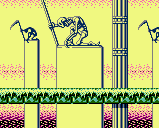
- In Castlevania II: Belmont's Revenge, when the player walks across the bridge that leads to Dracula, several statues that resemble Death can be seen in the background.
- Aside from his role as a boss in Castlevania: Bloodlines, the April 1994 issue of Beep! MegaDrive implies that Drolta Tzuentes may have actually been an alias for Death[255].
- Death's appearance planned in Castlevania: Resurrection resembles the pale horse in Gustave Doré's painting Death on the Pale Horse.
- In Castlevania: Circle of the Moon, the game has been observed to occasionally crash after Death is defeated when his second form is sucked into the black hole. This is especially prevalent when playing a ROM of the game on PC via an emulator, sometimes rendering the game impossible to continue due to crashing occurring either consistently or always.
- In Castlevania: Harmony of Dissonance, Death's second form is very similar to Ouroboros from the Strider series.
- Despite his loyalties to Dracula, Death fights Soma Cruz in both games he has appeared in, even though, technically, Soma is the reincarnation of Dracula.
- In the light novel Akumajō Dracula: Kabuchi no Tsuisōkyoku, Death explains he will serve anyone who is willing to heed the calling of Chaos and take up Dracula's name. It is possible that Death wanted Soma dead to allow the power of Chaos to possess him, and therefore revive Dracula, or that he had no interest in Soma since he didn't want to heed the calling of Chaos while other candidates did. In Grimoire of Souls he notes he has no care for Soma and only for Dracula, however in the novel he notes to Soma he will not befit any harm to him and to continue living his life in peace as a human. Death's inconsistent relationship with Soma is likely due to different writers having different interpretations of Soma's relationship with Death.
- Aside from his role as a boss in Dawn of Sorrow, Death also makes a brief cameo in the game over sequence for the same game, where he's seen holding a white flame (implied to be Soma's soul).
- Similarly, even though Death does not have a major role in Order of Shadows, he does make a cameo during the game over sequence, where he appears and descends upon Desmond Belmont's corpse.
- Garamoth has his own version of Death ten thousand years in the future, the Time Reaper. The Time Reaper heavily resembles Death from Curse of Darkness, and even Death himself acknowledge this in his[256] True Story Mode.
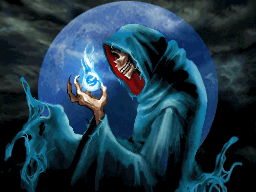
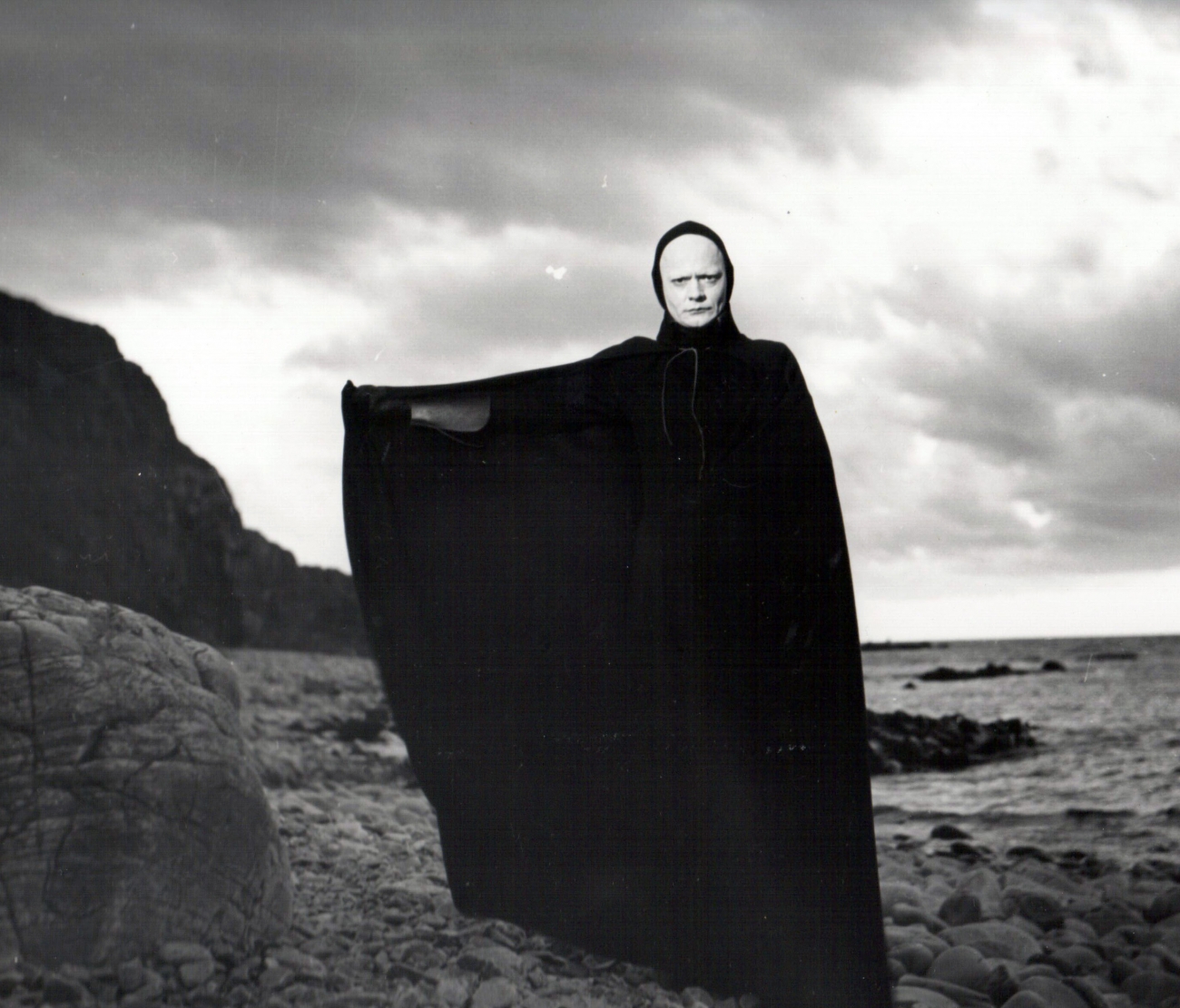
- Death disguising himself as a priest in Curse of Darkness is inspired by a scene in Ingmar Bergman's classic 1957 film, The Seventh Seal.
- In Portrait of Ruin, inside of Death's boss room in the Tower of Death, there are two statues of creatures that resemble Gaibon, possibly referencing this monster's allegiance to him alongside with Slogra.
- In The Dracula X Chronicles, Death says: "Face me, boy!" even if the player is playing as Maria Renard.
Misconceptions
"Gaiden" means "Non-Canon" or "Alternate Timeline"
This stems from the belief that when Iga or a producer calls a Castlevania game a "Gaiden" it is therefore non-canon or an alternate timeline and can be dismissed. This, however, is not the case.
The term "Gaiden" merely just means a side story, spin-off, or a separate tale. The term "Gaiden" does not determine the canonicity of a work, it just lets you know if the game is a spin-off/side-story or if it's a main story. Take, for instance, the Kingdom Hearts series. Kingdom Hearts: Chain of Memories would be considered a gaiden, as it's a side-story and spin-off title that isn't a mainline numbered title, however, it is in all manners canon and important to play to understand Kingdom Hearts II.
The same can be applied to Castlevania itself, Castlevania Symphony of the Night is a gaiden game. Yet it is very obviously canon and pretty important to play to understand more of Alucard's backstory. The idea of a Gaiden game for the Castlevania series itself would be any game not dealing with one of Dracula's main 100-year-resurrections, which in this case, even Castlevania 2: Simon's Quest is in a way a gaiden, despite being completely canon.
This is all to say that Gaiden does not at all mean "non-canon" or "alternate timeline" and should never be treated as such, the term itself has nothing to do with the canonicity of a product.
IGA Statements Quoted by a Fan
Any statements Iga has made about Judgment that don't come from this IGN interview or a sourced and reputable article are not usable. This is, of course, referring to the popular statements used when discussing Judgment's Canoncity about a fan asking IGA about the game's Canoncity on Facebook, here are some of them below:
- Fan: You mentioned Legend of Cornell was an alternate continuity. However, Cornell appears in Castlevania Judgment, which I believe is not an alternate continuity. How does that work? is he from a different universe than the other characters? It is not really explained in the game itself so I was hoping you could give some clarification on the issue.
- IGA: Judgment is a work that surpasses space and time and brings them together.
- Fan: I get it. So, is the explanation I suggested in the previous reply possibly correct?
- IGA: I don't think it's exactly correct. Judgment is a work born of thinking it would be fun to remove all the hedges and bring characters that appeared throughout the series together. I think that you need to view it as an event from another world which does not consider things like timelines or parallel dimensions at all.
Now these seem like pretty clear-cut statements until you start to try to find where these come from.
They come from both a timeline archive discussion on the Castlevania Wiki back on January 15th, 2012 and from a forum post from the same user as the wiki article.
There is no way to find anything sourced or verifiably proven that this person spoke to Iga. Trying to look up the person didn't get any real results either.
Some other issues fall under the inconsistencies within these Iga talks, the person claims that Iga confirmed that Order of Shadows and the Arcade are non-canon because they were intended from the very beginning to be such, however, an officially sourced interview has the lead game designer of Order of Shadows state that Iga was actively involved with ensuring the game was consistent with the current canon, this would be a weird thing to do if he intended it to be non-canon from the very beginning.
He also claims that Iga said Super Castlevania IV was an alternate continuity, when the wiki also notes Iga saying that the games are all legitimate and the same scenario of defeating Dracula, however this quote is also unsourced, they just claim Iga says this with no link or anything.
There is another one not related to the user who spoke to Iga, but a user on reddit who claimed that a magazine claimed that Castlevania: Circle of the Moon was stated to be in a "different time axis". Attempting to get it translated got no wording that said anything like that, with it not even mentioning anything about canon, timeline, time axis, or any other wording of the sort in a machine-translated attempt. Do note however that this is a machine translation so it could potentially be that it is there, but until a reputable and verifiable translator can confirm or deny this translation, the jury is out with it and it will not be used for the canoncity of Circle of the Moon.
Thus all of these quotes are merely hearsay until shown or proven otherwise.
Remakes/Remasters Being Non-Canon
This comes from an Iga quote that says:
- "IGA: FC版とX68000版ですが、X68000版はFC版をベースにアレンジを加えたものになっています。ゲームのアレンジは、その時に応じて、色々と施されるものですので、正直どちらも正統であると思ってよいのではないかと思っています。結論として、ドラキュラと戦い勝つというシナリオで、中間部分の切り抜きが違うと考えてもよいのではないかと考えています。スーパーファミコン版も違いますし…。どうしてもと考えるのであれば、FC版を尊重すべきかと考えます。
- Translation: Regarding the Famicom version and the X68000 version, the X68000 version is an arrangement based on the Famicom version. The arrangement of a game is the kind of thing where you add a lot of different things as needed, so honestly speaking, it think they both should be considered legitimate. In conclusion, I think they should be considered as the same scenario of fighting to defeat Dracula, just with a different middle part. The Super Famicom version is different as well... If you simply must have a clear answer, the Famicom version must be given deference."
Now the quote itself doesn't state remakes or remasters are non-canon despite what people believe. It's moreso a quote of Iga stating that all of them are the same scenario, just with differences. However, an interesting point is that Iga says the NES version should be given "deference", as in to defer to the NES version.
Of course, though, this has the same issue as the Judgment quotes, everyone claims Iga said this, but there is no source of him saying this. In fact, in Castlevania Chronicles, there's a reward interview you receive from Iga himself where he talks about the game, Iga pretty much explains how the game came to be and never says anything about the game not being canon or to defer to the original[257], if anything he treats this as just an updated version of the original. Interestingly to note too, the original he's talking about is not Castlevania on NES but instead, he's talking about the computer version of Castlevania[258], though it borrows a lot of elements from Castlevania NES.
Overall due to the quote itself having no source, it is unusable. The way we will treat remakes, remasters, or ports here however is that they are all equally canon unless stated otherwise. Most of these tell the same story with the only real differences being extra background information added, such as Haunted Castle having it be Dracula stole Simon's wife, though the same overall story still applies even here. Iga himself has already expressed that the original Castlevania's story is pretty simple[259] and Simon having a wife does not affect anything in the overall narrative. Super Castlevania IV notes that Simon is a vampire, though this was due to a novel writer making him a vampire in their novel. The novel was originally supposed to be an adaptation of Super Castlevania IV but was then dropped and made its own thing. Super Castlevania IV itself is still canon, but the subplot of Simon being a vampire is not. The most recent timeline even acknowledges it as canon[260].
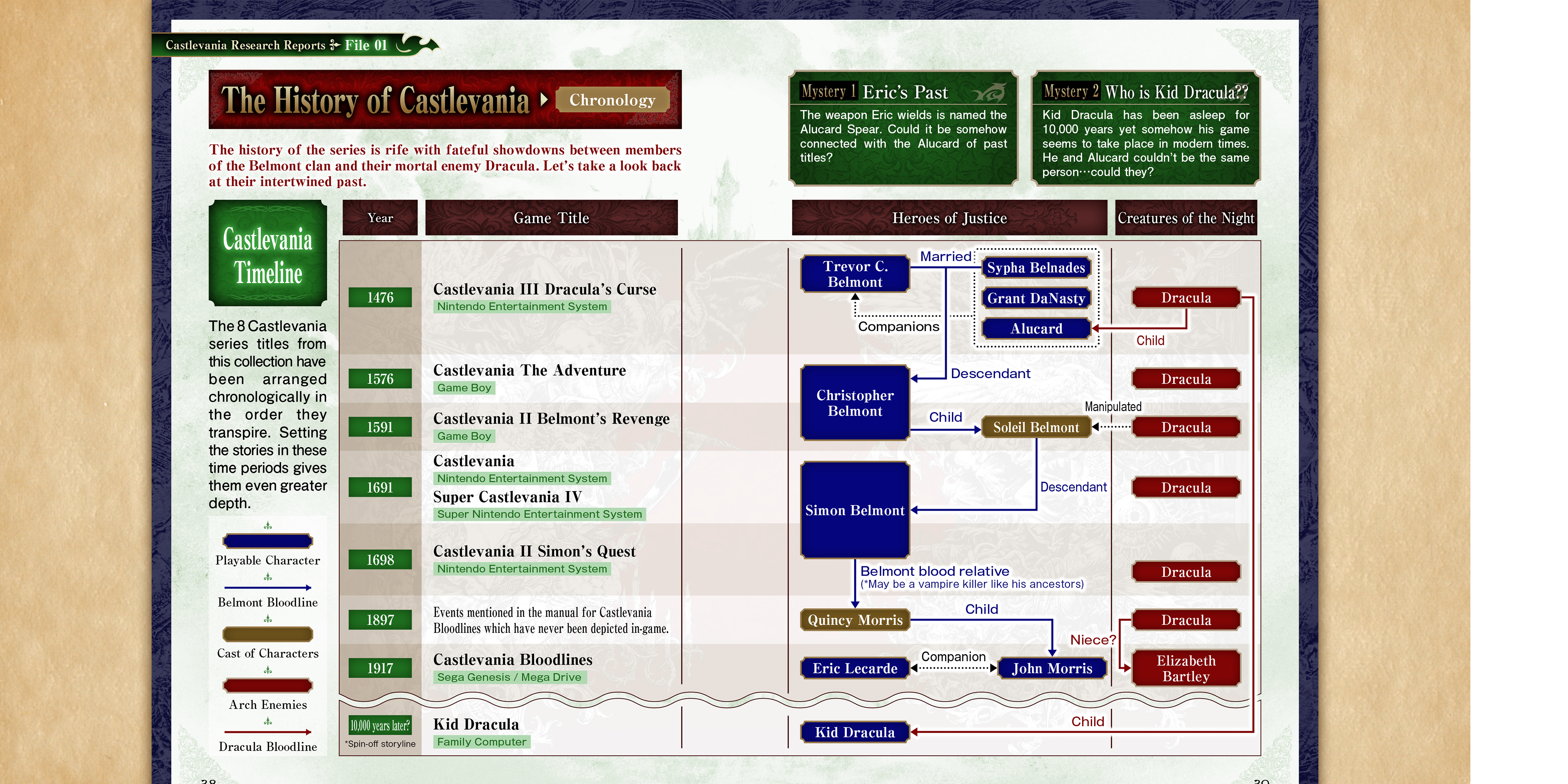
Iga Only Allows Stuff He Works on To Be Canon
There is a weirdly believed idea in the fandom that Iga only considers works he worked on canon, however, an officially sourced interview has the lead game designer of Order of Shadows state that Iga was actively involved with ensuring the game was consistent with the current canon, along with this Iga did not work on a lot of Castlevania games considered canon, such as the NES trilogy and the Gameboy games. In fact, he has only made 12 Castlevania games, out of the 30 Castlevania games in total, and most of them from the older console eras are still a part of the canon. Thus Iga does not only allow stuff he works on to be canon.
Iga is a Producer of Castlevania: Circle of the Moon
A Nintendo Power magazine calls Iga the producer of Circle of the Moon, with Iga talking like he worked on the game in that interview. However Iga can be found nowhere in the credits of the game. Making this Nintendo Power issue questionable as to if they were talking to Iga or if the game was mixed up. Though we have direct in-game proof that Iga was not a producer of Circle of the Moon.
Elements and Statements can be used from Lords of Shadows for the main continuity
This argument comes from Adi Shankar saying that even "non-canon" games are parallel timelines in the overall multiverse, sharing the same spirit and lore[261]. However, the Lord of Shadow games are directly noted in an interview with the lead developer, that the game has nothing to do with the canon, sharing none of the lore or original stuff for the characters. This directly conflicts with Adi Shankar's statement and it was very likely he was not even thinking of Lords of Shadows when making this statement but moreso games like Castlevania Legends. On top of this, Adi Shankar has no actual position within Konami, and being an executive producer for the Castlevania anime, thus he does not have any true say in terms of how Castlevania canon works and can only be used at most as a supporting piece of evidence.
Codex Statistics Questions
Q: Shouldn't the characters be around Tier 2 for defeating the Time Reaper who would've destroyed the very fabric of time[262], attempted to destroy the specific era of time[263], cause all beings everywhere to disappear, forever[264] and that the age was on the verge of collapse[265]?
A: We actually never get a direct outright method of Time Reaper's plan for doing this, from what Aeon mentions to Golem, if the Time Rift is not erased, all beings everywhere will disappear, forever[266], implying that it's the Time Rift causing this, this is further backed up by the fact that in Time Reaper's boss fight, there is a vortex in the background consuming everything[267], meaning this is an overtime feat that scales to no one physically.
Q: Shouldn't they get tier 2 for Dracula's influence destabilizing the flow of time[268]?
A: This is a potent ability but has nothing to do with Attack Potency, there is no quantification for "destabilizing the flow of time", along with this, even if it was taken as physically, then it would be overtime as the effects are not noticeable throughout most of Curse of Darkness. Thus this is merely potent Time Manipulation.
Q: Shouldn't Dracula and by proxy anyone that scales to him get tier 2 for him being able to sustain his castle?
A: This goes under our Stabilization Feats standards, which treats sustaining feats are non-combat applicable Attack Potency normally, though in Dracula's case the Castle is speficially powered by the existence of a Dark Lord, and doesn't necessarily need their strength to rise. In the Castlevania novel, the castle rose without a Dark Lord as an example. Along with this, no one scales to the collapse of the castle, in Curse of Darkness Hector would've died to the collapse of the castle if[269] Julia didn't come save him, and Isaac died within the castle[270]. In other cases the Castle does not collapse[271], but instead slowly fades away[272]. At the end of Dawn of Sorrow Soma Cruz and Genya Arikado (aka Alucard) must escape the collapsing abyss.
Q: Shouldn't Castlevania characters that scale to Death have Infinite speed due to Death being able to kill distance itself with his attacks?
A: Killing distance to attack is not a speed feat, it's a method of Spatial Manipulation by circumventing and ignoring distance, while one can say the attack spawns on you instantly, this is not really something quantifiable. Along with this, it would only scale to characters comparable to Death during post-Dawn of Sorrow, as Soma notes Death is far faster than he remembered from his fight with him in Dawn of Sorrow[273].
Battle Records
14 - 20 - 2
- Brauner - Fight[274]
- Conditions: Brauner was already defeated and weakened by Jonathan Morris and Charlotte Aulin.
- Location: Master's Keep
- Note: Due to Death along with Dracula being the hardest fight for Jonathan and Charlotte, it is likely that Death would be able to defeat Brauner without needing to wait for Jonathan and Charlotte to weaken him.
- Slogra & Gaibon - Fight[275]
- Conditions: Slogra and Gaibon were not their regular selves.
- Location: Castlevania
- Olrox - Fight ([1], [2], [3])
- Conditions: Death had help from Michelle Danasty
- Location: Castlevania
- Carmilla - Fight[277]
- Conditions: None.
- Location: Time Rift
- Note: Fights against characters in the time rift are technically not the actual characters but one's desires being made within the time rift, such as why some characters like Dracula kill others in their story mode but the characters is alive and defeats Time Reaper in their own story mode, never meeting Dracula.
- Trevor Belmont - Fight[278]
- Conditions: None.
- Location: Time Rift
- Note: Fights against characters in the time rift are technically not the actual characters but one's desires being made within the time rift, such as why some characters like Dracula kill others in their story mode but the characters is alive and defeats Time Reaper in their own story mode, never meeting Dracula.
- Cornell - Fight[279]
- Conditions: None.
- Location: Time Rift
- Note: Fights against characters in the time rift are technically not the actual characters but one's desires being made within the time rift, such as why some characters like Dracula kill others in their story mode but the characters is alive and defeats Time Reaper in their own story mode, never meeting Dracula.
- Grant Danasty - Fight[280]
- Conditions: None.
- Location: Time Rift
- Note: Fights against characters in the time rift are technically not the actual characters but one's desires being made within the time rift, such as why some characters like Dracula kill others in their story mode but the characters is alive and defeats Time Reaper in their own story mode, never meeting Dracula.
- Simon Belmont - Fight[281]
- Conditions: None.
- Location: Time Rift
- Note: Fights against characters in the time rift are technically not the actual characters but one's desires being made within the time rift, such as why some characters like Dracula kill others in their story mode but the characters is alive and defeats Time Reaper in their own story mode, never meeting Dracula.
- Golem - Fight[282]
- Conditions: None.
- Location: Time Rift
- Note: Fights against characters in the time rift are technically not the actual characters but one's desires being made within the time rift, such as why some characters like Dracula kill others in their story mode but the characters is alive and defeats Time Reaper in their own story mode, never meeting Dracula.
- Eric Lecarde - Fight[283]
- Conditions: None.
- Location: Time Rift
- Note: Fights against characters in the time rift are technically not the actual characters but one's desires being made within the time rift, such as why some characters like Dracula kill others in their story mode but the characters is alive and defeats Time Reaper in their own story mode, never meeting Dracula.
- Alucard - Fight[284]
- Conditions: None.
- Location: Time Rift
- Note: Fights against characters in the time rift are technically not the actual characters but one's desires being made within the time rift, such as why some characters like Dracula kill others in their story mode but the characters is alive and defeats Time Reaper in their own story mode, never meeting Dracula.
- Time Reaper - Fight[286]
- Conditions: None.
- Location: Time Rift
- Leon Belmont - Fight[287]
- Conditions: None.
- Location: Pagoda of the Misty Moon
- Trevor Belmont, Sypha Belnades, Grant Danasty, & Alucard - Fight[288]
- Conditions: None.
- Location: Castle Entrance
- Christopher Belmont - Fight[290]
- Conditions: None.
- Location: Stage 5 of Castlevania: The Adventure ReBirth
- Simon Belmont - Fight[291]
- Conditions: None.
- Location: Stage 15 of Castlevania
- Simon Belmont - Fight[292]
- Conditions: The match was a rematch.
- Location: Brahams Mansion
- Juste Belmont - Fight[293]
- Conditions: None.
- Location: Castle A: Luminous Cavern
- Richter Belmont - Fight[294]
- Conditions: Match was a rematch.
- Location: Stage 5: Ghost Ship
- Maria Renard - Fight[295]
- Conditions: None.
- Location: Stage 5: Ghost Ship
- Reinhardt Schneider - Fight[297]
- Conditions: None.
- Location: Stage 8 in Castlevania (N64)
- John Morris - Fight[299]
- Conditions: None.
- Location: Stage 6-6 in Castlevania: Bloodlines
- Eric Lecarde - Fight[300]
- Conditions: None.
- Location: Stage 6-6 in Castlevania: Bloodlines
- Stella Lecarde & Loretta Lecarde - Fight[301]
- Conditions: None.
- Location: Tower of Death
- Jonathan Morris & Charlotte Aulin - Fight[302]
- Conditions: Jonathan & Charlotte teamed up.
- Location: Tower of Death
- Jonathan Morris & Charlotte Aulin - Fight[303]
- Conditions: Jonathan & Charlotte teamed up. Death was teaming up with Dracula.
- Location: Throne Room
- Saint Germain - Fight[307]
- Conditions: None.
- Location: Forest Jigramunt
- Note: Saint Germain easily dodged most of Death's attacks and merely left after dodging them.
- Richter Belmont - Fight[308]
- Conditions: None.
- Location: Stage 0
- Note: Death left after Richter fended off his attacks.
References
| Expand here. |
|---|
|

Versus Threads
None.
None.
None.