For any inquires on backlink exchange or partnerships please contact thecodex@gmail.com
The Wiki Forums are up! Check them here!
There is an official chat room on the wiki! I'm always AFK here so pull by to say hi!
If you would like to join the discord, please read this page.
Lyudmil

|
"Mature Content" |
| This character or verse has mature themes and concepts, thus those of young age are ill-advised to look through these. |


|
“ | Please stop... Master Alucard! Please let me die like this. I can now understand Mistress Lisa's feelings. Mistress Lisa wanted to protect your heart, the part of you that is human. I... hated humans. How foolish of me... ah... Master Alucard redeemed my soul... you're a human, don't hate humans... | „ |
| ~ Lyudmil to Alucard |
Background
Lyudmil is a character from the audio drama Castlevania: Nocturne of Recollection. Lyudmil once served Adrian (Alucard) during the time shortly after his mother Lisa's execution. Lisa had healed Lyudmil's parents and many in his village, earning their gratitude. However, when Lisa was falsely accused of witchcraft, Lyudmil tried to aid her escape but failed. She was executed, and Lyudmil was branded a traitor by the villagers. This betrayal deeply embittered him, fueling his resentment toward humanity for their cruelty and hypocrisy.
Afterward, Lyudmil sought out Lisa’s son, Alucard, to share his grief and anger. Alucard reminded him of Lisa's final wishes, urging forgiveness rather than hatred. With nowhere else to turn, Lyudmil vowed to remain by Alucard's side and became his loyal servant, residing with him in Dracula’s Castle.
| This dropdown contains the synopsis of Lyudmil’s story. Read at your own risk as you may be spoiled otherwise! |
|---|
|
One day, Lyudmil and Alucard spent time in the castle garden discussing the white flowers that Lisa had cherished. Lyudmil reminisced about traditions from his village, such as crafting flower crowns to give to young girls. When Alucard asked if he ever wished to return to his village, Lyudmil replied that he could not, as he would be executed as a traitor. Despite this, he felt he belonged at Alucard's side. Over time, the longing to see his village proved overwhelming, and Lyudmil eventually returned, only to find it in ruins. Although the exact events are unclear, it is suggested that during Dracula’s vengeful campaign against humanity, Magnus, an incubus in Dracula’s service, destroyed the village and scattered its residents. Magnus gravely injured Lyudmil but left him alive as a means to lure Alucard. When Lyudmil awoke, he found Alucard by his side but had no memory of how he had been rescued. Magnus taunted Alucard, offering him Lyudmil's blood to save his life. Alucard resisted initially, though it is implied that he eventually succumbed. Alucard and his Imp companion later defeated Magnus in battle, though this encounter may have led Alucard to experience a brief period where he sought human blood. Magnus would later show Maria visions of Alucard preying on young maidens, though the truth of these visions remains uncertain. At some point, Lyudmil became a vampire, although it is unclear whether Alucard was responsible. Consumed by hatred for humanity's betrayal of Lisa, Lyudmil lived as a demon for centuries. In 1798, one year after Alucard awoke from his long slumber, Lyudmil resurfaced, likely due to Magnus’s schemes, and began preying on maidens in a village where Alucard and Maria had settled. His actions drew the attention of Richter Belmont, along with the vampire hunters Cyril and Alexis, who investigated the situation. Lyudmil joined forces with Magnus to battle Alucard, Maria, Richter, Cyril, and Alexis. During the confrontation, Lyudmil eventually broke free from Magnus's influence and turned against the incubus. However, the injuries Lyudmil sustained in the battle proved fatal, and he died in the presence of his friend Alucard. |
General Information
Origin: Castlevania: Nocturne of Recollection
First Appearance: Castlevania: Nocturne of Recollection
Company: Konami
Creator: Koji Igarashi
Actor: Masaya Matsukaze
Gender: Male
Sexuality: Heterosexual
Pronouns: He/Him
Age: 22 at the time he met Alucard (Noted he was 22 and that he was only a few years older then Alucard[2]), Unknown during Castlevania: Nocturne of Recollection
Time Period: 1798
Timeline: Main Timeline
Homeworld: Earth
Residence: Magnus' Lair
Story Role: Supporting Character
Legacy: Unknown Legacy
Influence: Unknown Influence
Language: English
Classification: Alucard's servant, Magnus's servant[3], Child of the Night
Species: Human (Formerly), Vampire (During Castlevania: Nocturne of Recollection)
State of Being: Regular
Physiology: Humanoid Physiology (Formerly), Vampire Physiology (During Castlevania: Nocturne of Recollection)
Occupation: Butler (Formerly)
Affiliations: Alucard (His master and close friend[5]), Magnus (While under his control[6]), Lisa Tepes (Indebted to her as she saved his parents from a deadly illness[7])
Enemies: Alucard (Formerly, while under Magnus' control[8])
Height: Unknown
Weight: Unknown
Status: Deceased (Died after breaking free from Magnus' control[9])
Date of Death: 1798 (The events of Nocturne of Recollection take place in 1798)
Alignment: Neutral Good as a human (A friend of Alucard's who would listen to his any command, such as not hating humans for the death of their family[10]), Chaotic Evill as a vampire (Due to giving into feeding, he attacked all of the girls in a village, draining them of their blood[11]. Views vampires as the superior race that can exercise their rights to eat humans like humans eat animal flesh[12]), returns to Neutral Good thanks to Maria Renard's power (It's noted that due to Maria's power Lyudmil was broken out of his control from Magnus[13])
Threat Level: Street Threat (Due to giving into feeding, he attacked all of the girls in a village, draining them of their blood[14])
Codex Statistics
Grade: A
Tier: At least 8-C, likely Far Higher
Cardinality: Finite
Power Source: Chaos (All monsters and creatures are Creatures of Chaos[15], where they are empowered by Chaos, always rebirthing from Chaos with each rebirth, the creatures takes a new form[16])
Dimensionality: 3-D
Attack Potency: At least Building level (Potency) (Vampires are considered far larger threats than the standard creature of the night monsters[17], which would put him above creatures such as Golem, from Castlevania Judgement, as he died to a random unknown hunter after his return from the time rift[18]. Golem with his ultimate can shoot out a mouth blast that vaporizes everything it touches as far as the eye can see[19] . Monsters like Gergoth[20], can be fought by an era of hunter[21], where Gergoth's mere stomps breaks large portions of the castle apart causing them to crash through multiple floors due to its sheer weight and size[20]), likely Far Higher (Can harm and fight against enemies stronger than characters who can take hits from neutron bomb[22], that have a yield range of 1-10 kilotons of TNT)
Durability: At least Building level, likely Far Higher (Easily blocked an attack from Cyril[23])
Striking Strength: At least Room Class (Potency), likely Far Higher
Lifting Strength: At least Class 10 (Vampires are considered far larger threats than the standard creature of the night monsters[24], which should make him superior to Hector's Battle-Type innocent devils who can move entire tree logs that are blocking roads out of the way[25] where logs can weigh around 15 to 5 tons[26] and Hector's battle-type innocent devils can lift open large iron doors that "no man could force open"[27])
Travel Speed: At least Superhuman regularly (Vampires can assume the shape of a wolf, a bat or fog[28]). At most Faster Than Light at top speed (Vampires are loved by the night, beyond even the typical Creature of the Night, making him faster then enemies such as the Sky Fish who moves so fast that it appears as a beam of light and is only slowed down when time is stopped[29] and the White Demon, who can move at the speed of light at short distances[30]. Vampires can move so fast that the light itself cannot keep up with them, leaving an afterimage behind[31]. Alucard in his suppressed Genya Arikado form can still move so fast that an afterimage made of light is behind him[32])
Attack Speed: At most Faster Than Light (Noted by Richter Belmont that Lyudmil had the upper hand in terms of speed in their fight[33])
Reaction Speed: At most Faster Than Light
Stamina: Limitless (Vampires are loved by the night, making them so powerful that vampires like Walter Bernhard never been defeated before Leon Belmont gained the vampire killer[34])
Range: Standard Melee, Higher with Summoning
Intelligence: Supergenius Intelligence (Lyudmil is a master of magic, where magic requires one to have a deep understanding of Quantum Physics to utilize it to its fullest, requiring understandings of theories such as "Curse Amplification"[35])
Knowledge: Grandmaster level
Is a Creature of the Night, which gives:
- Superhuman Physical Characteristics (Even the smallest creatures of the night can destroy a bridge[36], one of Dracula's bats easily destroyed a stone ground block[37])
- Intimidation (Creatures of the nights appearances can cause one to have their body's cells cry out in terror[38])
- Immortality
- Ageless: The biggest hindrance to humans when attempting to accomplish something is their limited lifespans, a limitation that cannot be overcome, however, dwellers of the darkness do not apply to the laws of the human world, ignoring such limitations[39].
- Immortal Metaphysical Aspect: Creatures of the Night can continue to exist even as a spirit and use their spirit form to form bodies out of inanimate material around them[40].
- Acausality (Causality Immunity; All immortal beings disrupt the flow of time according to Aeon[41], along with ignoring the very passage of time[42]. With their souls being completely free from time[43]. The biggest hindrance to humans when attempting to accomplish something is their limited lifespans, a limitation that cannot be overcome, however, dwellers of the darkness do not apply to the laws of the human world, ignoring such limitations[44])
- Free Will (Creatures of the Night do not follow the hand of God and instead choose of their own free will[45])
- Empowerment (Creatures of the night are empowered by the night[46], becoming stronger when it's night time[47])
- Evolution (Creatures of chaos can inherit evil natures[48] awakening into stronger enemies with new abilities and less weaknesses[49])
- Resurrection (Self-Resurrection; Creatures of chaos can be brought back to life from the power of hate[50]. This has also been shown with slain heads reviving as an angry wraith[51])
- Regeneration
- Type: Cyclical (Creatures of chaos are in a state of a "regeneration cycle"[52]).
- Source: Unholy Regeneration
- Capabilities: Even the castle from Castlevania is a Creature of Chaos[53], where they are always rebirth from Chaos with each rebirth, the creatures takes a new form[54]. Rebirth for creatures seem to their aspects, as the castle itself in every game essentially crumbles or fades away yet comes back in a new form[55].
- Invisibility (Creatures of Chaos possess a natural aura of darkness, which makes one unable to see those with an aura of darkness by the naked eye[56])
- Time Manipulation (1-T, Passive; All immortal beings disrupt the flow of time according to Aeon[57])
- Darkness Manipulation & Subjective Reality (Creatures of chaos very existence causes dark powers to flow beyond the control of the Elgos' grimoires, due to them collecting documented information on Dracula and his castle. Causing their power to materialize in the real world in the form of monsters[58]. With the real world and world of grimoires being considered the same or "equal"[59], compared to the like of Brauner's painting worlds that are quantum multi-layered spaces requiring understandings of theories such as "Curse Amplification"[60])
- Text Manipulation & Plot Manipulation (Passive; Creatures of the night's dark powers allowed them to rewrite the Grimoires to strengthen their dark powers greatly[61]. It is noted by Lucy that the "vital soul" of a monster is the cause of the grimoire chaos[62]. Their vital souls are causing the grimoires contents to be overwritten changing history to things such as Jonathan Morris is now at a disadvantage in battle[63], or Charlotte fading from existence due to them messing with the history of the Grimoires[64], Maria starting to fade because Richter's history is being rewritten[65], where if the contents of the book change the creatures magic will keep growing and eventually overflow into reality, causing the grimoire to fall into chaos and even more monsters materializing into the real world[66]. The text alterations also make the monsters stronger[67]. With the real world and world of grimoires being considered the same or "equal"[68], compared to the like of Brauner's painting worlds that are quantum multi-layered spaces requiring understandings of theories such as "Curse Amplification"[69])
- Law Manipulation (Creatures of Chaos can alter grimoires, which do not adhere to the laws of reality[70])
- Power Modification (Creatures of the night alterations of the Grimoire can greatly limit the powers of those far stronger than them, such as Jonathan Morris' power being limited due to the alterations[71]. The Chaos of the Grimoire destabilized the magic of the others[72]).
- Resistance to
- Ice Manipulation & Absolute Zero (All enemies in Castlevania III: Dracula's curse can eventually break out of being frozen from Sypha's ice magic[73]. Along with this to protect against ice attacks in series, one normally wears rings that help them resist against absolute zero[74])
- Time Manipulation (1-T; All immortal beings disrupt the flow of time according to Aeon[75], with their souls being completely free from time[76]. With time in Castlevania being so potent that not even eternity can withstand time[77], along with even artificial life being subject to the laws of time[78]. Some creatures of chaos are immune to time stop, normally being boss-level creatures[79])
- Fate Manipulation (Temporal Fate; All immortal beings disrupt the flow of time according to Aeon[80], with their souls being completely free from time[81], with fate being a truth wound by time[82])
Is a Vampire, which gives:
- Superhuman Physical Characteristics (Vampires are considered far larger threats than the standard creature of the night monsters[83])
- Stealth Mastery (Vampires are able to attack stealthily in search of human blood[84])
- Disguise Mastery (Vampires will sometimes disguise themselves[85] as villages in order to get near one[86])
- Immortality
- Ageless: Vampires defy God's decree that life should be limited, and exist for eternity[87], with Mathias noting he has eternal life[88]. Aeon notes that vampires exist for eternity[89]. Walter is noted to be a vampire that has eternal life[90]. The biggest hindrance to humans when attempting to accomplish something is their limited lifespans, a limitation that cannot be overcome, however, dwellers of the darkness do not apply to the laws of the human world, ignoring such limitations[91].
- Immortal Metaphysical Aspect: Vampires will someday come back to life despite them being killed due to being immortal[92].
- Acausality (Causality Immunity; All immortal beings disrupt the flow of time according to Aeon[93], along with ignoring the very passage of time[94]. With their souls being completely free from time[95]. The biggest hindrance to humans when attempting to accomplish something is their limited lifespans, a limitation that cannot be overcome, however, dwellers of the darkness do not apply to the laws of the human world, ignoring such limitations[96])
- Free Will (Vampires do not follow the hand of God and instead choose of their own free will[97], defying God's decree[98])
- Enhanced Senses (Vampires can smell that Reinhardt Schneider and Carrie Fernandez smell different from the usual adventurer[99])
- Surface Scaling (Vampires can stand on ceilings[100])
- Flight (Vampires can either naturally levitate grow wings to fly[101], turn into a bat[102], or into mist[103])
- Immersion (Vampires can infuse magic into paintings to increase their power[104])
- Empowerment (Vampires are loved by the night, making them so powerful that vampires like Walter Bernhard never been defeated before Leon Belmont gained the vampire killer[105]. Noted by Leon that the night should help Joachim Armster as well due to him being a vampire, with the only reason it doesn't is due to Walter holding the ebony stone[106])
- Resurrection (Even if one somehow manages to kill a vampire, they will someday come back to life despite them being killed due to being immortal[107])
- Transformation (Shapeshifting; Vampires can assume the shape of a wolf, a bat or fog[108]. Vampires can disguise themselves as humans[109])
- Teleportation (Vampires possess the ability to teleport freely[110]. Even non-threatening vampires such as Rosa, fade out from view[111])
- Power Suppression (Vampires can submerge their own vampiric powers if needed[112])
- Life-Force Absorption (Vampires can consume one's lifeforce[113], allowing them to heal themselves through biting into a victim[114])
- Vampirification (Vampires can turn others into vampires[115], Walter turned Rinaldo's daughter into a vampire[116])
- Invisibility (Vampires possess natural aura of darkness, which makes one unable to see those with an aura of darkness by the naked eye[117])
- Time Manipulation (1-T, Passive; All immortal beings disrupt the flow of time according to Aeon[118])
- Animal Manipulation (Bats serve under the control of vampires[119], being freely spawnned by any vampire[120])
- Cloth Manipulation (A vampire's blood can transform clothes, such as Hector combining a vampire's blood with a prince's clothes to get Dracula's clothes[121])
- Electricity Manipulation (Vampires can sometimes have electricity form around them as they transform[122])
- Soul Manipulation (The candles in Castlevania are people's souls that were taken by Death or by vampires[123])
- Text Manipulation & Plot Manipulation (Passive; Vampire's dark powers allowed them to rewrite the Grimoires to strengthen their dark powers greatly[124]. It is noted by Lucy that the "vital soul" of a monster is the cause of the grimoire chaos[125]. Their vital souls are causing the grimoires contents to be overwritten changing history to things such as Jonathan Morris is now at a disadvantage in battle[126], or Charlotte fading from existence due to them messing with the history of the Grimoires[127], Maria starting to fade because Richter's history is being rewritten[128], where if the contents of the book change the creatures magic will keep growing and eventually overflow into reality, causing the grimoire to fall into chaos and even more monsters materializing into the real world[129]. The text alterations also make the monsters stronger[130]. With the real world and world of grimoires being considered the same or "equal"[131], compared to the like of Brauner's painting worlds that are quantum multi-layered spaces requiring understandings of theories such as "Curse Amplification"[132])
- Law Manipulation (Vampires can alter grimoires, which do not adhere to the laws of reality[133])
- Power Modification (Vampire's alterations of the Grimoire can greatly limit the powers of those far stronger than them, such as Jonathan Morris' power being limited due to the alterations[134]. The Chaos of the Grimoire destabilized the magic of the others[135]).
- Resistance to
- Temperatures (Vampires bodies turn cold, with them feeling no heat[136])
- Biological Manipulation (Vampires biological functions are no longer required for them[137])
- Time Manipulation (1-T; All immortal beings disrupt the flow of time according to Aeon[138], with their souls being completely free from time[139]. With time in Castlevania being so potent that not even eternity can withstand time[140], along with even artificial life being subject to the laws of time[141])
- Mortality Manipulation ("Death" loses all meaning for Vampires, as they[142] defy God's decree that life should be limited, and exist for eternity[143]. Where even if one "kills" a vampire they will simply just come back as they are not bound to death[144])
- Fate Manipulation (Temporal Fate; All immortal beings disrupt the flow of time according to Aeon[145], with their souls being completely free from time[146], with fate being a truth wound by time[147])
- Law Manipulation (Vampires defy God's decree that life should be limited, and exist for eternity[148])
- Magic (Through utilizing magic, one has to have a deep understanding of Quantum Physics to utilize it to its fullest, requiring understandings of theories such as "Curse Amplification"[149])
- Non-Standard Interaction (Extra-Planar Interaction; Magic is able to interact with beings such as Camilla Fernandez[152], Physical attacks are difficult to land as Camilla lives in the Astral plane, and her earthly body is completely ethereal[153])
- Limited Immersion & Dimensional Travel (3+1-D; Magic users can align their magic with the magic of another to enter into painting worlds[154])
- Summoning (Magic can be used in order to summon weapons and items inscribed in grimoires[155])
- Soul Manipulation (Yoko through the use of magic discovered a new ability to draw the monster souls out and use them[156])
Energy Absorption (Lyudmil can get hearts out of objects and enemies, where hearts are a measure of one's stored energy, thus one is absorbing energy when gaining hearts[157]), Summoning (Summoned all of the demons within his lair to attack Richter[158])
Nothing notable.
Notable Techniques
- Blood Draining: Vampires can bite and drink the blood of their victims. Blood acts as a source of energy and life for vampires and creatures of the night, an example of this being Red Skeletons who endlessly[159] regenerate[160], from any kind[161] of damage due to it absorbing blood[162].
- Transformation: Vampires are able to turn into bats, wolves, fog, and other sorts of creatures as they please.
- Super Strength: Vampires are incredibly superhumanly strong, even for the average creature of the night, being noted to be stronger than even Werewolves.
- Super Speed: Vampires can move incredibly fast, to where all of them leave behind light projections due to how fast they're moving, while they can control their speeds even to approach speeds such as sound. They are normally beyond even other creatures in the castle such as the White Demon who moves at the speed of light at top speed.
- Call Forth All Demons: A summoning attack Lyudmil used to attack Richter and later Magnus when he broke free from his control. As the name implies, he calls forth all demons to attack.
Other
Standard Tactics: Lyudmil summons all the demons to attack his enemies.
Weaknesses
- Creature of the Night Weaknesses: Creatures of the night become weaker when exposed to the morning sun[163]. Garlic significantly weakens creatures of the night[164], and causes demons to die if its placed on the ground[165]. If a vital soul is defeated, the grimoire will revert back to its original content[166].
- Standard Vampire Weaknesses: After a vampire is sufficiently weakened, the sunlight can kill them[167]. Otherwise Vampires can stand out in the sunlight just fine[168]. Though some weaker vampires can have the sun burn them overtime, killing them[169]. Oak Stakes are able to break through the magic of a weakened vampire[170]. Defeating a vampire will stop the effects of someone they have bitten, but only before they've turned[171]. This is shown in Harmony of Dissonance where through Juste killing Dracula's Wraith, the bite marks on Lydie have vanished[172]. Vampires reflections do not appear on mirrors, making them easier to identify[173]. Vampires are noted to be weak during the dawn[174].
Note
- Contrary to popular belief, holy attacks and the whips in Castlevania can affect and harm people that aren't apart of the creatures of the night. Leon's doppelganger can use holy water and holy attacks against him in this fight along with the alchemy whip despite Leon being a pure and noble warrior[175]. Simon's doppelganger can harm him with the vampire killer, despite Simon being a noble hero. Holy Water even works and harms enemies such as the "Holy Armor"[176], a knight who has natural holy powers[177]. Corrupted enemies such as Charlie Vincent, use holy water attacks on Carrie and Reinhardt[178]. Characters like Jonathan Morris wear armor like the Holy Mail, an armor that reduces damage from holy attacks[179].
- The Sky Fish feat moving so fast that it appears as a beam of light and only slows once time is stopped[180] is a natural indication of Faster Than Light travel as at the speed of light, time is zero from its perspective. Soma Cruz having a hard time catching up with it initially does not mess with his scaling either as we know it's an unquantifiable level into Faster than Light at the most.
Explanation
Usage of games like Castlevania Legends & Castlevania: Circle of the Moon
Castlevania Legends
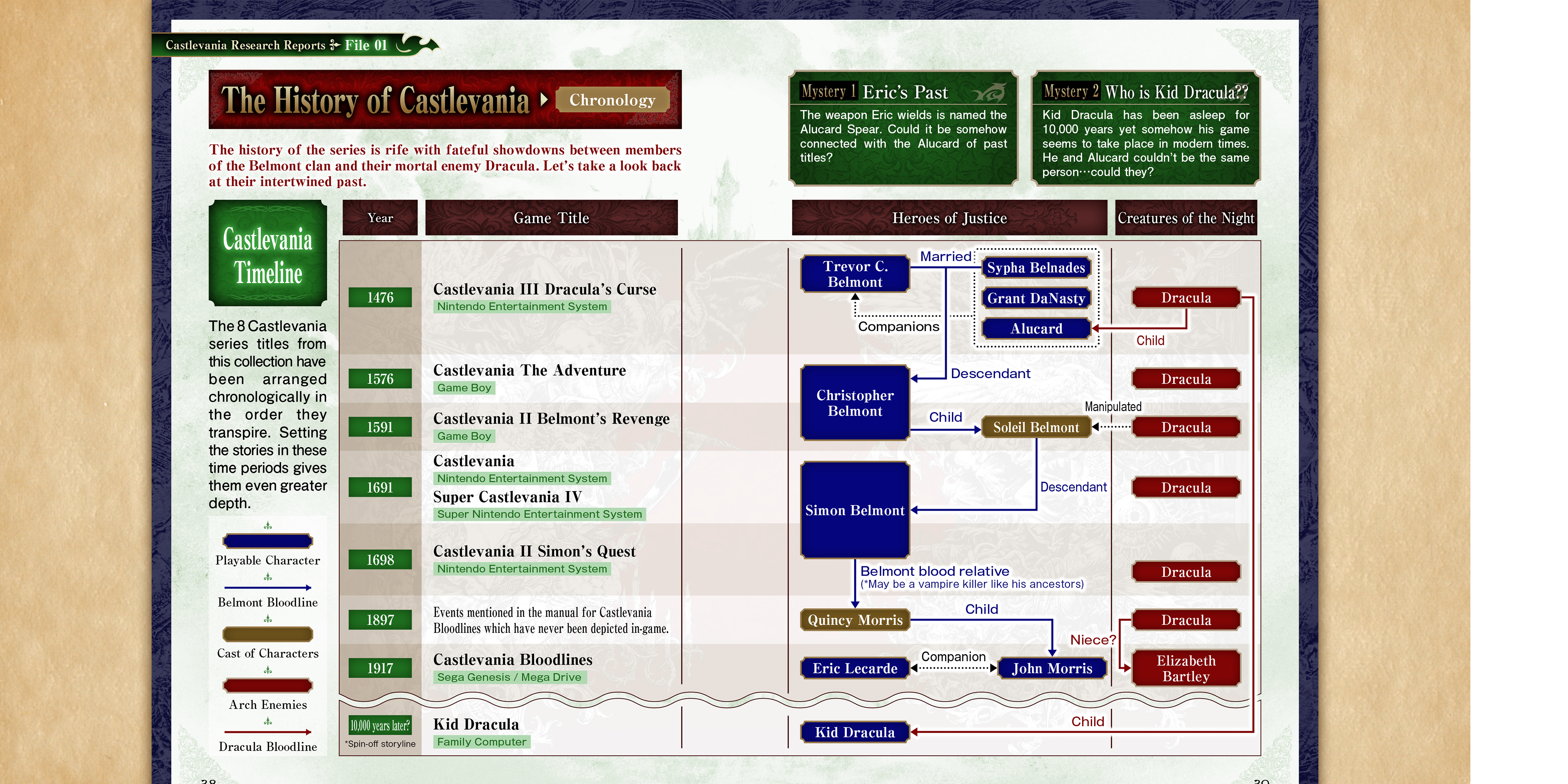
The game was originally meant to be a prequel to all the other games in the Castlevania series, this can be seen with Sonia's boss fight against Dracula serving as the first time Dracula ever encountered a Belmont along with the ending of the game saying "this story marks the beginning of the Belmont family legend that has been passed on through many ages". Along with this, Sonia shared a relationship with Alucard, heavily implying that her child is between her and Alucard. The existence of Lament of Innocence already greatly messes with this. The game manual even mentions that Sonia was the first of the Belmont family to leave her name to posterity as a vampire hunter[181]. Despite Leon Belmont being the one to start the legend of the Belmont Hunters being vampire hunters. Along with this, Trevor is canonically the first Belmont to defeat Dracula. Iga has gone out of his way to note too that Castlevania Legends was intentionally redacted from the timeline so that it doesn't conflict with the timing used in other titles.
Castlevania: Circle of the Moon
Although it was in the original 2006 timeline, it was removed by Iga from the timeline, along with Castlevania (N64), Legacy of Darkness, and Legends.
Why abilities from them are still usable for main timeline
These games were at one point officially a part of the original timeline before ultimately being removed, making them hypotheticals that could be done. This is further supported by an interview in the History of Castlevania - Crescent of the Moon book, where executive producer of Castlevania Netflix Adi Shankar noted that even the "non-canon" games are parallel timelines in the overall multiverse, sharing the same spirit and lore[182]. While one could argue his statement shouldn't be used, it comes from a book titled, "History of Castlevania - Crescent of the Moon", where it wouldn't make much sense if his statement was wrong and there was no correction over it. The book even has asterisks to give further context, yet they never claim him wrong. Along with this, it's consistent with the fact that most of the Castlevania games that are "non-canon" now were originally a part of the timeline. Thus this statement is usable. Thus abilities and the likes from these games can carry over to the main timeline games.
Trivia
Misconceptions
"Gaiden" means "Non-Canon" or "Alternate Timeline"
This stems from the belief that when Iga or a producer calls a Castlevania game a "Gaiden" it is therefore non-canon or an alternate timeline and can be dismissed. This, however, is not the case.
The term "Gaiden" merely just means a side story, spin-off, or a separate tale. The term "Gaiden" does not determine the canonicity of a work, it just lets you know if the game is a spin-off/side-story or if it's a main story. Take, for instance, the Kingdom Hearts series. Kingdom Hearts: Chain of Memories would be considered a gaiden, as it's a side-story and spin-off title that isn't a mainline numbered title, however, it is in all manners canon and important to play to understand Kingdom Hearts II.
The same can be applied to Castlevania itself, Castlevania Symphony of the Night is a gaiden game. Yet it is very obviously canon and pretty important to play to understand more of Alucard's backstory. The idea of a Gaiden game for the Castlevania series itself would be any game not dealing with one of Dracula's main 100-year-resurrections, which in this case, even Castlevania 2: Simon's Quest is in a way a gaiden, despite being completely canon.
This is all to say that Gaiden does not at all mean "non-canon" or "alternate timeline" and should never be treated as such, the term itself has nothing to do with the canonicity of a product.
IGA Statements Quoted by a Fan
Any statements Iga has made about Judgment that don't come from this IGN interview or a sourced and reputable article are not usable. This is, of course, referring to the popular statements used when discussing Judgment's Canoncity about a fan asking IGA about the game's Canoncity on Facebook, here are some of them below:
- Fan: You mentioned Legend of Cornell was an alternate continuity. However, Cornell appears in Castlevania Judgment, which I believe is not an alternate continuity. How does that work? is he from a different universe than the other characters? It is not really explained in the game itself so I was hoping you could give some clarification on the issue.
- IGA: Judgment is a work that surpasses space and time and brings them together.
- Fan: I get it. So, is the explanation I suggested in the previous reply possibly correct?
- IGA: I don't think it's exactly correct. Judgment is a work born of thinking it would be fun to remove all the hedges and bring characters that appeared throughout the series together. I think that you need to view it as an event from another world which does not consider things like timelines or parallel dimensions at all.
Now these seem like pretty clear-cut statements until you start to try to find where these come from.
They come from both a timeline archive discussion on the Castlevania Wiki back on January 15th, 2012 and from a forum post from the same user as the wiki article.
There is no way to find anything sourced or verifiably proven that this person spoke to Iga. Trying to look up the person didn't get any real results either.
Some other issues fall under the inconsistencies within these Iga talks, the person claims that Iga confirmed that Order of Shadows and the Arcade are non-canon because they were intended from the very beginning to be such, however, an officially sourced interview has the lead game designer of Order of Shadows state that Iga was actively involved with ensuring the game was consistent with the current canon, this would be a weird thing to do if he intended it to be non-canon from the very beginning.
He also claims that Iga said Super Castlevania IV was an alternate continuity, when the wiki also notes Iga saying that the games are all legitimate and the same scenario of defeating Dracula, however this quote is also unsourced, they just claim Iga says this with no link or anything.
There is another one not related to the user who spoke to Iga, but a user on reddit who claimed that a magazine claimed that Castlevania: Circle of the Moon was stated to be in a "different time axis". Attempting to get it translated got no wording that said anything like that, with it not even mentioning anything about canon, timeline, time axis, or any other wording of the sort in a machine-translated attempt. Do note however that this is a machine translation so it could potentially be that it is there, but until a reputable and verifiable translator can confirm or deny this translation, the jury is out with it and it will not be used for the canoncity of Circle of the Moon.
Thus all of these quotes are merely hearsay until shown or proven otherwise.
Remakes/Remasters Being Non-Canon
This comes from an Iga quote that says:
- "IGA: FC版とX68000版ですが、X68000版はFC版をベースにアレンジを加えたものになっています。ゲームのアレンジは、その時に応じて、色々と施されるものですので、正直どちらも正統であると思ってよいのではないかと思っています。結論として、ドラキュラと戦い勝つというシナリオで、中間部分の切り抜きが違うと考えてもよいのではないかと考えています。スーパーファミコン版も違いますし…。どうしてもと考えるのであれば、FC版を尊重すべきかと考えます。
- Translation: Regarding the Famicom version and the X68000 version, the X68000 version is an arrangement based on the Famicom version. The arrangement of a game is the kind of thing where you add a lot of different things as needed, so honestly speaking, it think they both should be considered legitimate. In conclusion, I think they should be considered as the same scenario of fighting to defeat Dracula, just with a different middle part. The Super Famicom version is different as well... If you simply must have a clear answer, the Famicom version must be given deference."
Now the quote itself doesn't state remakes or remasters are non-canon despite what people believe. It's moreso a quote of Iga stating that all of them are the same scenario, just with differences. However, an interesting point is that Iga says the NES version should be given "deference", as in to defer to the NES version.
Of course, though, this has the same issue as the Judgment quotes, everyone claims Iga said this, but there is no source of him saying this. In fact, in Castlevania Chronicles, there's a reward interview you receive from Iga himself where he talks about the game, Iga pretty much explains how the game came to be and never says anything about the game not being canon or to defer to the original[184], if anything he treats this as just an updated version of the original. Interestingly to note too, the original he's talking about is not Castlevania on NES but instead, he's talking about the computer version of Castlevania[185], though it borrows a lot of elements from Castlevania NES.
Overall due to the quote itself having no source, it is unusable. The way we will treat remakes, remasters, or ports here however is that they are all equally canon unless stated otherwise. Most of these tell the same story with the only real differences being extra background information added, such as Haunted Castle having it be Dracula stole Simon's wife, though the same overall story still applies even here. Iga himself has already expressed that the original Castlevania's story is pretty simple[186] and Simon having a wife does not affect anything in the overall narrative. Super Castlevania IV notes that Simon is a vampire, though this was due to a novel writer making him a vampire in their novel. The novel was originally supposed to be an adaptation of Super Castlevania IV but was then dropped and made its own thing. Super Castlevania IV itself is still canon, but the subplot of Simon being a vampire is not. The most recent timeline even acknowledges it as canon[187].
Iga Only Allows Stuff He Works on To Be Canon
There is a weirdly believed idea in the fandom that Iga only considers works he worked on canon, however, an officially sourced interview has the lead game designer of Order of Shadows state that Iga was actively involved with ensuring the game was consistent with the current canon, along with this Iga did not work on a lot of Castlevania games considered canon, such as the NES trilogy and the Gameboy games. In fact, he has only made 12 Castlevania games, out of the 30 Castlevania games in total, and most of them from the older console eras are still a part of the canon. Thus Iga does not only allow stuff he works on to be canon.
Iga is a Producer of Castlevania: Circle of the Moon
A Nintendo Power magazine calls Iga the producer of Circle of the Moon, with Iga talking like he worked on the game in that interview. However Iga can be found nowhere in the credits of the game. Making this Nintendo Power issue questionable as to if they were talking to Iga or if the game was mixed up. Though we have direct in-game proof that Iga was not a producer of Circle of the Moon.
Elements and Statements can be used from Lords of Shadows for the main continuity
This argument comes from Adi Shankar saying that even "non-canon" games are parallel timelines in the overall multiverse, sharing the same spirit and lore[188]. However, the Lord of Shadow games are directly noted in an interview with the lead developer, that the game has nothing to do with the canon, sharing none of the lore or original stuff for the characters. This directly conflicts with Adi Shankar's statement and it was very likely he was not even thinking of Lords of Shadows when making this statement but moreso games like Castlevania Legends. On top of this, Adi Shankar has no actual position within Konami, and being an executive producer for the Castlevania anime, thus he does not have any true say in terms of how Castlevania canon works and can only be used at most as a supporting piece of evidence.
Codex Statistics Questions
Q: Shouldn't the characters be around Tier 2 for defeating the Time Reaper who would've destroyed the very fabric of time[189], attempted to destroy the specific era of time[190], cause all beings everywhere to disappear, forever[191] and that the age was on the verge of collapse[192]?
A: We actually never get a direct outright method of Time Reaper's plan for doing this, from what Aeon mentions to Golem, if the Time Rift is not erased, all beings everywhere will disappear, forever[193], implying that it's the Time Rift causing this, this is further backed up by the fact that in Time Reaper's boss fight, there is a vortex in the background consuming everything[194], meaning this is an overtime feat that scales to no one physically.
Q: Shouldn't they get tier 2 for Dracula's influence destabilizing the flow of time[195]?
A: This is a potent ability but has nothing to do with Attack Potency, there is no quantification for "destabilizing the flow of time", along with this, even if it was taken as physically, then it would be overtime as the effects are not noticeable throughout most of Curse of Darkness. Thus this is merely potent Time Manipulation.
Q: Shouldn't Dracula and by proxy anyone that scales to him get tier 2 for him being able to sustain his castle?
A: This goes under our Stabilization Feats standards, which treats sustaining feats are non-combat applicable Attack Potency normally, though in Dracula's case the Castle is speficially powered by the existence of a Dark Lord, and doesn't necessarily need their strength to rise. In the Castlevania novel, the castle rose without a Dark Lord as an example. Along with this, no one scales to the collapse of the castle, in Curse of Darkness Hector would've died to the collapse of the castle if[196] Julia didn't come save him, and Isaac died within the castle[197]. In other cases the Castle does not collapse[198], but instead slowly fades away[199]. At the end of Dawn of Sorrow Soma Cruz and Genya Arikado (aka Alucard) must escape the collapsing abyss.
Q: Shouldn't Castlevania characters that scale to Death have Infinite speed due to Death being able to kill distance itself with his attacks?
A: Killing distance to attack is not a speed feat, it's a method of Spatial Manipulation by circumventing and ignoring distance, while one can say the attack spawns on you instantly, this is not really something quantifiable. Along with this, it would only scale to characters comparable to Death during post-Dawn of Sorrow, as Soma notes Death is far faster than he remembered from his fight with him in Dawn of Sorrow[200].
Battle Records
2 - 0 - 0
- Cyril Marquis - Fight[201]
- Conditions: None.
- Location: Lyudmil's Lair
- Alexis - Defeated Off Screen[202]
- Conditions: None.
- Location: Magnus' Lair
None.
None.
References
| Expand here. |
|---|
|
Versus Threads
None.
None.
None.
- Pages using Tabber parser tag
- Mature
- Templates
- Characters
- Male Characters
- Radio Drama Characters
- Dead Characters
- Good Characters
- Neutral Good Characters
- Evil Characters
- Chaotic Evil Characters
- Human Characters
- Humanoid Characters
- Vampire Characters
- Monster Characters
- Corrupted Characters
- Controlled Characters
- Reformed Characters
- Primary Antagonists
- Antagonists
- Reformed Antagonists
- Protagonists
- Villains
- Heroes
- Humans
- Non-Humans
- Adults
- Servants
- Summoners
- Vampires
- Monsters
- Demons
- Children of the Night
- Creatures of the Night
- Creatures of Chaos
- Street Threats
- Konami
- Castlevania
- Urban Tier
- Tier 8
- 8-C
- Superhumans
- Intimidation Users
- Immortality Users
- Acausality Users
- Shapeshifters
- Free Will Users
- Empowerment Users
- Evolution Users
- Resurrection Users
- Regeneration Users
- Invisibility Users
- Time Users
- Darkness Users
- Subjective Reality Users
- Text Users
- Plot Users
- Law Users
- Power Modification Users
- Energy Absorption Users
- Summoning Users