For any inquires on backlink exchange or partnerships please contact thecodex@gmail.com
The Wiki Forums are up! Check them here!
There is an official chat room on the wiki! I'm always AFK here so pull by to say hi!
If you would like to join the discord, please read this page.
Omnipotence

Omnipotence is a concept where a being can do anything and everything without any sort of restriction. These kinds of beings exist to such a degree they are incomprehensible, wielding unfathomable power. They have ability to utilize any ability to ever exist to any degree and even non-existent abilities. They are everywhere and nowhere at the same time due to their omnipresent state. They know everything is to know, will be to know, and know everything there is not to know due to their Omniscience. They exist beyond any sort of true of measurability as they exist outside of forms of logic and can do the illogical due to their Transcendence. Beings of this magnitude truly are worthy of the idea of "unlimited power."
It should be noted that only certain characters can be classified under this idea. Even then, the amount we can say actually truly meet what's needed to be this high is incredibly slim. It is hard to truly designate a character to such a position because of fictional limitations. This is also because it is unknown how to exactly ascertain characters reaching this level of existence. Hence, only characters that are Tier 1-Ω fall under the labeling of being an "Omnipotent" being for their profiles, as while it may be hard to directly prove, if an author fully intends the character to be omnipotent and there's nothing to cause issue to the contrary, then they're omnipotent.
The Different Views of Omnipotence
The Scholastic View of Omnipotence
The scholastic understanding of omnipotence is often described as "logical" omnipotence, a position widely defended in theology.
Those who hold to the classical view of omnipotence argue that God can only bring about what is logically possible, meaning that God does not violate the basic principles of classical logic. They contend that contradictions can never be part of reality and, therefore, cannot be considered actual things. Since nothing is simply the absence of being, everything that exists includes nothing within itself. Therefore, having the power to do "everything" does not include the ability to realize contradictions. The scholastic approach, before classifying God's power, is primarily concerned with making sense of it.
These proposed analyses are evaluated by several criteria. First, it must be determined whether the property described by the analysis captures what theologians and ordinary religious believers mean when they describe God as omnipotent, almighty, or all-powerful. Omnipotence is thought to be a quite impressive property. Indeed, the traditional God’s omnipotence is one of the attributes that make Him worthy of worship. If, therefore, an analysis implies that certain conceivable beings who are not impressive with respect to their power count as omnipotent, then the analysis is inadequate.
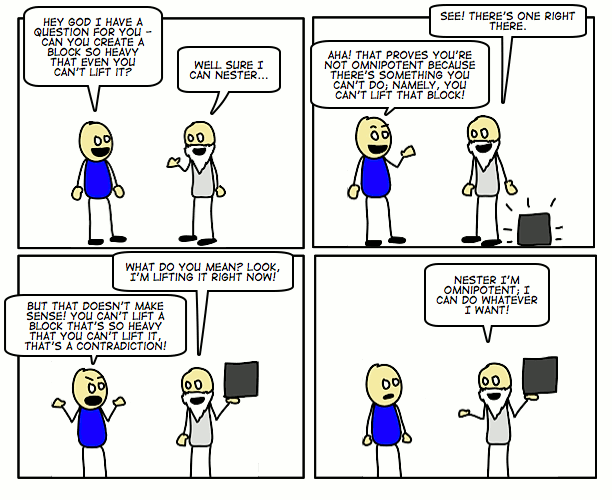
Second, when a particular analysis does seem to be in line with the ordinary use of the term, the next question is whether the property described is self-consistent. For instance, many proposed analyses of omnipotence give inconsistent answers to the question of whether an omnipotent being could create a stone too heavy for it to lift. Third, it is necessary to determine whether omnipotence, so understood, could form part of a coherent total religious view. Some analyses of omnipotence require that an omnipotent being be able to do evil, or to break promises, but God has traditionally been regarded as unable to do these things. It has also been argued that the existence of an omnipotent being would be inconsistent with human freedom. Finally, divine omnipotence is one of the premises leading to the alleged contradiction in traditional religious belief known as the Logical Problem of Evil.
A successful analysis of omnipotence is one which captures the ordinary notion, is free from internal contradiction, and is compatible with the other elements of the religious view in which it is embedded.
—Internet Encyclopedia of Philosophy - Omnipotence Definition
It is important to note that the claim of possibility and impossibility aren't in the ordinary sense, but rather in the metaphysical sense. For example, something like human flight is impossible for us, but it is not the kind of impossibility when referring to an omnipotent, because such a thing is not logically contradictory. The impossibility concerns things that do not fit into any possible world, such as a triangle whose hypotenuse is greater than the sum of its legs, a larger square fitting perfectly into a smaller circle, or anything that violates classical logical principles like non contradiction. A helpful concept to understand here is the notion of a "possible world," a term later developed by Gottfried Leibniz.
The writer C.S. Lewis, best known for The Chronicles of Narnia, also addressed the issue of omnipotence. In his book The Problem of Pain, Lewis took a position similar to that of Aquinas.
In this case the ideology is that any illogical application is pure nonsense and not something that one can use to dismiss the power of an omnipotent (in this case God). One might object that if omnipotence is restricted or conditioned by something external to itself, then it is not truly omnipotent. This is a reasonable concern from a semantic standpoint. However, it is important to recognize that the argument is that nothing external to omnipotence can constrain it; the only thing as great as omnipotence is omnipotence itself. Following this line of reasoning, many scholastic philosophers hold that God must be identical with the necessary laws that govern existence, because these laws are above all else. One can argue that the fundamental principles of logic and mathematics are not external rules to which God (an omnipotent) is subjected, nor abstract objects that limit them, but rather are reflections of one's own reasoning. They are aspects of the divine mind.
The Anti-Scholastic View: Universal Possibilism, Dialetheism, and Paraconsistent Logic
This perspective follows that an omnipotent (in this case God) can invalidate all logical understanding an pull things that are not possible. The illogical view of omnipotence holds that God could violate even the most fundamental laws of classical logic, such as the law of non contradiction, the law of excluded middle, and the law of identity. It also allows for mathematical impossibilities, such as a triangle whose hypotenuse exceeds the sum of its legs, logical impossibilities, such as making a rock it itself cannot lift and effectively ignoring and applying by all paradoxes.
Such things include calling blasphemy for suggesting that God could not undo what has already been done, that is, change the past and classic logic calls blasphemy for attemtping to impose limits on God.
There were also arguments that that God, being infinite, is the coincidentia oppositorum—the coincidence of opposites. This means that God must possess all existing properties, including both being and non being, both positive and negative. This logically includes properties that contradict each other. In this way, it would be possible for God not only to be contradictory, but also to create contradictory objects.
One might think of omnipotence as the ability to perform all acts that can be expressed by words that assume consistent meaning in potency, and to carry them out, it is enough for that power to be in act. This line of thought could explain certain paradoxes, such as the stone paradox, where God has within Himself both the act of creating the stone and the act of lifting it.
There are two philosophical currents that can apply under the anti-scholastic view of omnipotence: paraconsistent logic and dialetheism.
Paraconsistent logic challenges this standard view. A logical consequence relation is said to be paraconsistent if it is not explosive. Thus, if a consequence relation is paraconsistent, then even in circumstances where the available information is inconsistent, the consequence relation does not explode into triviality. Thus, paraconsistent logic accommodates inconsistency in a controlled way that treats inconsistent information as potentially informative.
The prefix ‘para’ in English has two meanings: ‘quasi’ (or ‘similar to, modelled on’) or ‘beyond’. When the term ‘paraconsistent’ was coined by Miró Quesada at the Third Latin American Conference on Mathematical Logic in 1976, he seems to have had the first meaning in mind. Many paraconsistent logicians, however, have taken it to mean the second, which provided different reasons for the development of paraconsistent logic as we will see below.
Paraconsistent logic is defined negatively: any logic is paraconsistent as long as it is not explosive. This means there is no single set of open problems or programs in paraconsistent logic. As such, this entry is not a complete survey of paraconsistent logic. The aim is to describe some philosophically salient features of a diverse field.
—Standford Encyclopedia of Philosophy Paraconsistent Logic Defintion
Paraconsistent logic is a non classical logic that accepts and treats contradictions without everything becoming trivial. A logic is paraconsistent if its consequence relation is not explosive, meaning that from a contradiction, anything follows.
Dialetheism is the view that there are dialetheias. If we define a contradiction as a couple of sentences of which one is the negation of the other, or as a conjunction of such sentences, then dialetheism amounts to the claim that there are true contradictions. As such, dialetheism opposes—contradicts—the Law of Non-Contradiction (LNC), sometimes also called the Law of Contradiction. The Law can be expressed in various ways; fixing the precise formulation is itself a topic of debate (Priest et al. 2004, Part II). Thomas Reid put the LNC in the form ‘No proposition is both true and false’. A strong (modal) statement of the LNC is: for any A, it is impossible that both A and ¬A be true. In Book Γ of the Metaphysics, Aristotle introduced (what was later to be called) the LNC as “the most certain of all principles” (1005b24)—firmissimum omnium principiorum, as the Medieval theologians said. Since Aristotle, there have been few sustained attempts to defend the law. The LNC has been an (often unstated) assumption, felt to be so fundamental to rationality that some claim it cannot be defended, e.g. David Lewis 1999. As a challenge to the LNC, therefore, dialetheism assails what most philosophers take to be unassailable common sense, calling into question the rules for what can be called into question (cf. Woods 2003, 2005; Dutilh Novaes 2008).
Since the advent of paraconsistent logic in the second half of the twentieth century, dialetheism has been developed as a view in philosophical logic, with precise formal language. Dialetheism has been most famously advanced as a response to logical paradoxes, in tandem with a paraconsistent logic. The view has been gaining, if not acceptance, the respect of other parties in the debate; one critic writes that dialetheists have shown,
- as clearly as anything like this can be shown, that it is coherent to maintain that some sentences can be true and false at the same time. … [A]nd that perhaps is a radical conclusion, and a major advance in our understanding of the issues. (Parsons 1990)
—Standford Encyclopedia of Philosophy Dialetheism Defintion
Dialetheism is the view that there are true contradictions, that is, some statements can be both true and false at the same time.
Recent developments have revealed limitations in classical logic and in Aristotelian principles such as non contradiction, which has encouraged mathematicians to develop paraconsistent logic, which deals with the explosive nature of contradictions, and dialetheism, which accepts that contradictions can be real. Examples of such applications include self referential paradoxes, like the Liar Paradox:
- Proposition is false.
Or:
- Proposition is true.
- Proposition is false.
This paradox forces us to conclude that a statement can be both true and false, which clearly violates the law of non contradiction. This demonstrates a limitation in the principle of non contradiction when applied to language. One argument is that if human language itself can generate contradictions that violate non contradiction, why could omnipotence, a transcendent quality, not also violate that law?
Another example is Russell's paradox, which gives rise to the Barber Paradox:
Consider a city with only one barber, where men can only shave in one of two ways: either by shaving themselves or by going to the barber. This barber does not shave anyone who shaves alone, and shaves all those who do not shave alone. Then who shaves the barber? If the barber shaves himself, then he does not belong to the group of people he shaves. If he does not shave himself, then he belongs to the group of people he shaves.
This is not limited to language. Paraconsistent logic is also used in computing and artificial intelligence.
We also find situations in quantum physics where the principle of non contradiction appears to be violated, as in the famous thought experiment of Schrödinger's cat, where the cat is considered both alive and dead until observed. Similarly, wave particle duality in quantum mechanics shows that a quantum object can behave both as a wave and as a particle.
Dialetheism, however, does not claim that all contradictions are true. It must be distinguished from trivialism.
In conclusion, there is sufficient philosophical and logical basis to support the view that omnipotence could violate the principle of non contradiction. For this to be possible, it would be enough for omnipotence to be paraconsistent. Since paraconsistency is itself a branch of logic, we cannot even claim that this view is "illogical," because logic as a whole encompasses far more than just classical and Aristotelian principles.
The View Used Here
As there are many different views all with their own equally valid interpretation, the question would be how the Codex's view of it works.
Omnipotence is simplified in a sense that it is all encompassing and all-powerful, surpassing both the logical and illogical, thus any paradoxes and such are due to it's inexplicable and unexplainable nature.
Thus this wiki naturally applies more to the anti-scholastic ideals of the concept.
Addressing the Omnipotence Paradox

One of the claims that people make about Omnipotence is that it would be impossible. They try to create logical contradictions by conjuring hypothetical scenarios that should debunk this idea with impossible or self-contradicting situations. We will cover the most common example just to show what's wrong with the way people address the concept of Omnipotence.
"God obeys the laws of logic because God is eternally logical in the same way that God does not perform evil actions because God is eternally good. So, God, by nature logical and unable to violate the laws of logic, cannot make a boulder so heavy he cannot lift it because that would violate the law of non contradiction by creating an immovable object and an unstoppable force."
If God cannot do any evil as any act done by God is therefore good. Then, God cannot do any contradiction as even if God does an act we view as a contradiction, it will be not be one as God did it. The simple way to put this is that God sets Gods own truth on the matter. We cannot enforce logic onto God as that would be self-defeating of the idea of how Omnipotence works. It would treat logic as something that be set as superior to God, meaning God wouldn't be all-powerful considering God is bound by a supposed superior force of logic. Utilizing paradoxes to say Omnipotence doesn't exist isn't a proper reason to not include it on this wiki.
While one could argue with the scholastic vision of omnipotence where these paradoxes would be applying nonsense and thus can be dismissed, the introduction of concepts such as paracosistency and dialetheism which are backed by ideas such as the Schrödinger's cat experiment, shows us that we do not have the full picture yet of all logical basis and thus it is easier to conclude God transcends both the logic and illogical.
This can also be shown with concepts such a Monad.
Questions Related to Omnipotence
Could an omnipotent being create a stone they can not even lift?
Yes*
An omnipotent being can do anything they so wish, the very concept of creating a stone even they cannot lift would apply and they would be able to lift it anyways as they are omnipotent. Attempting to claim they cannot would be bounding the omnipotent being to logic and thus removing
Could an omnipotent being create another omnipotent being?
Yes*
An omnipotent being can do whatever they please, thus they can make another omnipotent being, though it would be the omnipotent being. As an infinite set that transcends and encompasses all possible properties, there can be nothing external that opposes an omnipotent. In other words, it can create a being with the same properties as it, but from the point that this being has the same properties as it, that being would be nothing more than itself. This is similar to the principle of the "Law of Identity".
Could an omnipotent renounce its omnipotence?
Yes*/Depends on the viewpoint
It has been shown in certain works in Christian theology that Jesus can renounce his godhood to become a man. In Christianity, Jesus is considered God (John 1:1), and became man (John 1:14), emptied of himself (Philippians 2:5-7). From the point where he became man and emptied himself, he was renouncing his attributes, similarly, the same omnipotent can be omnipotent again, as it also happened later. However, there are others that disagree with the doctrine of the Holy Trinity. In a case like this the question would become if they renounced their omnipotence, how would they get it back? In truth it would be an illogical state of the self they discarded has renounced their omnipotence and is no longer apart of their omnipotent self and gains it back by merging back with it. In this case the omnipotent has technically renounced it's omnipotence but also keeps it as there exists an all-encompassing infinite being and a discarded self that is no longer truly the omnipotent being.
Could an omnipotent kill itself?
Yes*
Similarly to the stone paradox, an omnipotent can kill itself. As an omnipotent is everything, it contains both "death" and "life". Thus the omnipotent can kill itself and would still be alive and even though it is alive it did kill itself.
What would happen in a fight between two omnipotent?
Incoherent
- An omnipotent being encompasses everything so for there to be two omnipotents that encompass everything means that they are both the same being, there would realistically be no "fight".
Conclusion
One would likely note the asterisks (*) placed next to each answer, this is due to the fact that it is technically a yes but in a way that cannot abide by logical standards.
How Fictional Characters Could Have This
One of the possible confusions people often postulate is asking how there could be multiple "Omnipotent" beings when it comes to indexing. However, such a dilemma can be answered wit multiple ideas, a pretty common one being the Omni-Creator. This idea is basically that all supreme entities are the same being and that the appearances in other media would be the preferable forms they take for that specific series. As an omni-dimensional being, an Omnipotent being would be capable of this if we applied such an idea. This guarantees the sacrosanct unicity of Omnipotence, removing all potential paradoxes, and notably explains how crossovers are possible in the first place, and why local Omnipotents never fight one another as they are the same being.
The other answer is simple, it's a fictional series that does not have other series in mind. In the works of Journey to the West there is nothing suggesting Macbeth exists in it, as these are completely different author and cultures that have never met nor are likely fully aware of the other.
References
- ↑ LEWIS, Clive Staples. The Problem of Pain. 1940, The Centenary Press.