Vampire Killer

|
"Mature Content" |
| This character or verse has mature themes and concepts, thus those of young age are ill-advised to look through these. |

| “ | A whip that destroys all that is associated with the dark creatures of the night. As a result of an ancient blood pact, it can only be used by a Belmont. | „ |
| ~ Dawn of Sorrow library entry |
Background
The Vampire Killer whip, also known as the Belmont Family Whip, Holy Whip, Mystical Whip, and formerly known as the Whip of Alchemy, is a recurring legendary whip in the Castlevania series.
Originally created as the Whip of Alchemy by an alchemist named Rinaldo Gandolfi, in order to slay the Vampire King Walter Bernhard, it was eventually passed down to Leon Belmont. The whip was fond of Leon and grew more powerful as a result of being wielded by him, but was still not powerful enough to defeat Walter.
Eventually, Leon found that Walter had transformed Leon’s betrothed, Sara Trantoul, into a vampire. Eager to preserve her soul in any way that he could, Leon turned to Rinaldo, who suggested that Sara’s vampiric soul be infused within the Whip of Alchemy before she died.
After doing so, the Whip of Alchemy grew a great hatred towards anything related to the creatures of the night, and became known as the Vampire Killer. Leon would go on to not only defeat Walter Bernhard, but spark up the feud with Count Dracula (then known as Mathias Cronqvist) that would last the next thousand years.
The Vampire Killer whip went on to be passed down through generations of Belmont’s, each wielding it to destroy creatures of the night. Eventually, however, Richter Belmont grew to believe that he was not worthy of the whip, and gave it away to the Morris Clan.
For a brief time, the Morris Clan was in possession of the Vampire Killer whip, although that clan was not recognized as worthy of the whip and thus it began to slowly drain their lifeforce. Come the 21st Century, the whip, was returned to the Belmont Clan in the hands of Julius Belmont, who is the last known wielder.
General Information
Name: The Whip of Alchemy[1]
Origin: Castlevania: Lament of Innocence
First Appearance: Castlevania: Lament of Innocence
Latest Appearance: Castlevania: Lament of Innocence
Company: Konami
Creator: Hitoshi Akamatsu, Koji Igarashi
Age: Unknown
Time Period: 1094
Timeline: Main Timeline
Legacy: Unknown Legacy
Influence: Event Influence (The whip gave Leon Belmont the power to fight against the creatures of the night)
Language: N/A
Classification: Alchemy Whip[2]
In-Universe Creator: Rinaldo Gandolfi[3]
Wielders: Rinaldo Gandolfi, Leon Belmont
Height: Unknown
Weight: Unknown
Status: Other (The Whip of Alchemy was transformed into the Vampire Killer[4])
Protection Level: Global Protector (Used by Rinaldo and Leon Belmont to stop night creatures such as Walter Bernhard)
Name: The Whip of Alchemy[5] (formerly), The Vampire Killer[6], Belmont Family Whip
Origin: Castlevania
First Appearance: Castlevania NES (Game release wise it's first appearance), Castlevania: Lament of Innocence (Chronologically its first appearance)
Latest Appearance: Castlevania: Grimoire of Souls, Castlevania: Nocturne (Non-Canon Netflix Adaptation)
Age: 964 years old
Time Period: 1094 (During Lament of Innocence), 1476 (During Dracula's Curse), 1479 (During Curse of Darkness), 1576 (During The Adventure), 1591 (During Belmont's Revenge), Late 1600s (During Order of Shadows), 1691 (During Castlevania), 1698 (During Simon's Quest), 1748 (During Harmony of Dissonance), 1792 (During Rondo of Blood/The Dracula X Chronicles), 1797 (During Symphony of the Night), 1798 (During Nocturne of Recollection), 1830 (During Circle of the Moon), 1852 (During Castlevania (N64)), Late 1800s (During Order of Ecclesia), 1917 (During Castlevania: Bloodlines), 1944 (During Portrait of Ruin), 1999 (During the Big War), 2035 (During Aria of Sorrow), 2036 (During Dawn of Sorrow), 2037 (During Requiem of the Divine Abyss)
Timeline: Main Timeline, Legends Timeline, & Circle of the Moon Timeline
Legacy: Worldwide Legacy (The Vampire Killer is well known throughout the world, with characters being able to instantly tell the whip and know who the vampire hunter is through it[7])
Influence: Event Influence (The whip gave Leon Belmont the power to fight against the creatures of the night)
Language: N/A
Classification: Legendary Whip
Creator: Created from a ceremony from[8] Rinaldo Gandolfi, Leon Belmont, and Sara
Wielders:
Leon Belmont, Trevor Belmont, Christopher Belmont, Soleil Belmont, Desmond Belmont, Simon Belmont, Juste Belmont, Richter Belmont, Reinhardt Schneider, John Morris, Jonathan Morris, Julius Belmont; every Belmont has the ability to wield it
Height: Unknown
Weight: Unknown
Status: Active
Protection Level: Global Protector (The whip is used by the Belmont Clan to hunt the night and protect the world from Dracula)
Codex Statistics
Key: Before Being Held by Leon Belmont | After Being Held by Leon Belmont
Key Information
- Before Being Held by Leon Belmont: This key covers before the Whip of Alchemy was wielded by Leon Belmont.
- After Being Held by Leon Belmont: This key covers after the Whip of Alchemy was wielded by Leon Belmont.
Grade: A | A
Tier: At least 8-C, likely Far Higher | At least 8-C, likely Far Higher
Cardinality: Finite
Dimensionality: 3-D
Attack Potency: At least Building level (Potency), likely Far Higher (Noted to be stronger than any dead man's discarded sword[10], wielded by a Rinaldo Gandolfi who managed to use it to defeat his daughter while she was a vampire, where vampires are considered far larger threats than standard creature of the night monsters[11], which would put her above creatures such as Golem, from Castlevania Judgement, as he died to a random unknown hunter after his return from the time rift[12]. Golem with his ultimate can shoot out a mouth blast that vaporizes everything it touches as far as the eye can see[13] . Monsters like Gergoth[14], can be fought by an era of hunter[15], where Gergoth's mere stomps breaks large portions of the castle apart causing them to crash through multiple floors due to its sheer weight and size[14]) | At least Building level (Potency), likely Far Higher (The Whip became more powerful due to Leon holding it[16] to the point that Medusa noted that it wasn't so powerful before believing the whip gained its complete form[17]. Leon with it can fight and defeat Joachim Armster[18] where vampires are considered far larger threats than standard creature of the night monsters[19], which would put her above creatures such as Golem, from Castlevania Judgement, as he died to a random unknown hunter after his return from the time rift[20]. Golem with his ultimate can shoot out a mouth blast that vaporizes everything it touches as far as the eye can see[21] . Monsters like Gergoth[14], can be fought by an era of hunter[15], where Gergoth's mere stomps breaks large portions of the castle apart causing them to crash through multiple floors due to its sheer weight and size[14]. . Monsters like Gergoth[14], can be fought by an era of hunter[15], where Gergoth's mere stomps breaks large portions of the castle apart causing them to crash through multiple floors due to its sheer weight and size[14]. Can fight and defeat a golem[22] who should be relative to the Golem from Castlevania Judgment)
Durability: At least Building level, likely Far Higher (Unable to be broken) | At least Building level, likely Far Higher
Range: Extended Melee (The typical whip is around 90 centimeters). At least Tens of Meters with Elemental attacks (The Elemental Attacks create massive AoE attacks[23] massive iciciles[24]. being able to freeze stone solid with a single touch[25] and create thunder attacks from the sky[26])
Key: Leather Whip | Vampire Killer
Key Information
- Leather Whip: This key covers the leather whip form of the Vampire Killer, a weaker form it takes with inexperienced Belmonts[27].
- Vampire Killer: This key covers the true form of the Vampire killer, the form it takes once a Belmont has fully gained its power[28].
Grade: S (Can harm anything related to vampires, even if they are a divine being[29]. A whip that is the bane of the children of the night[30])
Tier: At least 8-C, likely Far Higher | At least 8-C, likely Far Higher. Even Higher with each new wielder
Cardinality: Finite
Dimensionality: 3-D
Attack Potency: At least Building level (Potency), likely Far Higher (For more inexperienced users, the whip takes the form of a leather whip, being a weaker form[31], though wielders such as Desmond Belmont can fight the likes of Dracula's minions such as Medusa[32], who serves as one of the four pillars that guard the castle, being ranked by her prevailing magic powers[33], with such ranking putting her above the likes of Golem from Castlevania Judgement, as he died to a random unknown hunter after his return from the time rift[34]. Golem with his ultimate can shoot out a mouth blast that vaporizes everything it touches as far as the eye can see[35] . Monsters like Gergoth[14], can be fought by an era of hunter[15], where Gergoth's mere stomps breaks large portions of the castle apart causing them to crash through multiple floors due to its sheer weight and size[14]) | At least Building level (Potency) (Once turned into the Vampire Killer, it became a whip that was a bane of the children of the night[36]. Leon could use it to fight and defeat the Forgotten One[37], a man-made monster eternally sealed away due to an enormous uncontrollable power[38], making it superior to Walter Bernhard), likely Far Higher (Can harm enemies stronger than characters who can take hits from neutron bomb[39], that have a yield range of 1-10 kilotons of TNT). Even Higher with each new wielder (As Dracula grows stronger each time he revives, the Belmonts have had to keep up, meaning that the Vampire Killer also grew stronger overtime[40])
Durability: At least Building level, likely Far Higher (Unable to be broken) | At least Building level, likely Far Higher
Range: Extended Melee (The typical whip is around 90 centimeters). At least Tens of Meters with Elemental attacks (The Elemental Attacks create massive AoE attacks[41] massive iciciles[42]. being able to freeze stone solid with a single touch[43] and create thunder attacks from the sky[44])
- Superhuman Physical Characteristics
- Non-Standard Interaction
- Metaphysical Interaction: The Whip of Alchemy can interact with ghost[45].
- Elemental Interaction: The Whip of Alchemy can interact with enemies that are the mist itself[46].
- Air Manipulation (The Alchemy whip can create a large gust of wind with its finishing attack in a combo[47]. The Alchemy whip can create wind blades around its user to protect them from all directions[48])
- Light Manipulation (The Alchemy whip can bring down holy light to attack the enemy[49])
- Holy Manipulation (Holy Whips cannot be touched by people weak to holy magic or else it will burn their hands and cause them to disintegrate[50]).
All previous powers and abilities to a greater extent.
- Superhuman Physical Characteristics
- Anti-Type Weaponry (Can harm and kill anything related to vampires, even if they are a divine being[52])
- Extrasensory Perception (The Vampire Killer can sense who is a vampire[53], even those who are half-vampire such as Alucard[54])
- Magic (The Vampire Killer has been referred to as a magic whip[55])
- Contact Damage (Just through enemies merely touching the Vampire Killer they will be damaged by its effects[56])
- Non-Standard Interaction
- Abstract Interaction: Can interact with and kill Death, the abstract concept of death.
- Metaphysical Interaction: The Vampire Killer can interact with the creatures of the night[57] which includes[58] ghosts[59]. This is also shown in Haunted Castle Revisited[60]. Noted by Simon Belmont that the Vampire Killer will cleave one's soul[61].
- Elemental Interaction: The Vampire Killer can interact with creatures of the night made of sand[62]. Can interact with creatures of the night made of fire[63]. Can fully disperse and destroy water bubbles instead of the attack just going through it[64].
- Blood Interaction; Can harm and kill enemies made of blood[65].
- Nullification
- Invulnerability Negation: The Vampire Killer can completely remove Walter's invulnerability[66] to where he was immune to all other[67] weapons prior other then the Vampire Killer[68].
- Power Nullification: Julius sealed the Vampire Killer within Dracula's castle in order to rip away Dracula's soul and magic[69].
- Energy Nullification: Should be comparable to other magical whips that have been used to negate Dracula's Demonic Megiddo[70]. The Vampire Killer can nullify energy projectiles through hitting them[71], even those from Dracula[72]. Can negate fire projectiles[73].
- Electricity Nullification: Can completely disperse and nullify electricity attacks[74].
- Seal & Forcefield Nullification: The Vampire Killer can easily break open barrier seals[75].
- Transformation Nullification: Christopher with the Vampire Killer injured Dracula so bad to the point that he was unable to transform back into "human" form[76].
- Abstract Nullification: The Vampire Killer can nullify and destroy the scythes from Death, who can use his scythes to kill abstractions such as distance and sound[77].
- Pain Immunity Nullification: The Vampire Killer can make the White Dragon visibly react to pain[78] and scream out in pain, where it is an immortal being immune to pain and suffering[79])
- Regeneration Negation (Holy; Christopher with the Vampire Killer injured Dracula to the point that his powers were greatly depleted and he was unable to do things like simply transform back into "human" form[80]. Juste with the Vampire Killer could permanently kill Dracula's Wraith to where he'll fade from the world for good who regenerated from the complete destruction of his body[81])
- Immortality Negation
- Ageless & Life and Death Immunity: The Vampire Killer can render immortal skeleton death gods like Death, mortal, having him bleed from attacks, giving him mortality as shown when Death dies to his own scythe cutting off his head and having blood spurt out, something not possible as a skeleton[82]. The Vampire Killer can kill Death to the point that he requires Mathias to survive in order for him to rise from the dead[83]. Death is a being unconstrained by mortality[84].
- Immortal Metaphysical Aspect: Can harm and kill anything related to vampires, even if they are a divine being[85].
- Resurrection Bypassing (The Vampire Killer can kill zombies[86], who are corpses brought back to life from the power of hate[87])
- Purification (The Vampire Killer can purify people who was turned into a monster[88]. Christopher with the Vampire Killer purified his son of the evil effects of Dracula[89])
- Fire Manipulation (Enemies fade into fire upon being struck with the Vampire Killer[90]. Enemies burst into flames when struck by the vampire killer, with the flames attaching to anything it's connected to, such as a spider having its webs burst into flames too[91]. The whip can have fire burst around the enemies even without them dying[92]. Causes even objects like coffins to burst into flames[93]. This is even shown in Lament of Innocence, once Leon has the vampire killer[94]. This is even shown in graphic novels such as Belmonts Legacy[95])
- Explosion Manipulation (Trevor swinging the whip at the ground caused the ground to explode[96])
- Memory Manipulation & Soul Manipulation (The Vampire Killer holds the souls of the many Belmonts who once wielded it[97], the Vampire Killer could also possibly hold the souls of Belmonts who have not even touched it yet, as it was originally planned to have it summon Julius from the future but they ultimately didn't go with the idea)
- Lifeforce Absorption (Even if the The Vampire Killer accepts one as its master, it still chips away at one's life force with every lash[98]. One must sacrifice their lifeforce in order to wield it[99])
- Deconstruction (The Vampire Killer can reduce one to just a skeleton[100])
- Light Manipulation (The Whip can create orbs of light to light up torches[101])
- Fire Manipulation (With Whip of Flames[105], adds fire elemental damage onto the Whip of Alchemy and Vampire Killer[106]. Being able to melt the ice off an ice blocked door in the Dark Palace of Waterfalls[107], along with setting stone itself on fire[108])
- Ice Manipulation (With Whip of Ice[109], adds ice elemental damage onto the Whip of Alchemy and Vampire Killer[110]. Being able to freeze stone solid with a single touch[111])
- Absolute Zero (As the whip of ice is obtained from the ice elemental, a greater demon that harnesses artic chill[112], putting them above the Frost Demon, a demon that wields absolute cold[113] and a total command of cold[114], making it superior to the likes of Cyril who can wield absolute zero and is seen as a standard ability from a creature of the night[115]. Along with this to protect against ice attacks in series, one normally wears rings that help them resist against absolute zero[116])
- Electricity Manipulation (With Whip of Lightning, adds lightning elemental damage onto the Whip of Alchemy and Vampire Killer[117])
- Ice Manipulation (With Blue Stone, adds ice to attacks made with a whip[118])
- Air Manipulation (With Green Stone, adds wind to attacks made with a whip[119])
- Fire Manipulation (With Red Stone, adds fire to attacks made with a whip[120])
- Electricity Manipulation (With the Yellow Stone, adds lightning to attacks made with a whip[121])
- Energy Projection (With the Bullet Tip[122], can fire an energy projectile from the whip when at maximum health, using the soul of Christopher Belmont[123][124])
- Statistics Boost (With Crushing Stone[125], enhances the whip with a charged attack that can break through stone[126])
Other
Weaknesses: Inexperienced Belmonts cannot draw the full power from the Vampire Killer, with it taking a weaker form for them[127]. Can only be wielded by those it deems worthy, anyone who it deems unworthy, will have their lifeforce, slowly drained from them[128]. One will have a harder time using the whip to strike theose who carry the Lecarde family[129].
Note
- Contrary to popular belief, holy attacks and the whips in Castlevania can affect and harm people that aren't apart of the creatures of the night. Leon's doppelganger can use holy water and holy attacks against him in this fight along with the alchemy whip despite Leon being a pure and noble warrior[130]. Simon's doppelganger can harm him with the vampire killer, despite Simon being a noble hero. Holy Water even works and harms enemies such as the "Holy Armor"[131], a knight who has natural holy powers[132]. Corrupted enemies such as Charlie Vincent, use holy water attacks on Carrie and Reinhardt[133]. Characters like Jonathan Morris wear armor like the Holy Mail, an armor that reduces damage from holy attacks[134].
- The Sky Fish feat moving so fast that it appears as a beam of light and only slows once time is stopped[135] is a natural indication of Faster Than Light travel as at the speed of light, time is zero from its perspective. Soma Cruz having a hard time catching up with it initially does not mess with his scaling either as we know it's an unquantifiable level into Faster than Light at the most.
Explanation
Usage of games like Castlevania Legends & Castlevania: Circle of the Moon
Castlevania Legends
The game was originally meant to be a prequel to all the other games in the Castlevania series, this can be seen with Sonia's boss fight against Dracula serving as the first time Dracula ever encountered a Belmont along with the ending of the game saying "this story marks the beginning of the Belmont family legend that has been passed on through many ages". Along with this, Sonia shared a relationship with Alucard, heavily implying that her child is between her and Alucard. The existence of Lament of Innocence already greatly messes with this. The game manual even mentions that Sonia was the first of the Belmont family to leave her name to posterity as a vampire hunter[136]. Despite Leon Belmont being the one to start the legend of the Belmont Hunters being vampire hunters. Along with this, Trevor is canonically the first Belmont to defeat Dracula. Iga has gone out of his way to note too that Castlevania Legends was intentionally redacted from the timeline so that it doesn't conflict with the timing used in other titles.
Castlevania: Circle of the Moon
Although it was in the original 2006 timeline, it was removed by Iga from the timeline, along with Castlevania (N64), Legacy of Darkness, and Legends.
Why abilities from them are still usable for main timeline
These games were at one point officially a part of the original timeline before ultimately being removed, making them hypotheticals that could be done. This is further supported by an interview in the History of Castlevania - Crescent of the Moon book, where executive producer of Castlevania Netflix Adi Shankar noted that even the "non-canon" games are parallel timelines in the overall multiverse, sharing the same spirit and lore[137]. While one could argue his statement shouldn't be used, it comes from a book titled, "History of Castlevania - Crescent of the Moon", where it wouldn't make much sense if his statement was wrong and there was no correction over it. The book even has asterisks to give further context, yet they never claim him wrong. Along with this, it's consistent with the fact that most of the Castlevania games that are "non-canon" now were originally a part of the timeline. Thus this statement is usable. Thus abilities and the likes from these games can carry over to the main timeline games.
Trivia
- According to a statement made by the head director of the three Famicom Castlevania games, Hitoshi Akamatsu, the inclusion of the whip as the player's weapon of choice is a reference to Indiana Jones, a fictional action-adventure film character who is famously known to wield a bullwhip.
- The first official instance in which the whip was referred to by the name "Vampire Killer" was in Castlevania: Bloodlines, where it appears as such in the instruction booklet and in the game itself of both the US and Japanese versions (the US version was actually released one day before the Japanese version, on March 17 and 18 of 1994, respectively).
- However, technically, the very first time the name "Vampire Killer" was used to refer to the whip would be on a worldbuilding document sent to Electronic Gaming Monthly and other publications.
- According to an internal document[138] shared by Konami's Chicago offices to Electronic Gaming Monthly as part of the prerelease of Castlevania: Bloodlines, the original intention was for there to be three whips throughout the series. The Vampire Killer would have been the Morris Clan's replica of the Belmont whip, here referred to as Excalibur in the document.
- In Super Smash Bros. Ultimate, both hilts of Simon and Richter's Vampire Killers were redesigned to resemble their Lords of Shadow series counterpart, Gabriel's Combat Cross, while the chain whip part is the fully upgraded version of the whip from the main series.
Misconceptions
"Gaiden" means "Non-Canon" or "Alternate Timeline"
This stems from the belief that when Iga or a producer calls a Castlevania game a "Gaiden" it is therefore non-canon or an alternate timeline and can be dismissed. This, however, is not the case.
The term "Gaiden" merely just means a side story, spin-off, or a separate tale. The term "Gaiden" does not determine the canonicity of a work, it just lets you know if the game is a spin-off/side-story or if it's a main story. Take, for instance, the Kingdom Hearts series. Kingdom Hearts: Chain of Memories would be considered a gaiden, as it's a side-story and spin-off title that isn't a mainline numbered title, however, it is in all manners canon and important to play to understand Kingdom Hearts II.
The same can be applied to Castlevania itself, Castlevania Symphony of the Night is a gaiden game. Yet it is very obviously canon and pretty important to play to understand more of Alucard's backstory. The idea of a Gaiden game for the Castlevania series itself would be any game not dealing with one of Dracula's main 100-year-resurrections, which in this case, even Castlevania 2: Simon's Quest is in a way a gaiden, despite being completely canon.
This is all to say that Gaiden does not at all mean "non-canon" or "alternate timeline" and should never be treated as such, the term itself has nothing to do with the canonicity of a product.
IGA Statements Quoted by a Fan
Any statements Iga has made about Judgment that don't come from this IGN interview or a sourced and reputable article are not usable. This is, of course, referring to the popular statements used when discussing Judgment's Canoncity about a fan asking IGA about the game's Canoncity on Facebook, here are some of them below:
- Fan: You mentioned Legend of Cornell was an alternate continuity. However, Cornell appears in Castlevania Judgment, which I believe is not an alternate continuity. How does that work? is he from a different universe than the other characters? It is not really explained in the game itself so I was hoping you could give some clarification on the issue.
- IGA: Judgment is a work that surpasses space and time and brings them together.
- Fan: I get it. So, is the explanation I suggested in the previous reply possibly correct?
- IGA: I don't think it's exactly correct. Judgment is a work born of thinking it would be fun to remove all the hedges and bring characters that appeared throughout the series together. I think that you need to view it as an event from another world which does not consider things like timelines or parallel dimensions at all.
Now these seem like pretty clear-cut statements until you start to try to find where these come from.
They come from both a timeline archive discussion on the Castlevania Wiki back on January 15th, 2012 and from a forum post from the same user as the wiki article.
There is no way to find anything sourced or verifiably proven that this person spoke to Iga. Trying to look up the person didn't get any real results either.
Some other issues fall under the inconsistencies within these Iga talks, the person claims that Iga confirmed that Order of Shadows and the Arcade are non-canon because they were intended from the very beginning to be such, however, an officially sourced interview has the lead game designer of Order of Shadows state that Iga was actively involved with ensuring the game was consistent with the current canon, this would be a weird thing to do if he intended it to be non-canon from the very beginning.
He also claims that Iga said Super Castlevania IV was an alternate continuity, when the wiki also notes Iga saying that the games are all legitimate and the same scenario of defeating Dracula, however this quote is also unsourced, they just claim Iga says this with no link or anything.
There is another one not related to the user who spoke to Iga, but a user on reddit who claimed that a magazine claimed that Castlevania: Circle of the Moon was stated to be in a "different time axis". Attempting to get it translated got no wording that said anything like that, with it not even mentioning anything about canon, timeline, time axis, or any other wording of the sort in a machine-translated attempt. Do note however that this is a machine translation so it could potentially be that it is there, but until a reputable and verifiable translator can confirm or deny this translation, the jury is out with it and it will not be used for the canoncity of Circle of the Moon.
Thus all of these quotes are merely hearsay until shown or proven otherwise.
Remakes/Remasters Being Non-Canon
This comes from an Iga quote that says:
- "IGA: FC版とX68000版ですが、X68000版はFC版をベースにアレンジを加えたものになっています。ゲームのアレンジは、その時に応じて、色々と施されるものですので、正直どちらも正統であると思ってよいのではないかと思っています。結論として、ドラキュラと戦い勝つというシナリオで、中間部分の切り抜きが違うと考えてもよいのではないかと考えています。スーパーファミコン版も違いますし…。どうしてもと考えるのであれば、FC版を尊重すべきかと考えます。
- Translation: Regarding the Famicom version and the X68000 version, the X68000 version is an arrangement based on the Famicom version. The arrangement of a game is the kind of thing where you add a lot of different things as needed, so honestly speaking, it think they both should be considered legitimate. In conclusion, I think they should be considered as the same scenario of fighting to defeat Dracula, just with a different middle part. The Super Famicom version is different as well... If you simply must have a clear answer, the Famicom version must be given deference."
Now the quote itself doesn't state remakes or remasters are non-canon despite what people believe. It's moreso a quote of Iga stating that all of them are the same scenario, just with differences. However, an interesting point is that Iga says the NES version should be given "deference", as in to defer to the NES version.
Of course, though, this has the same issue as the Judgment quotes, everyone claims Iga said this, but there is no source of him saying this. In fact, in Castlevania Chronicles, there's a reward interview you receive from Iga himself where he talks about the game, Iga pretty much explains how the game came to be and never says anything about the game not being canon or to defer to the original[139], if anything he treats this as just an updated version of the original. Interestingly to note too, the original he's talking about is not Castlevania on NES but instead, he's talking about the computer version of Castlevania[140], though it borrows a lot of elements from Castlevania NES.
Overall due to the quote itself having no source, it is unusable. The way we will treat remakes, remasters, or ports here however is that they are all equally canon unless stated otherwise. Most of these tell the same story with the only real differences being extra background information added, such as Haunted Castle having it be Dracula stole Simon's wife, though the same overall story still applies even here. Iga himself has already expressed that the original Castlevania's story is pretty simple[141] and Simon having a wife does not affect anything in the overall narrative. Super Castlevania IV notes that Simon is a vampire, though this was due to a novel writer making him a vampire in their novel. The novel was originally supposed to be an adaptation of Super Castlevania IV but was then dropped and made its own thing. Super Castlevania IV itself is still canon, but the subplot of Simon being a vampire is not. The most recent timeline even acknowledges it as canon[142].
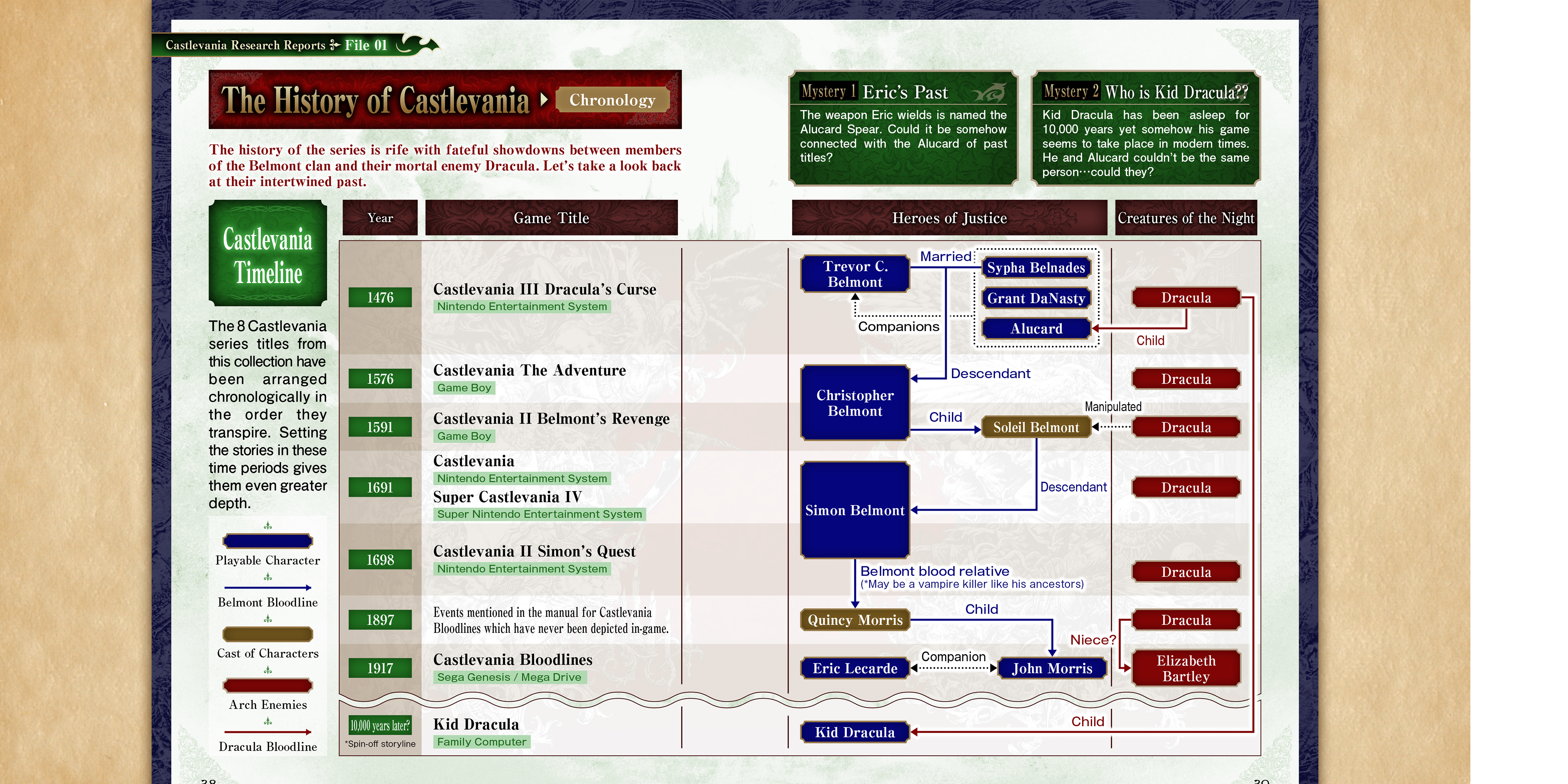
Iga Only Allows Stuff He Works on To Be Canon
There is a weirdly believed idea in the fandom that Iga only considers works he worked on canon, however, an officially sourced interview has the lead game designer of Order of Shadows state that Iga was actively involved with ensuring the game was consistent with the current canon, along with this Iga did not work on a lot of Castlevania games considered canon, such as the NES trilogy and the Gameboy games. In fact, he has only made 12 Castlevania games, out of the 30 Castlevania games in total, and most of them from the older console eras are still a part of the canon. Thus Iga does not only allow stuff he works on to be canon.
Iga is a Producer of Castlevania: Circle of the Moon
A Nintendo Power magazine calls Iga the producer of Circle of the Moon, with Iga talking like he worked on the game in that interview. However Iga can be found nowhere in the credits of the game. Making this Nintendo Power issue questionable as to if they were talking to Iga or if the game was mixed up. Though we have direct in-game proof that Iga was not a producer of Circle of the Moon.
Elements and Statements can be used from Lords of Shadows for the main continuity
This argument comes from Adi Shankar saying that even "non-canon" games are parallel timelines in the overall multiverse, sharing the same spirit and lore[143]. However, the Lord of Shadow games are directly noted in an interview with the lead developer, that the game has nothing to do with the canon, sharing none of the lore or original stuff for the characters. This directly conflicts with Adi Shankar's statement and it was very likely he was not even thinking of Lords of Shadows when making this statement but moreso games like Castlevania Legends. On top of this, Adi Shankar has no actual position within Konami, and being an executive producer for the Castlevania anime, thus he does not have any true say in terms of how Castlevania canon works and can only be used at most as a supporting piece of evidence.
Codex Statistics Questions
Q: Shouldn't the characters be around Tier 2 for defeating the Time Reaper who would've destroyed the very fabric of time[144], attempted to destroy the specific era of time[145], cause all beings everywhere to disappear, forever[146] and that the age was on the verge of collapse[147]?
A: We actually never get a direct outright method of Time Reaper's plan for doing this, from what Aeon mentions to Golem, if the Time Rift is not erased, all beings everywhere will disappear, forever[148], implying that it's the Time Rift causing this, this is further backed up by the fact that in Time Reaper's boss fight, there is a vortex in the background consuming everything[149], meaning this is an overtime feat that scales to no one physically.
Q: Shouldn't they get tier 2 for Dracula's influence destabilizing the flow of time[150]?
A: This is a potent ability but has nothing to do with Attack Potency, there is no quantification for "destabilizing the flow of time", along with this, even if it was taken as physically, then it would be overtime as the effects are not noticeable throughout most of Curse of Darkness. Thus this is merely potent Time Manipulation.
Q: Shouldn't Dracula and by proxy anyone that scales to him get tier 2 for him being able to sustain his castle?
A: This goes under our Stabilization Feats standards, which treats sustaining feats are non-combat applicable Attack Potency normally, though in Dracula's case the Castle is speficially powered by the existence of a Dark Lord, and doesn't necessarily need their strength to rise. In the Castlevania novel, the castle rose without a Dark Lord as an example. Along with this, no one scales to the collapse of the castle, in Curse of Darkness Hector would've died to the collapse of the castle if[151] Julia didn't come save him, and Isaac died within the castle[152]. In other cases the Castle does not collapse[153], but instead slowly fades away[154]. At the end of Dawn of Sorrow Soma Cruz and Genya Arikado (aka Alucard) must escape the collapsing abyss.
Q: Shouldn't Castlevania characters that scale to Death have Infinite speed due to Death being able to kill distance itself with his attacks?
A: Killing distance to attack is not a speed feat, it's a method of Spatial Manipulation by circumventing and ignoring distance, while one can say the attack spawns on you instantly, this is not really something quantifiable. Along with this, it would only scale to characters comparable to Death during post-Dawn of Sorrow, as Soma notes Death is far faster than he remembered from his fight with him in Dawn of Sorrow[155].
References
| Expand here. |
|---|
|