For any inquires on backlink exchange or partnerships please contact thecodex@gmail.com
The Wiki Forums are up! Check them here!
There is an official chat room on the wiki! I'm always AFK here so pull by to say hi!
If you would like to join the discord, please read this page.
Alice Margatroid
Alice Margatroid (アリス・マーガトロイド Arisu Māgatoroido) is a youkai magician who specializes in manipulating dolls. She resides in a house within the Forest of Magic, not far from Marisa Kirisame's home.
Alice first appeared in the PC-98 canon as the Stage 3 and Extra Stage boss in Mystic Square. She later reappeared in the Windows games, serving as both midboss (twice) and Stage 3 boss in Perfect Cherry Blossom. Since Imperishable Night, she has become a playable character in multiple titles, often teaming with Marisa, and also appears in Immaterial and Missing Power. Additionally, she acts as a possible supporting character for Marisa in Subterranean Animism.
| Alice Margatroid | |
|---|---|


 | |
| Origin | |
| Origin | Touhou |
| Creator | ZUN |
| First Appearance | Touhou 05: Mystic Quest |
| Actor | Fan-made Series:
Nichika Omori, Chiwa Saito, Asami Seto, Haruka Tomatsu, Nao Shiraki, Wakana Maruoka, Arisa Kiyoto, Aoi Koga, Miku Ito, Tomoyo Kurosawa, Saya Aizawa, Saori Sudo, Marika Hayase, Ayase Ito, Kaede Hondo, Yukina Shuto, Akiha Matsui, Marika Kono, Saki Fujita, Ikumi Hasegawa, Riho Sugiyama, Hyosei, Nina Nakabayashi, Teru Ikuta, Ayaka Ohashi, Tomomi Jiena Sumi, Ai Kauma |
| Characteristics | |
| Species | Magician |
| Gender | Female |
| Pronouns | She/Her |
| Sexuality | Unknown |
| Age | Unknown |
| Birthday | Unknown |
| Height | Fairly Tall |
| Weight | Unknown |
| Ethnicity | European |
| Status | Alive |
| Alignment | Neutral Good |
| Archetype | Magician |
| Occupation | N/A |
| Time Period | Non-linear |
| Language | Japanese |
| Combat Style | Magic Fighting |
| Homeworld | Makai (PC-98 Era), Gensokyo (Windows Era) |
| Relationships | |
| Affiliations | Marisa Kirisame, Shinki, Mima, Yuuka Kazami, Reimu Hakurei, Three Fairies of Light, Eirin Yagokoro |
| Enemies | Marisa Kirisame (Formerly), Mima (Formerly), Yuuka Kazami (Formerly), Reimu Hakurei (Formerly), Eirin Yagokoro (Formerly) |
Background
| This dropdown contains the synopsis of Alice Margatroid’s story. Read at your own risk as you may be spoiled otherwise! | ||||||||||||||||||||||||||||||||||||||||||||||||||||||||||||||||||||||||||||||||||||
|---|---|---|---|---|---|---|---|---|---|---|---|---|---|---|---|---|---|---|---|---|---|---|---|---|---|---|---|---|---|---|---|---|---|---|---|---|---|---|---|---|---|---|---|---|---|---|---|---|---|---|---|---|---|---|---|---|---|---|---|---|---|---|---|---|---|---|---|---|---|---|---|---|---|---|---|---|---|---|---|---|---|---|---|---|
|
Mystic Square
Alice first appears in Mystic Square during the third stage, introduced as a young-looking magician bearing the title "Girl of Death". She confronts Reimu, Marisa, Mima, or Yuuka as they invade Makai, but is defeated. She later reappears in the Extra Stage under the title "Alice of the Magic Land". Confident after obtaining her grimoire, she seeks to finally defeat the heroine, though she loses once again despite her preparations. {{#tag:tabber|
|-|First Windows Generation= Perfect Cherry Blossom 
In Perfect Cherry Blossom, Alice has no particular reason for fighting Reimu or Marisa, merely happening to be present when the protagonist passes through and thus becoming an opponent by chance. Immaterial and Missing Power
Alice investigates the unusual mist and the numerous festival banquets occurring that summer. She begins by looking into her neighbor, Reimu Hakurei, as well as Sakuya Izayoi, hoping to put a stop to the celebrations. Patchouli Knowledge suggests she try having a "nice, straightforward discussion" with the mist, offering Alice a subtle clue. She approaches Youmu Konpaku for assistance in communicating with a phantom the size of Gensokyo, but ultimately decides to head to the Hakurei Shrine, where the feast is scheduled to take place. There, she encounters and defeats Yukari Yakumo, who then forces the true culprit—Suika Ibuki—to reveal herself. Alice defeats Suika as well, resolving the incident. Imperishable Night  
In Imperishable Night, Alice senses something amiss with the Moon. After failing to investigate the matter on her own, she recruits Marisa by tempting her with rare grimoires. Alice thus becomes the youkai component of the Magic Team. After defeating Wriggle Nightbug and Mystia Lorelei on their way out of the forest, they reach the Human Village, where Keine Kamishirasawa attacks them. Entering the Bamboo Forest of the Lost, they encounter Reimu Hakurei, who mistakes them for the incident's perpetrators. Following her defeat, they proceed to Eientei and confront Eirin Yagokoro and Reisen Udongein Inaba. Depending on player choice, Marisa and Alice then face either Eirin or Kaguya Houraisan after defeating the lunar rabbit. Later, upon learning from Kaguya about a trial of guts taking place within the Bamboo Forest of the Lost, Alice and Marisa decide to return. There, they encounter and defeat Fujiwara no Mokou. Shoot the BUllet
Scarlet Weather Rhapsody
Observing scarlet clouds and chaotic weather, Alice suspects these phenomena may be precursors to an earthquake. She inquires about the scarlet clouds among various residents, including Reimu Hakurei, Youmu Konpaku, Patchouli Knowledge, and Sakuya Izayoi. The shrine maiden mentions that an earthquake has already destroyed her shrine. Alice does not encounter anyone capable of confirming or refuting her theory until she faces Iku Nagae. Believing Iku to be responsible, Alice fights her, though Iku insists after her defeat that she is not the true culprit. Some time later, Alice locates and defeats the actual perpetrator, bringing the incident to a close. Subterranean Animism
Alice serves as one of Marisa's possible partners in Subterranean Animism, communicating with her through her dolls. Concerned that her dolls are behaving erratically near the geyser behind the Hakurei Shrine, she convinces Marisa that investigating underground would be an enjoyable diversion. Marisa descends into the Underworld, defeating Kisume, Yamame Kurodani, and Parsee Mizuhashi before encountering Yuugi Hoshiguma, who directs her toward the Palace of the Earth Spirits. There, she defeats Satori Komeiji, who guides her to the Remains of Blazing Hell, where Rin Kaenbyō attempts to block her path. Marisa then confronts the incident's culprit, believing that defeating her will stop the geyser. After Utsuho Reiuji mentions receiving her powers from two gods, Marisa decides to return to the shrine on the mountain. However, she and Alice encounter only Koishi Komeiji there, who attacks them after overhearing her sister and Utsuho discussing Marisa. Touhou Hisoutensoku A dream version of herself is also encountered in Meiling's scenario, where Alice was sent by the Giant Catfish to assassinate Meiling. Hopeless Masquerade  Alice appears as a background cameo in Hopeless Masquerade on the Human Village stage, visible standing on the far right-hand side of the screen.
Bohemian Archive in Japanese Red 
Alice in her article in Bohemian Archive in Japanese Red

Alice during her interview in Bohemian Archive in Japanese Red
Alice's practice of creating straw effigies and nailing them to trees behind the Hakurei Shrine led Aya Shameimaru to suspect someone was placing curses. After some time, Aya managed to interview Alice, who explained this was not the case—she was merely conducting research toward creating a fully independent doll. During the interview, Alice stated that if anyone witnesses the ritual, its effectiveness would diminish, and requested that Aya keep her distance from the dolls to ensure success. When asked about her motivation for creating an independent doll, Alice mentioned having witnessed something similar long ago, which inspired her to pursue methods of replicating it. Strange and Bright Nature Deity In chapter 9, the fairies seek assistance from various individuals regarding the vines enveloping their house. When they approach Alice, she expresses indifference toward the plight of other youkai and declines to help, though she suggests they visit Marisa instead. Perfect Memento in Strict Sense The Grimoire of Marisa  Marisa documents Alice's spell cards, adding explanations about them and considering to imitate them. Foul Detective Satori In the latter half of chapter 9, Marisa is interrogated by Satori Komeiji, Yuyuko Saigyouji, and Youmu Konpaku regarding her actions during the possession. Whispered Oracle of Hakurei Shrine |
Name Meaning
Her full name is Alice Margatroid (アリス・マーガトロイド). The given name Alice derives from Old French roots meaning "noble" and "kind". She did not possess a surname in Mystic Square. Her name is likely also a reference to the popular character Alice from Lewis Caroll's Alice in Wonderland, this can be further supported with the stage name theme for the Extra Stage in Mystic Square, which is directly called "Alice in Wonderland"[1].
Her surname, Margatroid, derives from the real surname Murgatroyd. The inspiration is likely Miss Murgatroyd from Agatha Christie's novel A Murder is Announced. The Japanese transliteration of Murgatroyd matches Alice's surname exactly (マーガトロイド Māgatoroido), suggesting the spelling difference may be an error rather than intentional. Murgatroyd also appears as a vampire nickname in Kim Newman's Anno Dracula.
An interesting connection exists in the BBC Radio 4 adaptation of the aforementioned Christie novel, where Alice Arnold voiced the role of Miss Murgatroyd.
Appearance
General Description: Alice is a figure with blonde hair who is said to resemble a doll at first glance. Her height is described as "fairly tall." Her eye color varies between appearances, being gold in most games but blue in others.
Appearance:
- Mystic Square Appearance:
- Facial Features: Blonde hair and gold eyes, consistent with most later appearances. A pink/white headband with a ribbon on the side is worn in her hair.
- Clothing/Outfit: A pink and white dress with a blue apron. White socks.
- Items: Her signature grimoire, carried since the Extra Stage.
- Perfect Cherry Blossom Appearance:
- Facial Features: Blonde hair with a red band. Blue eyes (a departure from her usual gold).
- Clothing/Outfit: A light blue dress with long white sleeves. Two pink ribbons: one around her neck and another around her waist.
- Immaterial and Missing Power / Scarlet Weather Rhapsody / Touhou Hisoutensoku:
- Facial Features: Portraits show gold eyes, while sprites depict her with blue eyes. Blonde hair.
- Clothing/Outfit: Black boots are worn. Strings are visible on her fingers for controlling her dolls.
- Items: Her grimoire is wrapped in a red ribbon.
Special Features: Alice's eye color is inconsistent across the Windows era, appearing gold in most portraits but blue in some sprites and her Perfect Cherry Blossom appearance. She is noted for resembling a doll at first glance and is considered fairly tall. Strings on her fingers for doll manipulation are visible in her fighting game appearances.
Alternate Forms/Disguises: Alice has several different alternate outfits giving her different colored clothes and hair.
Personality
- Indifferent and Indoors: Alice is generally indifferent to others. She is an "indoor type" who spends most of her time alone in the Forest of Magic and rarely ventures outside it. She does not know much about the outside world.
- Confident but Timid: Alice puts on a confident attitude but also has a timid side.
- Obsessive Collector: Alice loves magic and has an obsession with collecting magic items and books. This sometimes causes conflict with Marisa, who has similar interests.
- Hospitable to Visitors: Despite being a youkai, she has a high understanding and friendship level with humans. If someone gets lost and arrives at her house, she gladly offers them shelter. She offered tea and cake to the Three Fairies and extended friendship after learning they were weak fairies. She helped Sakuya leave the forest when she became lost.
- Eerie Presence: Alice's house is filled with dolls, and she is not eager for conversation. Visitors often flee immediately upon arrival due to the eerie atmosphere.
- Enjoys Fighting: Unlike most youkai, Alice does not attack humans, but she enjoys fighting and gladly accepts challenges.
- Values Strategy over Power: Alice values brains and strategy over raw power in danmaku battles. She does not find dominating opponents with overwhelming power fun. She fights while only slightly exceeding her opponent's abilities and does not show her full power even when losing. She believes losing while using full strength would be the end of the line.
Goals
- Defeat Reimu, Marisa, Mima, and Yuuka (Failed).
- Steal the spring from Reimu or Marisa (Failed).
- Solve the incident of the mist (Succeeded in her story).
- Solve the incideint of the Eternal night (Suceeded in Marisa's story).
- Solve the incident of the scarlet weather (Succeeded in her story).
- Deal with the incident of the geyser (Suceeded in Marisa's story).
Relationships
Alice shares a complex relationship with fellow magician Marisa Kirisame, characterized by both rivalry and friendship. The two have frequently partnered throughout the Windows canon, working together as the "Magic Team" in Imperishable Night and with Alice supporting Marisa in Subterranean Animism. In the former, Alice recruited Marisa specifically because she was "used to" resolving incidents, offering some of her grimoires as compensation. In the latter, Alice communicates with Marisa through her dolls to assist during the adventure. They have also crossed paths in Perfect Cherry Blossom, Immaterial and Missing Power, Scarlet Weather Rhapsody, and Touhou Hisoutensoku.
They both have a friendly rivalry. They argue over who is the better magician, who takes incident-solving more seriously (with Alice chiding Marisa's lack of seriousness and Marisa retorting that Alice "cannot do anything but say her name" in Imperishable Night) and frequently trade insults. Notably, this bickering appears to soften somewhat after Imperishable Night.
Beneath the rivalry lies genuine friendship. In the Magic Team's bad ending, Alice sleeps next to Marisa at the latter's house. She also tags along during Marisa's escapes in other endings and once recommended Marisa's shop to the Three Fairies of Light when they needed youkai extermination. Additionally, Marisa demonstrated care for Alice by looking after her when she was left unconscious after an attack by Mizuchi Miyadeguchi in Foul Detective Satori.
At the conclusion of Mima's story in Mystic Square, Mima takes Alice as her maid, though she releases her from this service sometime later.
Three Fairies of Light (Sunny Milk, Luna Child, and Star Sapphire)
Alice is one of the few youkai the Three Fairies of Light have sought out for assistance.
In Strange and Bright Nature Deity, the fairies visit Alice's house and lie to her, claiming they are not the type of fairies who prank humans. Despite their dishonesty, Alice ultimately decides that having them "bitten by birds is enough" and allows them to leave her house without holding a grudge.
During a second visit, when the fairies ask for help dealing with vines overtaking their own house, Alice creates dolls in their likeness and playfully pokes at them with the creations.
Eirin Yagokoro
Alice is a regular customer at Eientei, where she purchases the Butterfly Dream Pill from Eirin. When questioned about Alice or the nature of her purchases, Eirin herself declined to comment further on the matter.
General Information
Name: Alice Margatroid[2]
Titles
Origin: Touhou
Overall Series: Touhou Project
First Appearance: Touhou 05: Mystic Quest
Latest Appearance: Foul Detective Satori Chapter 12
Company: Team Shanghai Alice, ZUN Soft
Creator: ZUN
Actor: The following voice acted roles are all from fan-made series not apart of any canonical Touhou works.
- Japanese Voice Actor: Nichika Omori (Musou Kakyou: A Summer Day's Dream), Chiwa Saito (Touhou Cannonball), Asami Seto (Touhou Spell Bubble), Haruka Tomatsu (Koumajou Remilia: Scarlet Symphony, Koumajou Remilia II: Stranger's Requiem), Nao Shiraki (Touhou LostWord Alice Margatroid), Wakana Maruoka (Touhou LostWord Alice Margatroid), Arisa Kiyoto (Touhou LostWord Alice Margatroid), Aoi Koga (Touhou LostWord Alice Margatroid (Cherry Blossom)), Miku Ito (Touhou LostWord Alice Margatroid (Cherry Blossom)), Tomoyo Kurosawa (Touhou LostWord Alice Margatroid (Cherry Blossom)), Saya Aizawa (Touhou LostWord Alice Margatroid (Skilled Droid Engineer)), Saori Sudo (Touhou LostWord Alice Margatroid (Skilled Droid Engineer)), Marika Hayase (Touhou LostWord Alice Margatroid (Skilled Droid Engineer)), Ayase Ito (Touhou LostWord Alice Margatroid (Magical Girl of Constellations)), Kaede Hondo (Touhou LostWord Alice Margatroid (Magical Girl of Constellations)), Yukina Shuto (Touhou LostWord Alice Margatroid (Magical Girl of Constellations)), Akiha Matsui (Touhou LostWord Alice Margatroid (Sporadically Margaret)), Marika Kono (Touhou LostWord Alice Margatroid (Sporadically Margaret)), Saki Fujita (Touhou LostWord Alice Margatroid (Sporadically Margaret)), Ikumi Hasegawa (Touhou LostWord Alice Margatroid (Scarlet)), Riho Sugiyama (Touhou LostWord Alice Margatroid (Scarlet)), Hyosei (Touhou LostWord Alice Margatroid (Scarlet)), Nina Nakabayashi (Touhou LostWord Alice Margatroid (Seven-Colored Model Kit Maker)), Teru Ikuta (Touhou LostWord Alice Margatroid (Seven-Colored Model Kit Maker)), Ayaka Ohashi (Touhou LostWord Alice Margatroid (Seven-Colored Model Kit Maker)), Tomomi Jiena Sumi (Touhou Gensou Eclipse), Ai Kauma (Touhou Spell Carnival)
Gender: Female
Sexuality: Unknown
Pronouns: She/Her
Handedness: Right-Handed
Age: Unknown
Birthday: Unknown
Time Period: The world of Gensokyo itself is in a non-linear time period
Timeline: Main Timeline
Homeworld
- PC-98 Era: Makai
- Windows Era: Gensokyo
Residence
- PC-98 Era: Makai
- Windows Era: Forest of Magic
Story Role
- Mystic Square: Stage 3 Boss, Extra Stage Boss
- Perfect Cherry Blossom: Stage 3 Boss
- Immaterial and Missing Power/Scarlet Weather Rhapsody/Touhou Hisoutensoku: Playable Fighter
- Subterranean Animism: Supporting Protagonist (For Marisa)
Legacy: Local Legacy (Alice is locally known as a youkai that lives within the Forest of Magic, helping visitors that are lost in it)
Influence: Event Influence (Has helped out in resolving incidents in Perfect Cherry Blossom, Immaterial and Missing Power, Imperishable Night, and Scarlet Weather Rhapsody)
Language: Japanese
Ethnicity: European
Religion: N/A (Youkais lack faith, not caring about religious related values[6])
Classification: Youkai Magician
Species: Magician
State of Being: Regular
Physiology: Humanoid Physiology (Magician Youkais bodies are nearly the same as humans' so they are frail in comparison to other youkai[7])
In-Universe Creator: Shinki
Occupation: N/A
Combat Style: Magic Fighting
Affiliations: Marisa Kirisame, Shinki, Mima, Yuuka Kazami, Reimu Hakurei, Three Fairies of Light, Eirin Yagokoro
Enemies: Marisa Kirisame (Formerly), Mima (Formerly), Yuuka Kazami (Formerly), Reimu Hakurei (Formerly), Eirin Yagokoro (Formerly)
Height: Fairly Tall (It's noted by ZUN that he does not have an official height listed for characters, though generally speaking they are about as tall as height of a human in her late teens or older)[8]
Weight: Unknown
Status: Alive
- Innate Youkai Nature: Neutral Evil (Youkai carry about one thing in common, that they attack and prey upon humans, they only think of themselves, and they are the most dangerous enemies to humans[9])
- Magicians Nature: Chaotic Neutral (Magician Youkai are most likely to steal livestock, along with stealing food, drinks, and curios such as moon rocks, and at their worst they might even steal children[10])
- Unique Nature: Neutral Good (It's noted that Alice will cheerfully allow people wandering the Forest of Magic to stay in her house[11]. Due to Alice originally being human, she most likely rarely attacks humans[12])
Threat Level: Street Threat
- Type(s) of Potential: Growth Potential
- Level of Potential: Growth
- Description: It's acknowledged that Alice's an average melee fighter, along with her body movement and magic using being average, instead she has very high skillfulness, which enables her to control many dolls as if they're living beings, with the skillfulness being the finest in Gensokyo[13].
- Limitations: Alice refuses to use her full power as dominating the enemy with overwhelming power is not fun for her to the point that even when she loses she doesn't show her full power[5].
Archetype: Magician
Codex Statistics
Tabber Information: This tabber covers the entirety of the PC-98 era of the Touhou Games, back when the game were made with the PC-98 engine in mind.
Key:
Key Information
Grade: A
Tier: Low 10-B physically, Far Higher with Spiritual Power & Grimoire, Even Higher with Preparation
Cardinality: Finite
Dimensionality: 3-D
Power Source: Magic (Magician Youkais are youkai possessed by magic, such that one's body itself is powered by magic[7])
Attack Potency: Below Average Human level (Magicians use arsenic and mercury a lot when they use magic, which eats away at their body, which is why there are so many magicians with weak bodies[14]), Far Higher with Spiritual Power (Spiritual Power is the main power source for how characters are able to fight, all of their attacks normally drain spirit and even blocking attacks drains spirit[15], where if they're out of spirit they cannot use bullets, special moves, or spell cards[16], where spiritual power is in the same layer as magic[17]. Noted how even Yumemi Okazaki's scientific magic truly pales in comparison with the real thing[18], which Yumemi noted to not make light of the power of her science as she could blow up the planet at any moment[19]) & Grimoire (Read all sorts of magic in the time Reimu, Marisa, Mima, or Yuuka was gone and greatly powered up from that[20]), Even Higher with Preparation (A properly prepared magician is noted to be able to take on any kind of youkai[21]). Can ignore conventional durability with Magic (Magic exists outside of the Grand Unified Theory[22], a theory with any model that merges electromagnetic, weak, and strong forces into a single force at high energies, unifying gravity with the electronuclear interaction, providing a more comprehensive theory of everything. Yumemi explains that on her world, all power can be explained by the Grand Unified Theory, however she posits an existence of a power not covered by the Theory: the power of magic[23]. Yumemi also explains that in the world of Gensokyo, magic unifies everything[24]. Magic is noted by Yumemi to have close ties with religion[25]. The second layer of reality is spirit and magic, while the first layer is where all things within the laws of physics presides, putting attacks with magic outside of the conventional laws of physics[17])
Durability: Average Human level (Magicains bodies are only about as strong as that of an ordinary human, so running away from them is simple[21]. Magician Youkais bodies are nearly the same as humans' so they are frail in comparison to other youkai[7]), Far Higher with Spiritual Power (Spiritual Power is what protects fighters from other spiritual attacks[26], where if they're out of spirit they cannot use bullets, special moves, spell cards or block attacks[27], where spiritual power is in the same layer as magic[17]. Characters with their spiritual powers[28] have survive minature[29] suns exploding[30]), Even Higher with Preparation. Her Youkai Physiology makes her very difficult to kill (It's noted that one cannot defeat spirits or devilish powers without a weapon with an unnatural amount of spiritual power such as the Yin-Yang Orb[31]. Physical attacks such as a whacking a sake bottle over the head are considered violent methods that wouldn't work on youkai[32], with it only being spiritual attacks that cause fatal wounds to youkai[9]. When attempting to exterminate a youkai, one does not use weapons that cause physical damage, instead weapons with an "origin" are more preferable[33]. In the world beyond (Gensokyo), physical form has no meaning for all non-human entities[34])
Striking Strength: Below Average Human Class
Lifting Strength: Below Average Human Class
Travel Speed: Regular Human on foot, Superhuman (Can keep up with other characters flight speeds, where they can reach across long distances due to being able to fly[35])
Attack Speed: Superhuman. Magic Attacks lack a defined speed (Magic exists outside of the Grand Unified Theory[36], a theory with any model that merges electromagnetic, weak, and strong forces into a single force at high energies, unifying gravity with the electronuclear interaction, providing a more comprehensive theory of everything. Yumemi explains that on her world, all power can be explained by the Grand Unified Theory, however she posits an existence of a power not covered by the Theory: the power of magic[37]. Yumemi also explains that in the world of Gensokyo, magic unifies everything[38]. Magic is noted by Yumemi to have close ties with religion[39])
Stamina: Superhuman (Youkai have stronger bodies than humans[9]. Youkais within Gensokyo do not have much demand for medicine for physical illnesses as they are comprised mostly of spirit, thus they are always fit and robust[40])
Range: Standard Melee. At least Kilometers with Abilities (Warped an entire area of Makai to turn into a mountainous land[41]), Cross-Dimensional with Battlefield Removal (Ordinary youkai[42], can send themself and their opponent to a different battlefield[43])
Tabber Information: This tabber covers the entirety of the First Windows era of the Touhou Games, the earlier games of Touhou Project ranging from the Embodiment of Scarlet Devil to Phantasmagoria of Flower View.
Key: Perfect Cherry Blossom | Immaterial and Missing Power | Imperishable Night
Key Information
- Perfect Cherry Blossom: This key covers all information from the game Perfect Cherry Blossom.
- Immaterial and Missing Power: This key covers all information from the game Immaterial and Missing Power.
- Imperishable Night: This key covers all information from the game Imperishable Night.
Grade: S
Tier: Low 10-B physically, Far Higher with Spiritual Power, Even Higher with Preparation | Low 10-B physically, Far Higher with Spiritual Power, Even Higher with Preparation | Low 10-B physically, Far Higher with Spiritual Power, Even Higher with Preparation
Cardinality: Finite
Dimensionality: 3-D
Attack Potency: Below Average Human level, Far Higher with Spiritual Power (Should be more skilled of a magician then before as she can utilize attacks[44] that prior she needed to keep reading the Grimoire in order to use[45]), Even Higher with Preparation | Below Average Human level, Far Higher with Spiritual Power, Even Higher with Preparation | Below Average Human level, Far Higher with Spiritual Power, Even Higher with Preparation
Durability: Average Human level, Far Higher with Spiritual Power, Even Higher with Preparation. Her Youkai Physiology makes her very difficult to kill | Average Human level, Far Higher with Spiritual Power, Even Higher with Preparation. Her Youkai Physiology makes her very difficult to kill | Average Human level, Far Higher with Spiritual Power, Even Higher with Preparation. Her Youkai Physiology makes her very difficult to kill
Striking Strength: Below Average Human Class | Below Average Human Class | Below Average Human Class
Lifting Strength: Below Average Human Class | Below Average Human Class | Below Average Human Class
Travel Speed: Regular Human on foot, Superhuman | Regular Human on foot, Superhuman | Regular Human on foot, Superhuman
Attack Speed: Superhuman. Magic Attacks lack a defined speed | Superhuman. Magic Attacks lack a defined | Superhuman. Magic Attacks lack a defined
Reaction Speed: Superhuman | Superhuman | Superhuman
Stamina: Superhuman (Alice has to constantly have her hands full concentrating even why on controlling every doll while they're doing all the household chores[46]. Fought against[47], several opponents[48], over the course of[49], three days[50], without showing[51], any signs of tiring[52] or resting[53]. Traveled around[54] solving the[55] eternal night[56] incident[57] over the course of[58] several[59] hours[60] without[61] showing[62] any signs of tiring[63])
Range: Standard Melee. At least Kilometers with Abilities (Absorbs all the spring around her while using her spell cards that darken the entire area[64]), Cross-Dimensional with Battlefield Removal
Tabber Information: This tabber covers the entirety of the Second Windows era of the Touhou Games, this era starts with Mountain of Faith, which introduced a new game engine[65] and started the interconnected plots from Mountain of Faith to Hopeless Masquerade.
Key: Scarlet Weather Rhapsody | Touhou Hisoutensoku
Key Information
- Scarlet Weather Rhapsody: This key covers all information from the game Scarlet Weather Rhapsody.
- Touhou Hisoutensoku: This key covers all information from the game Touhou Hisoutensoku.
Grade: S
Tier: Low 10-B physically, Far Higher with Spiritual Power, Even Higher with Preparation | Low 10-B physically, Far Higher with Spiritual Power, Even Higher with Preparation
Cardinality: Finite
Dimensionality: 3-D
Attack Potency: Below Average Human level, Far Higher with Spiritual Power, Even Higher with Preparation | Below Average Human level, Far Higher with Spiritual Power, Even Higher with Preparation
Durability: Average Human level, Far Higher with Spiritual Power, Even Higher with Preparation. Her Youkai Physiology makes her very difficult to kill | Average Human level, Far Higher with Spiritual Power, Even Higher with Preparation. Her Youkai Physiology makes her very difficult to kill
Striking Strength: Below Average Human Class | Below Average Human Class
Lifting Strength: Below Average Human Class | Below Average Human Class
Travel Speed: Regular Human on foot, Superhuman | Regular Human on foot, Superhuman
Attack Speed: Superhuman. Magic Attacks lack a defined speed | Superhuman. Magic Attacks lack a defined speed
Reaction Speed: Superhuman | Superhuman
Stamina: Superhuman (Fought against[66], several opponents[67], in her story mode[68], while trying to[69], solve the mystery of the scarlet weather[70], without showing any signs of tiring[71]
Range: Standard Melee. At least Kilometers with Abilities (Warps the entire forest around her when she's performing spell cards[72]), Cross-Dimensional with Battlefield Removal
Intelligence: Genius Intelligence (Magician Youkais are noted to be generally intelligent, studious people[7])
Knowledge: At least Grandmaster level (It's acknowledged that Alice's an average melee fighter, along with her body movement and magic using being average, instead she has very high skillfulness, which enables her to control many dolls as if they're living beings, with the skillfulness being the finest in Gensokyo[13])
- Air Dash (Can perform[73] dashes while in the air[74])
- Acrobatics (Every fighter has three high jumps they can use in combat to get around their opponent while fighting[75])
- Second Wind (All characters after their health bar is drained can recover with a second health bar for a second round[76])
- Counter (All characters have counter hits, which cause wall slams and ground slams[77])
- Guard Break (All characters have two Guard Crush attacks[78] that can break through guards if not blocked correctly[79], and cause the fighter to instantly lose all spirit[80])
- Aerial Recovery (Fighters can recover in the air while being combo'd in the air[81])
- Autopilot (All fighters can instantly bomb right after being time stopped by Sakuya to defend themselves[82])
- Invincibility Frames (Grazing allows the fighter to pass through all of the projectiles hitting them, taking no damage[83])
- Restoration (When a fighter loses spirit, they enter a state of Guard Crush where they need to wait for the spirit bar to refill[84])
- Transmutation (When fighters attack another fighter, they automatically turn all of their projectiles into points that refill their spirit bar[85])
- Invulnerability
- Spirit Manipulation (Special Attacks and techniques utilize the spirit bar[87])
- Vibration Manipulation (All fighters can use bombs in order to cause a massive shockwave that pushes the opponents back[89])
- Acrobatics (Fighters are able to jump high into the air and do somersaults and backflips[92]. Fights can also perform a super jump, to jump far higher into the air[93])
- Guard Break (Through Guard Crush, breaks the opponent's guard[94])
- Second Wind (Fighters can get back up and fight against for a second round even after their health has been depleted[95])
- Aerial Recovery (Fighters can recover from being launched through the air[96])
- Counter (Fighters can perform a Guard Reversal to parry an attack while guarding to send the opponent flying away[97])
- Invincibility Frames (Throgh grazing, allows fighters to dash through projectiles[98])
- Statistics Boost (With Spell Amplifier, grants 2 spell cards if uninterrupted[99])
- Healing (With Illness Recovery Charm, heals a small bit of health if uninterupted[100])
- Restoration (With Magic Potion, spirit recovers temporarily faster[101]. With Grimoire, spirit recovery is permanently faster[102])
- Damage Reduction (With Sacrificial Doll, a doll that absorbs some damage taken[103])
- Ability Optimization (With Ibuki Gourd, grants two cards if uninterupted[104])
- Nullification
- Statistics Boost (With Control Rod, deals more damage but also takes more damage[108])
- Super Armor (With Dragon Star, grants hyper-armour that breaks after 2 hits[109])
- Invulnerability
- Metaphysical Invulnerability: With Three Heavenly Drops, grants invulnerability after the third card[110].
- Summoning (With Catfish's Great Earthquake, summons a giant catfish to crash into the ground[111])
- Ice Manipulation (With Frozen Frog, creates an icy floor that causes anyone to trip over it by dashing or jumping into it[112])
- Air Manipulation
- Energy Manipulation
- Time Manipulation
- Forcefield Manipulation (With Custom Parasol, protects against most projectiles with a forcefield in front of the character[116])
- Spirit Manipulation
- Vibration Manipulation (All fighters can use bombs in order to cause a massive shockwave that pushes the opponents back[120])
- Weather Manipulation (With Temperment Manifestation, changes the weather[121]. With Sword of Scarlet Perception, changes the weather[122]. During story mode, all fighters have a mysterious mist around them and said mist changes the surrounding weather suited to each person's temperment[123]), which induces the following effects:
- Sunny: Statistics Boost & Ability Optimization (Let's one fly longer and turn quicker, Border Escapes also cost nothing[124])
- Drizzle: Statistics Boost (Spell Cards deal more damage[125])
- Cloudy: Ability Optimization (Spell Cards now cost 1 card less[126])
- Blue Sky: Ability Optimization (Special attacks can be cancelled into each other[127]. 4Special-Special cancels cost half an orb[128])
- Hail: Ability Optimization & Statistics Boost (Projectiles hurt more and spirit regenerates quicker[129])
- Spring Haze: Attack Nullification (Melee attacks are disabled[130]), Power Modification (In Hisoutensoku's Spring Haze, melee attacks can be used but now they can easily be grazed through[131]) Ability Optimization (Spirit regenerates faster[132])
- Heavy Fog: Damage Manipulation (Dealing damage gives health[133])
- Snow: Spell gauge decreases with damage taken[134]
- Sunshower: Guard Break (Incorrectly blocked melee attacks instantly guard crushes[135]. In Hisoutensoku's Sun Shower, no orbs are lost on guard breaks[136])
- Sprinkle: Statistics Boost (All special moves are upgraded to level 4[137])
- Tempest: Ability Optimization (Can fly 3 times in the air, all melee attacks can be jump cancelled[138]), Statistics Boost (Dash speed and distance increased[139])
- Mountain Vapor: Perception Manipulation (All spell cards are hidden[140]), Power Modification (The current deck is randomized[141])
- River Mist: Spatial Manipulation (Both fighters are kept a fixed distance from each other[142]. In Hisoutensoku's River Mist, the characters slide back and forth[143]), Space-Time Manipulation (Noted by ZUN that manipulating time also means manipulating space and vice versa[144])
- Typhoon: Nullification (Removes hitsun and removes the ability to block[145])
- Calm: Healing (A healing beacon on who hit last[146])
- Diamond Dust Technique Nullification (Disables the use of ground teching, damage is taken on wakeup[147])
- Dust Storm: Counter (Everything is a counter hit[148])
- Scorching Sun: Statistics Boost (More damage in the air but the air hurts[149])
- Monsoon: Wall and Ground bounce more[150]
- Aurora: Probability Manipulation (Any random weather effect can happen[151]).
- Resistance to
- Extreme Colds (Characters can fight while in a hail[152])
- Environmental Hazards (Characters can fight in Typhoons[153])
- Electricity Manipulation (Fighters can take electricity attacks and keep fighting[154])
- Energy Manipulation, Essence Manipulation, Soul Manipulation & Absorption (Fighters are unaffected by the scarlet mist of Tenshi, which are causing the number of phantoms to decrease, where those who died are not turning into ghost and seem to have simply vanished[155], with it being found out that the all living things temperaments are rising up and being sucked into the sky[156], with the scarlet mist being non-perceptive qi, the essence of living things' temperamnets[157])
While Youkai are noted to be physically stronger than humans[33], Magician Youkais bodies are nearly the same as humans' so they are frail in comparison to other youkai[7], thus they only carry some of the standard Youkai abilities which are:
- Enhanced Senses (Unlike humans, youkai can see in the dark to the point that it's a way for them to spot a human[158])
- Extrasensory Perception (Youkai are able to see the human village that Keine made essentially invisible from history from humans[159])
- Longevity (Marisa notes that youkai live a really long time, beyond even human years[160]. Youkais have longer lifespans than humans[9])
- Aura (Noted that Youkai possess an aura[161][162], along with an energy source called "Youkai Energy"[163])
- Invisibility (Youkai are noted to be life-forms that are invisible to humans, appearing to them via fluctuations[164]. Noted that all objects within Gensokyo were all hidden in the invisible gaps of the quantum world[165])
- Non-Standard Damage (Youkai's attacks are spiritual based whereas having standard durability against them does not help. When a youkai has injured someone, they need special recovery from youkai practitioners otherwise they cannot recover normally[166])
- Non-Standard Defenses (Reimu realized that only the Yin-Yang Orb was effective against non-human creatures[167], with it being noted that Reimu using her ofuda, her spirit power, and her martial arts all prove to be useless against her enemies[168], meaning Youkai cannot really be harmed by regular or standard weaponry. It's noted that one cannot defeat spirits or devilish powers without a weapon with an unnatural amount of spiritual power such as the Yin-Yang Orb[169]. Physical attacks such as a whacking a sake bottle over the head are considered violent methods that wouldn't work on youkai[170], with it only being spiritual attacks that cause fatal wounds to youkai[9]. When attempting to exterminate a youkai, one does not use weapons that cause physical damage, instead weapons with an "origin" are more preferable[33]. In the world beyond (Gensokyo), physical form has no meaning for all non-human entities[34])
- Absorption
- Acausality
- For Their Physiology
- For their Magic
- Irregular Causality
- Unknown: A youkai's magical power exists outside of the Grand Unified Theory[174], a theory with any model that merges electromagnetic, weak, and strong forces into a single force at high energies, unifying gravity with the electronuclear interaction, providing a more comprehensive theory of everything. It's further explained that magic is a force that cannot be explained by the Grand Unified Theory, with Yumemi even proposing a "Non-Unified Magic World" theory[175]. Yumemi explains that on her world, all power can be explained by the Grand Unified Theory, however she posits an existence of a power not covered by the Theory: the power of magic[176]. Magic does not exist in Yumemi's world, which is a Probability World, a different world, but in the same dimension[177].
- Irregular Causality
- Reliance
- True Sight (It's noted by ZUN[179] that Youkai can see through illusions that humans can't[180])
- Empowerment (Youkai are amplified by the power of the moon[181], Mima specifically reqested Yumemi in an ending to stop the moon so that she could always be empowered by its light[182])
- Battlefield Removal
- Application Based: Ordinary youkai[183], can send themself and their opponent to a different battlefield[184].
- Magic (Youkais have developed a civilization of magic, making it a common ability used by them[185]. Magic exists outside of the Grand Unified Theory[186], a theory with any model that merges electromagnetic, weak, and strong forces into a single force at high energies, unifying gravity with the electronuclear interaction, providing a more comprehensive theory of everything. Yumemi also explains that in the world of Gensokyo, magic unifies everything[187]. Magic is noted by Yumemi to have close ties with religion[188])
- Extrasensory Perception (Noted by Patchouli that those who use magic are sensitive to changes in temperment[189])
- Transferal (Magic users can transfer their magic into a tool, having the tool change depending on the user[190])
- Acausality
- For their Magic
- Irregular Causality
- Unknown: A youkai's magical power exists outside of the Grand Unified Theory[191], a theory with any model that merges electromagnetic, weak, and strong forces into a single force at high energies, unifying gravity with the electronuclear interaction, providing a more comprehensive theory of everything. It's further explained that magic is a force that cannot be explained by the Grand Unified Theory, with Yumemi even proposing a "Non-Unified Magic World" theory[192]. Yumemi explains that on her world, all power can be explained by the Grand Unified Theory, however she posits an existence of a power not covered by the Theory: the power of magic[193]. Magic does not exist in Yumemi's world, which is a Probability World, a different world, but in the same dimension[194].
- Irregular Causality
- For their Magic
- Holy Manipulation (Magic is noted by Yumemi to have close ties with religion[195])
- Spirit Manipulation (The bombs used are referred to as spiritual attacks[196], being directly called spiritual attacks[197])
- Explosion Manipulation (When bomb users are cornered from attacks they cannot repel with regular attacks they can release a massive spirit explosive that destroys all objects on screen[198], along with killing all enemies on screen[199])
- Magnetism Manipulation (When using a bomb[200], all items on screen will be attracted towards the user[201])
- Perception Manipulation (When using a bomb the screen flashes white and an image of the bomb user can be seen[202])
- Logic Manipulation (The Great Hakurei Barrier is a boundary of common sense, which things with high spiritual power in the cause to waver[203])
- Nullification & Erasure
- Projectile Nullification & Physical Erasure: Bomb users can use a bomb to nullify & erase all projectiles on screen[204]. This makes the enemy incapable of[205] shooting out any further projectiles until the bomb's duration is done[206].
- Invulnerability
- Temperature Manipulation (Youkai being released caused the room to get more cold[208])
- Emotion Manipulation (A youkai's Noh is able to take away people's emotions[209])
- Portal Manipulation (The denizens of Makai found out about the human world and managed to obtain the power to make a hole in the barrier[210])
- Forcefield Manipulation (Youkais use their magic in order to strengthen and reinforce the great barrier with an ever stronger power to prevent invasion by humans[211])
- Curse Manipulation (Youkai energy naturally curses people[212])
- Quantum Manipulation (Youkai are naturally in a state of lurking within quantum gaps, were they can exist in both the human world and Gensokyo freely while not being noticed in the human world and passing through objects, being compared to the idea of Schrödinger's Cat[213])
- Spirit Manipulation (The bombs used are referred to as spiritual attacks[196], being directly called spiritual attacks[214])
- Explosion Manipulation (When bomb users are cornered from attacks they cannot repel with regular attacks they can release a massive spirit explosive that destroys all objects on screen[198], along with killing all enemies on screen[215])
- Magnetism Manipulation (When using a bomb[216], all items on screen will be attracted towards the user[217])
- Perception Manipulation (When using a bomb the screen flashes white and an image of the bomb user can be seen[218])
- Logic Manipulation (The Great Hakurei Barrier is a boundary of common sense, which things with high spiritual power in the cause to waver[219])
- Nullification & Erasure
- Projectile Nullification & Physical Erasure: Bomb users can use a bomb to nullify & erase all projectiles on screen[220]. This makes the enemy incapable of[221] shooting out any further projectiles until the bomb's duration is done[222].
- Invulnerability
- Link Manipulation (Strong Emotions can be contained in objects that can connect between the main world and the netherworld[224]).
- Resistance to
- Extreme Temperatures (Youkai are unaffected by things such as heatstrokes[225])
- Sealing (Youkais can overtime break out of seals[226]. Youkais use their magic in order to strengthen and reinforce the great barrier with an ever stronger power to prevent invasion by humans[227])
- Observation & Subjective Reality (Once a youkai/non-human enters Gensokyo or if a youkai/non-human is a native, they are liberated from the spell of human imagination and obtain true freedom, being able to develop their own characteristics, though the observations of the humans from within Gensokyo can have some effect on them to a degree[228])
- Probability Manipulation (Yumemi explains that on her world, all power can be explained by the Grand Unified Theory, however she posits an existence of a power not covered by the Theory: the power of magic[229]. Magic does not exist in Yumemi's world, which is a Probability World, a different world, but in the same dimension[230])
- Madness Manipulation (Unaffected from the affects of the Lunarian Full Moon, a hypnosis that drove the humans who came to the Moon insane[231], further being noted by Reisen that the moon drives people insane[232])
- Illusion Manipulation (Youkai are unaffected by illusions[179] as they can easily see through them[180])
- Disease Manipulation (Non-Humans within Gensokyo do not have much demand for medicine for physical illnesses as they are comprised mostly of spirit, thus they are always fit and robust with no diseases[40])
- Matter Manipulation & Physics Manipulation (Youkai are noted to be fluctuations that exist in worlds which are not dominated by concepts such as photons, but instead other types of particles not explored by humans in the Outside World[164], with the grand unified theory being the reason for all pheneomna in the human world, which does not apply to Gensokyo[233]. Gensokyo is a brane world dominated by particles with different properties, not following the standard physics of the real world[165])
- Gravity Manipulation (Noted by Maribel that in the world of Gensokyo, they the gravitons likely have a different structure and the world's properties are likely different too, likening it to being one of the brane worlds[234])
- Information Manipulation, Biological Manipulation & Disease Manipulation (Youkai's do not possess DNA, meaning that nothing regarding biological processes can truly affect them[235], the hereditary material and information of DNA that is stored as a code made up of all things that make an organism[236], unique through biological instructions[237] and controls all cells in one's body[238], where normally one that lacks DNA would have adominal pain, nausea dizziness, rapid immune system collapse into systemic infection and system-wide organ failure leading to death[239])
- Life Manipulation & Death Manipulation (Youkai cannot be affected by the Hourai Elixir[240], which removes death from part of one's existence[241], where being without death is being without life[242], being free from the boundaries of life and death[243])
- Genius Intelligence (Magician Youkais are noted to be generally intelligent, studious people[7])
- Preparation (A magican who is properly prepared is so strong that they can take on any kind of youkai[21])
- Magic (Magician Youkais are youkai possessed by magic, such that one's body itself is powered by magic[7], with their livelihood revolving around magical research, spending their days thinking about new spells[7])
- Immortality
- Self-Sustenance
- Nutritional Self-Sustenance: Humans learn to become Magician Youkai when they abandon the need for food[7]. Magicians are able to compensate for not eating food through magic power[246].
- Restful Self-Sustenance: It's noted that magician youaki do not need to eat and sleep[11].
- Age Manipulation (Magicians can restore their youth through repeatedly casting magic[246]).
- Resistance to
- Disease Manipulation (Magicians use arsenic and mercury a lot when they use magic, where it gets in little by little no matter what and it starts eating away at their body, which is why there are so many magicians with weak bodies[247], however this would kill actual humans while magicians just remain with with weak bodies for centuries)
- Probability Manipulation (Yumemi explains that on her world, all power can be explained by the Grand Unified Theory, however she posits an existence of a power not covered by the Theory: the power of magic[248]. Magic does not exist in Yumemi's world, which is a Probability World, a different world, but in the same dimension[249])
- Magic (Alice has the ability to handle magic[5])
- Motor Control Manipulation (Alice can manipulate dolls with magic and makes it appear as if they were alive[11]. where doll manipulation magic is magic that makes it seem as if the dolls are alive[250]. The dolls do the cooking, laundry, cleaning, and other household chores[46]. Alice can make the dolls move in nearly any way a human can, she can also have her dolls control other dolls[46]. Her control over her dolls makes it look like she's no controlling them with how they move completely asychronously[251])
- Large Size
- Familiar Summoning (Summons in familiars to attack with her[253])
- Explosion Manipulation (Alice can control[12] her dolls to explode[256])
- Thread Manipulation (Alice has magical threads she uses to control the dolls[257], the threads do not require her fingers as they can be attached all across her body[258])
- Fire Manipulation (Sends out dolls set on fire trying to crash into the opponent[259])
- Motor Control Manipulation (Alice can manipulate dolls with magic and makes it appear as if they were alive[11]. where doll manipulation magic is magic that makes it seem as if the dolls are alive[250]. The dolls do the cooking, laundry, cleaning, and other household chores[46]. Alice can make the dolls move in nearly any way a human can, she can also have her dolls control other dolls[46]. Her control over her dolls makes it look like she's no controlling them with how they move completely asychronously[251])
- Human Achievements (Alice handmakes all of her dolls[250])
- Intimidation (The sight of Alice's house is so spooky it scares rare visitors away[13])
- Sheer Will (Alice achieves the control of all of her puppets using her own will[260])
- Breaking the Fourth Wall (Touhou characters constantly acknowledge being a stage boss[261]. Yuuka directly addresses the player in her bad ending in Mystic Square telling them that they likely lost due to being tired and they should try again when they're well-rested[262])
- Cartoon Physics (Gensokyo is a world that lacks and defies common sense[263], where characters can explode[264], this is even acknowledged with ZUN roleplaying as the characters in-universe that they explode upon defeat[265]. Despite this they will still come back, even human characters that do not have regeneration)
- Non-Standard Interaction
- Metaphysical Interaction: As a non-human that can only be truly harmed from powerful spiritual attacks, they should also be able to harm other non-humans.
- Accelerated Development
- Training
- Analytical Prediction (Could tell through bad omens and the weather that an earthquake would occur[267])
- Absorption
- Abstract Absorption: Alice is able[268] to absorb the spring within her[269].
- Empowerment (The dolls around her are enchanted with magic[270])
- Flight (Can fly around while attacking her opponent[271])
- Power Modification (Spell Card Rules allows someone to apply meaning and a name to an attack to form it[272], allowing for people to use abilities like Sakuya's time stop[273])
- Nullification
- Teleportation (Alice can teleport[275] into the battlefield[276])
- Reality Warping (Warped an entire area of Makai to turn into a mountainous land[278]. Warped the entire area of[279] the extra stage in Mysic Square[280])
- Curtain Fire
- Multi Directional & Rapid Fire: Shoots out dozens of energy bullets in all directions[281]. Shoots out a spread of energy fire while also having her familiars shooting in all directions[282]. Shoots out 4 layers of circular energy waves in all directions[283]. Can create a glass-like object that fires out bullets sporadically in all directions with a singular line of energy bullets aimed at the opponent[284]. Shoots out dozens of missiles that travel across the entire screen[285]. Can shoot out dozens upon dozens of energy projectiles that cover the entire screen[286]. Can shoot out energy projectiles sporadically in all directions[287]. Can shoot out dozens upon dozens of energy projectiles in a wavy-like motion across both sides of the screen[288]. Can repeatedly shoot out energy projectiles rapidly in all directions[289]. Can shoot out dozens upon dozens of energy projectiles that bounce around the screen making the screen more more full as more come out[290]. Can shoot out dozens of energy projectiles in a spread-like manner[291]. Repeatedly shoots out energy orbs that cover the entire screen[292]. Shoots out energy bullets in all directions, filling the entire screen the more that are shot out[293]. Can shoot out dozens upon dozens of bullets in a clockwise manner, covering the entire screen as they travel[294]. Can shoot out energy projectiles in all directions multiple times, filling up the entire screen[295]. Can shoot out energy projectiles that split into smaller and smaller bits, making it harder to dodge around[296]. Can shoot out energy projectiles sporadically in all directions covering the entire screen[297]. Fires out dozens of projectiles in a circular motion that expands outwards covering the entire screen through the amount she repeatedly shoots out[298].
- Energy Manipulation
- Glyph Manipulation (Can create an entire supernatural border out of a massive glyph that protects her from attacks[303])
- Forcefield Manipulation (Instictively makes a barrier when a bomb is used[304])
- Ricochet Manipulation (Can shoot out energy projectiles that bounce around the screen[305])
- Elemental Manipulation
- Size Manipulation (Studied to learn the ability to magically enlarge objects[306])
- Curse Manipulation (With Curse Sign "Straw Doll Kamikaze", a spell card that throws cursed straw dolls, with the curse power overflowing and scattering everywehre, causing spiritual harm[307]).
- Resistance to
- Transmutation (Alice naturally lives in the Forest of Magic[308], where the Forest of Magic has the power to change the very nature of the beings within it[309])
- Mind Manipulation (Alice is a natural resident in the Forest of Magic[310], a place with a wide number of hallucinogenic mushrooms where simply being near them will make hallucinations appear as if one was entranced by magic[311])
- Fungus Manipulation (As a resident of the Forest of Magic, she is constantly surrounded by mushrooms and fungus[312], where it's noted that the forest's environment is extremely ill-suited to human life, with th espores of monster mushrooms dancing about in the air, even breathing there would be hazardous to the health of a normal human, having "noxious miasma"[311])
- Resurrection
- Self-Resurrection
- Self-Resurrection
- Repeated Resurrection: With Phoenix's Tail, grants Fujiwara no Mokou's ability to increase the user's lives by 3[315].
- Power Manifestation (With Spell Card, gives one more Spell Card, essentially giving another ability[316]. With Fragmented Spell Card, a card that holds the most half-baked ability in the world[317])
- Supernatural Luck (With Money Comes and Goes on its Own[318], grants Nazrin's ability to give more money[319])
- Statistics Amplification (With Ringo-Brand Dango, grants Ringo's ability to increase the user's power[320])
- Transmutation (With No Problem for a Creator!, grants Keiki Haniyasushin's ability to convert funds into 3 times as much bullet money[321])
- Luck Manipulation (With Soot-covered Uchiwa, grants Shion Yorigami's ability to minimize the difficulty level from the next wave onward[322])
- Dream Manipulation (With Sheep You Want to Count, Doremy's ability to make everything a dream to instantly clear the stage[323])
- Throwing Objects (With Teacup Reimu, grants Reimu's ability to throw giant seat cushions[324]. With Teacup Marisa, grants Marisa's ability to throw giant star plushies[325])
- Body Control (With Stimulating Scales, grants Eternity Larva's ability to fling scales in all directions[326])
- Homing Attack (With Yin-Yang Orb, grants Reimu's ability to shoot homing bullets at enemies[327])
- Non-Standard Damage (With Yin-Yang Orb (Needle), grants Reimu's ability to shoot youkai-vanquishing needles[328])
- Penetration Damage
- Erasure
- Familiar Summoning (With Half-Half Ghost, grants one Youmu Konpaku's phantom to attack while following right behind the user[332]. With Shanghai Doll, grants Alice's dolls, which automatically seeks out the enemies to defeat, they move as if they have a mind of their own[333]. With Freewheeling Severed Head, grants Sekibanki's ability to give one a severed head that collects items for them[334])
- Summoning (With Annoying UFO, grants Nue Houjuu's ability to summon a flying UFO around oneself, with the UFO acting like a shield[335]. With Laid-Back Invertebrate, grants Eika Ebisu's ability to summon a bullet-eating jellyfish that floats around[336])
- Shielding
- Erasure
- Metaphysical Erasure: The UFO erases bullets around its user[337].
- Energy Manipulation
- Energy Projection (With Mini-Hakkero, grants Marisa's ability to fire a laser, holding one of the highest-firepower for Equipment Cards[338]. With Quiet Twinkling, grants Star Sapphire's ability to shoot towards each side. With Lunatic Silence, grants Luna Child's ability to shoot forwards and backwards. With Exuberant Powerlessness, grants Sunny Milk's ability to shoot diagonally. With The Rabbit That Landed, grants Seiran's ability to provide support fire from behind[339]. With Offensive Jewel Pagoda, grants Shou Toramaru's ability to shoot lasers diagonally[340])
- Explosion Manipulation (With Mini-Hakkero (Missile), grants Marisa's ability to shoot missiles[341]. With Safe Return Amulet, grants the Moriya Shrine's popular amulet which can shoot exploding frog shots[342])
- Ricochet Manipulation (With Maid Knife (Ricochet), grants Sakuya's ability to throw ricocheting knives[343])
- Animal Manipulation (With Shed Snakeskin Amulet, grants Sanae's ability to shoot snake bullets that bite at the enemies[344])
- Ice Manipulation (With Ice Fairy, grants Cirno's ability to scatter ice shards everywhere[345])
- Door Manipulation (With Back Door, grants Okina's ability to unlock the door in one's back[346])
- Erasure
- Metaphysical Erasure: This allows one to erase bullets that are behind them.
- Erasure
- Forcefield Manipulation (With Idol Defense Corps, grants Keiki Haniyasushin's ability to deploy a bullet-erasing barrier[347])
- Erasure
- Metaphysical Erasure
- Erasure
- Superhuman Physical Characteristics
- Superhuman Speed (With Gale Geta, grants Aya Shameimaru's ability to enable super-fast speed, greatly shrinking one's hitbox[348])
- Invulnerability
- Metaphysical Invulnerability: One is briefly invincible when beginning to move.
- Invulnerability
- Superhuman Speed (With Gale Geta, grants Aya Shameimaru's ability to enable super-fast speed, greatly shrinking one's hitbox[348])
- Social Influencing (With Lucky Cat with Good Business Skills, grants Mike Goutokuji's ability to improve product lineups, increasing the variety of cards one can by from bosses[349]. With Yamawaro Shopping Technique, grants Takane Yamashiro's ability, allowing one to buy cards for slightly cheaper[350]. With Capitalist's Dilemma, grants Nitori Kawashiro's ability to randomly change prices in a Black Market[351])
- Alternate Breathing (With Sky-Blue Magatama, a magic item that lets one breathe even in low oxygen areas[352])
- Body Control (With Scam Rabbit's Foot, grants Tewi Inaba's ability to increase one's grazing range)
- Resurrection
- Self-Resurrection
- Repeated Resurrection: With Physical Enhancement Jizo, grants Narumi Yatadera's ability to gradually gain lives over time[353]. With Dragon Pipe, grants Sannyo Komakusa's ability to slowly increase one's stock of lives[354]. With Phoenix's Tail, grants Fujiwara no Mokou's ability to increase one's lives by three[355].
- Self-Resurrection
- Resurrection of the Deceased: With Life Explosion Elixir, grants Eirin Yagokoro's ability to grant one extra life and make one explode upon getting hit, deploying a Spirit Strike that changes nearby bullets into bullet money[356]. With Bumper Crop of Life, grants Minoriko Aki's ability to grant one extra life[357].
- Self-Resurrection
- Supernatural Luck (With Lucky Rabbit's Foot, grants Tewi Inaba's ability to give one a tiny bit of good luck upon getting hit, their window to use a Spell Card upon death gets longer, they won't lose any money upon dying, and they won't lose a life upon dying[358]. With Pebble Hat, grants Koishi Komeiji's ability to prevent one from crashing into enemies and less power is lost when getting hit[359]. With Kiketsu Matriarch's Threat, grants Yachie Kicchou's ability to make enemies produce extra money[360]. With Princess Kaguya's Secret Stash, grants Kaguya Houraisan's ability to increase the amount of Bullet Money produced[361])
- Reactive Power Level (With Indominable Meathead, grants Saki's ability to gain 1 life and become stronger each time they're hit[362])
- Power Manifestation (With Blank Card, grants Chimata Tenkyuu's ability where in exchange for all of the user's money, they immediately obtain only the rare cards that are available in the next shop[363]. With Princess Kaguya's Secret Stash, grants Kaguya Houraisan's ability to produce a Spell Card item whenever one gets hit[364]. With Spell Before The Fall, grants Patchouli Knowledge's ability to gain more Spell Cards[365])
- Statistics Amplification (With Law of the Survival of the Fittest, grants Saki Kurokoma's ability to increase the power of one's regular shot and make one's shots larger[366]. With Sutra of Dharmatic Power, grants Byakuren Hijiri's ability to massively buff one's Spell Cards & it increases the radius of one's magic circle[367]. With Reliable Tanuki Apprentice, grants Mammizou Futatsuiwa's ability to constantly keep one's Power high, +1.0 Power is recieved upon aquiring the card and even when one dies, they can only lose Power down to 3.0 at minimum and can increase main shots by 3[368]. With Gluttonous Centipede, grants Momoyo Himemushi's ability to make one stronger if they don't die or bomb, gradually getting stronger each time they defeat an enemy[369]. With Ringo-Brand Dango, grants Ringo's ability to increase the amount of main shots one can fire[370]. With Physical Enhancement Jizo, grants Narumi Yatadera's ability to increase one's shot power[371]. With Magician's Basic Study, grants Patchouli Knowledge's ability to increase one's magic circle attack power[372]. With Dragon's Passage, grants Mononobe no Futo's ability to extend one's magic circle's duration[373]. With Gale Geta, grants Aya Shameimaru's ability to increase one's movement speed by 1 level, moving around faster and their magic circle also moves faster too[374]. With Drunkenly Whimsical Ibuki Gourd, grants Suika Ibuki's ability to drastically boost one's attack power with the power of alcohol[375])
- Teleportation (With Pristine Self-Confidence, grants Junko's ability to skip straight to the end portion of a stage[376])
- Ability Optimization (With Unleash the Guardian Hounds, grants Aunn Komano's ability to reduce one's magical circle cooldown time. With Life-Burning Tourch, grants Clownpiece's ability to reduce one's cooldown times)
- Summoned Power (With Hundreth Black Market, grants Takane Yamashiro's ability to summon cards that haven't been obtained[377])
- Destruction
- Metaphysical Destruction: With Beauty of Destruction, grants Flandre's ability to destroy enemy bullets with one's magic circle[378].
- Stasis (With Drenched Giant Snake, grants Urumi Ushizaki's ability to stop bullets within one's magic circle[379])
- Erasure
- Nullification
- Abstract Nullification: With Blank Card, grants Chimata Tenkyuu's ability to prevent Black Markets from being held[382].
- Magnetism Manipulation (With Misers Advice, grants Nitori Kawashiro's ability to dramatically expand one's item collection radius[383]. With Offerings to a Sacred Mountain, grants Kanako Yasaka's ability to collect every last thing offered to the mountain[384])
- Luck Manipulation (With Irresistible Julie Fan, grants Joon Yorigami's ability to maximize the difficulty level from the next wave onward[385])
- Mortality Manipulation (With Death Avoidance Elixir, grants Eirin Yagokoro's ability to negate death in exchange for two Spell Cards[386]. With Money Is The Best Lawyer In Hell, grants Eiki Shiki, Yamaxanadu's ability to spend 200 of one's money and pretend a death never happened or they nullify one's death by spending one's Bullet Money[387])
- Explosion Manipulation (With Bursting Red Frog, grants Suwako Moriya's ability to make one's shot sometimes explode[388])
- Natural Weaponry (With Vampire Fang, grants Remilia Scarlet's ability to deal fatal damage with a fang at short range[389])
- Aura
- Shielding (With Keystone of Endurance, grants Tenshi Hinanawi's ability to throw a keystone, which acts as a shield and erases bullets[391])
- Summoning (With Item Season, an ability card that summons Lily White when used[393])
- Invulnerability
- Metaphysical Invulnerability: With Smelt Scales, grants Wakasagihime's ability to become briefly invincible[394].
- Transmutation (With Miracle Mallet, grants Shinmyoumaru Sukuna's ability to change enemy bullets into money[395])
- Attack Reflection (With Psychokinesis, grants Sumireko Usami's ability to reflect enemy bullets[396])
- Transferal (With Spirit Power Sample Bottle, grants Tsukasa Kudamaki's ability to fire a spell card in exchange for power, it can also be used to fire a Spirit Strike in exchange for power[397])
- Nullification
- Projectile Nullifcation: With Heavy Bass Drum, grants Raiko Horikawa's ability to wipe away enemy bullets at close range[398].
- Erasure
- Statistics Amplification (With Great Tengu's Barley Rice, grants Megumu Iizunamaru's ability to increase one's power any number of times[401])
- Boundary Manipulation (With Screen Border, grants Yukari Yakumo's ability to let one freely warp between screen edges[402])
- Madness Manipulation (With Moon of Madness, grants Clownpiece's ability to hurl a fake moon straight forward[403]; where this is in reference to the hypnosis that drove the humans who came to the Moon insane[404], further being noted by Reisen that the moon drives people insane[405])
- Heat Manipulation (With Underground Sun, grants Utsuho Reiuji's ability to burn everything to ash[406])
- Cloth Manipulation (With Nimble Fabric, grants Seija Kijin's ability to avoid attacks by hiding behind a cloth)
- Preparation (With Useful & Dangerous Bear Trap, grants Enoko Mitsugashira's ability to throw additional traps)
- Animal Taming (With Make Peace With Cats, grants Orin's ability to safely pass through quelled spirits)
- Statistics Amplification (With Physical Enhancement Jizo, grants Narumi Yatedera's ability to increase shot power. With Hoarder's Advice, grants Marisa Kirisame's ability to increase the spirit power item collection radius. With Unleash the Guardian Hounds, grants Aunn Komano's ability to increase one's charge speed. With Pendulum, grants Nazrin's ability to increase the number of spirit strikes by two. With Otterly Excited, grants Yachie Kicchou's ability to strengthen the Otter Spirits sent over. With Keiga Family's Pressure, grants Saki Kurokoma's ability to strengthen the Wolf Spirits sent over. With Full-Bellied Beast Spirits, grants Yuuma Toutetsu's ability to strengthen the Eagle Spirits sent over. With 24/7 Drunken Fist, grants Suika Ibuki's ability to increase firepower against nearby enemies. With Heartless Land, grants Zanmu Nippaku's ability to fire extra oni shots. With Aggression is the Spice of Hell, grants Zanmu Nippaku's ability gain extra bombs via Gauge Attacks)
- Statistics Reduction (With Otterly Nervous, grants Yachie Kicchou's ability to weaken the Otter Spirits on one's screen. With Keiga Family's Harsh Hierarchy, grants Saki Kurokoma's ability to weaken the Wolf Spirits on one's screen. With Prey Animal's Terror, grants Yuuma Toutetsu's ability to weaken the Eagle Spirits on one's screen)
- Ability Optimization (With Nazrin Rods, grants Nazrin's ability to make spirit strikes last longer)
- Power Modification (With Accompanying Gourd, grants Suika Ibuki's ability to add extra offensive options. With Poles Are For Throwing, grants Son Biten's ability to throw tons of extra poles. With Curse-Soaked Blood, grants Chiyari Tenkajin's ability to throw additional syringes)
- Homing Attack (With Yin-Yang Orb, grants Reimu Hakurei's ability to shoot homing bullets at enemies. With Amur Grapes of Disgrace, grants Hisami Yomotsu's ability to have extra enemy-chasing options)
- Body Control (With Appreciated Talisman, grants Reimu Hakurei's ability to make one's hitbox smaller)
- Phasing Attacks (With Phantom Transport Cart, grants Orin's ability to fire penetrating phantom shots)
- Intangibility
- Phasing: With Kiketsu Family Title, grants Son Biten's ability to safely pass through Otter Spirits. With Keiga Family Member, grants Enoko Mitsugashira's ability to safely pass through Wolf Spirits. With Chupacabra Popularity, grants Chiyari Tenkajin's ability to safely pass through Eagle Spirits.
- Erasure
- Metaphysical Erasure: With Smoke Break, grants Mamizou Futatsuiwa's ability to erase enemy bullets when one's barrier is broken.
- Energy Manipulation
- Energy Projection (With Mini-Hakkero, grants Marisa Kirisame's ability to shoot a laser. With Fox-Filled Tube (Vertical), grants Tsukasa Kudamaki's ability to fire additional shots forward and back. With Fox-Filled Tube (Horizontal), grants Tsukasa Kudamaki's ability to fire additional shots left and right)
- Aura Manipulation (With Guardian Komainu, grants Aunn Komano's ability to increase one's exorcism aura size)
- Explosion Manipulation (With The Moon Rabbit That Landed, grants Seiran's ability to provide concentrated support fire from behind, with missile backup attacks. With The City Rabbit That Landed, grants Seiran's ability to provide wide-area support fire from behind, with missile backup attacks)
- Animal Manipulation (With Kanako Yasaka's Amulet, grants Sanae Kochiya's ability to fire snake shots that bite onto enemies)
- Spirit Manipulation (With Bakeneko's Shiki Paper (Front-Facing), grants Ran Yakumo's ability to set a shikigami on one's current position vertically. With Bakeneko's Shiki Paper (Side-Facing), grants Ran Yakumo's ability to set a shikigami on one's current position horizontally)
- Plant Manipulation (With Mobile Leaf, grants Mamizou Futatsuiwa's ability to fire additional leaf shots)
- Velocity Manipulation (With Loathsome Road to Yomi, grants Hisami Yomotsu's ability to slow down some enemy bullets)
Dolls


- Description: Alice Margatroid's dolls are the primary manifestation of her magic, as her purpose as a magician is bound to this technique. These dolls serve as her weapons, her servants, and the focus of her lifelong research into creating autonomous life.
- Appearance: Alice's dolls vary in design but are typically humanoid figures crafted by her own hands. They are often seen wearing clothing and can be outfitted for different purposes or even dressed for the weather, as seen when they donned snow clothing in Strange and Bright Nature Deity. Despite their lifelike movements, they remain inanimate objects at their core.
- Usage: Alice controls her dolls using magical threads rather than physical strings, allowing her to manipulate them remotely without using her hands. In combat, her army of dolls vastly outnumbers opponents, firing danmaku while Alice herself concentrates on commanding them. Defeated dolls are simply replaced. Many dolls are filled with gunpowder or can be magically detonated, allowing Alice to repurpose them as kamikaze bombs once they have served their initial function. This explosive tendency is referenced in spell cards such as Magic Sign "Artful Sacrifice" and skills like "Doll Cremation." Outside of combat, Alice delegates cooking, laundry, cleaning, and other chores to her dolls, keeping her hands full with the concentration required to command them.
- Function: The dolls are not given life, but are instead manipulated through magical threads that connect to Alice's will. This same link between body and soul is what allows her to control them. The dolls can be made to move in nearly any way a human could, and can even control other dolls in turn. They are capable of firing danmaku, with Alice rarely joining in herself—and when she does, her personal attacks are notably weaker and more plain. The dolls have demonstrated the ability to speak and show emotion in various instances, such as in the prologue of Imperishable Night, the good ending of Subterranean Animism, and multiple chapters of Strange and Bright Nature Deity. However, as Marisa points out, this is merely Alice manipulating them to talk, making it effectively a "lame one-person act."
- Notable Traits: Alice's ultimate objective is to create a completely autonomous doll that possesses its own thoughts and moves by its own volition. Despite pouring her soul into this research, she has yet to succeed and admits she still has much to learn. Her experiments involve studying the link between dolls and souls, including nailing humanoid straw dolls to trees to understand how the subject experiences pain through this connection. Ironically, despite her goal of autonomy, Alice admits that dolls she controls herself are more useful than ones that would think for themselves. The one task she never delegates to her dolls is creating other dolls—this work she reserves for her own hands only. Her weakness in combat stems from her need to concentrate on manipulation, leaving her own movements sluggish and her personal fighting abilities low, making her a prime target for opponents who can reach her.
P (Red)
Increases shot power by 1[407].
点(Purple)
The higher on the screen it is collected, the more the score will increase.
S (red)
Increases shot power by 10.
夢(Light Blue)
Increases the Dream Gauge.
B(Green)
Grants 1 additional bomb.
Bomb Up!
Grants 1 additional bomb[408].
1UP(Blue)
Grants 1 additional life.
F (Yellow)
Grants maximum power.
| Japanese | English | Comments | Appears In | Stage |
|---|---|---|---|---|
| 操符「マリオネットパラル」 | Puppeteer Sign "Marionette Parrar" | Used only in the earliest demo version; not present in subsequent demos or full release | PCB | St. 3: E/N |
| 操符「マニピュレイトパペット」 | Puppeteer Sign "Manipulate Puppet" | Used only in demo version 0.05; not present in subsequent demos or full release | PCB | St. 3: E/N |
| 操符「乙女文楽」 | Puppeteer Sign "Maiden's Bunraku" | PCB | St. 3: H/L | |
| 蒼符「博愛の仏蘭西人形」 | Blue Sign "Fraternal French Dolls" | PCB | GoM St. 3: E/N/H— | |
| 蒼符「博愛のオルレアン人形」 | Blue Sign "Fraternal Orléans Dolls" | PCB | St. 3: L | |
| 紅符「紅毛の和蘭人形」 | Scarlet Sign "Red-Haired Dutch Dolls" | PCB | St. 3: E/N | |
| 白符「白亜の露西亜人形」 | White Sign "Chalk-White Russian Dolls" | PCB | St. 3: H/L | |
| 闇符「霧の倫敦人形」 | Darkness Sign "Foggy London Dolls" | PCB,GoM | St. 3: E/N— | |
| 廻符「輪廻の西蔵人形」 | Cycle Sign "Samsaric Tibetan Dolls" | PCB | St. 3: H | |
| 雅符「春の京人形」 | Elegant Sign "Spring Kyoto Dolls" | PCB | St. 3: L | |
| 咒詛「魔彩光の上海人形」 | Malediction "Magically Luminous Shanghai Dolls" | PCB | St. 3: E/N/H | |
| 咒詛「首吊り蓬莱人形」 | Malediction "Hanged Hourai Dolls" | PCB | St. 3: L | |
| 魔符「アーティフルサクリファイス」 | Magic Sign "Artful Sacrifice" | IaMP, IN, SWR | Use, Use, Use | |
| 魔操「リターンイナニメトネス」 | Magipulation "Return Inanimateness" | IaMP, IN, SWR, GoM | Use, Use, Use — | |
| 戦符「リトルレギオン」 | War Sign "Little Legion" | IaMP, SWR | Use, Use | |
| 戦操「ドールズウォー」 | War Command "Dolls' War" | IaMP, SWR | Use, Use | |
| 咒符「上海人形」 | Curse Sign "Shanghai Doll" | IaMP, SWR | Use, Use | |
| 咒詛「蓬莱人形」 | Malediction "Hourai Doll" | IaMP, SWR | Use, Use | |
| 符の壱「アーティフルチャンター」 | Sign I "Artful Chanter" | IaMP | Story | |
| 符の弐「ドールクルセイダー」 | Sign II "Doll Crusader" | IaMP | Story | |
| 魔光「デヴィリーライトレイ」 | Evil Light "Devilry Light Ray" | IaMP | Story | |
| 「グランギニョル座の怪人」 | "The Phantom of the Grand Guignol" | IN, GoM, LW — | ||
| 操符「ドールズインシー」 | Puppeteer Sign "Dolls in Sea" | StB | St. 3 | |
| 呪符「ストロードールカミカゼ」 | Curse Sign "Straw Doll Kamikaze" | StB, GoM | St. 3— | |
| 赤符「ドールミラセティ」 | Red Sign "Doll Mira Ceti" | StB, GoM | St. 3— | |
| 偵符 「シーカードールズ」 | Spy Sign "Seeker Dolls" | SWR | Use | |
| 紅符 「和蘭人形」 | Scarlet Sign "Holland Doll" | SWR | Use | |
| 人形 「未来文楽」 | Doll "Futuristic Bunraku" | SWR | Use | |
| 注力 「トリップワイヤー」 | Focus Power "Trip Wire" | SWR | Use | |
| 足軽「スーサイドスクワッド」 | Foot Soldiers "Suicide Squad" | SWR | Story | |
| 剣符「ソルジャーオブクロス」 | Sword Sign "Soldier of Cross" | SWR | Story | |
| 人形「魂のないフォークダンス」 | Dolls "Soulless Folk Dance" | SWR | Story | |
| 槍符「キューティー大千槍」 | Lance Sign "Cutie Phalanx" | Soku | Use | |
| 人形「レミングスパレード」 | Dolls "Lemmings' Parade" | Soku | Use | |
| 人形「セミオートマトン」 | Doll "Semi-Automaton" | Soku | Story | |
| 騎士「ドールオブラウンドテーブル」 | Knight "Doll of Round Table" | Soku | Story | |
| 犠牲「スーサイドパクト」 | Sacrifice "Suicide Pact" | Soku | Story | |
| 試験中「レベルティターニア」 | Testing "Level Titania" | Soku | Story | |
| 試験中「ゴリアテ人形」 | Testing "Goliath Doll" | Soku | Story |


Temperament Manifestation


Bomb


Guard Reversal


Spell Amplifier


Life Regenerator


Spirit Regenerator


Spiritual Strike Talisman
無敵時間が有り安定性が高い


Magic Potion


Stopwatch
一種の移動カードとなる


Hakurouken
使い方は多岐に渡る優秀カード

Sacrificial Doll
効果は微々たる物だが永続し 複数使うと防御が累積する

Grimoire
所持者の霊力を活性化し、使うと永続的に霊力回復速度が増加する複数の使用で効果が累積


Custom Parasol
使うと射撃を防ぐバリアを展開 実はもう一つ効果があるが…?


Soul Torch
本体が攻撃を受けても消滅しない


Left-Handed Folding Fan
防御側は食らえばノーダメージでやり過ごすことが出来る


Ibuki Gourd
使うと符力が漲りカードを二枚 引くことが出来る便利なアイテム

Tengu Fan
手に持つと風で体が身軽になり 永続的に移動速度がアップする 複数使うと効果が累積


Spell-Breaking Drug


Yesterday's Money


Divine Raiment of the Dragon Fish
押されて苦しい時は頼もしい


Sword of Scarlet Perception
使うと天候を発動させたり
現在の天候を終了させたり出来る


Illness Recovery Charm
使用すると体力が一定量回復する


Frozen Frog


Dragon Star

Control Rod


Three Heavenly Drops


Catfish's Great Earthquake
|
|
命のカード |
Life Card |
|---|---|---|
|
|
スペルのカード |
Spell Card |
|
|
欠けた命のカード |
Fragmented Life Card |
|
|
欠けたスペルのカード |
Fragmented Spell Card |
|
|
勝手に天下の回り物 |
Money Comes and Goes On its Own[409] |
|
|
鈴瑚印の団子 |
Ringo-Brand Dango |
|
|
不死鳥の尾 |
Phoenix's Tail |


|
|
陰陽玉 |
Yin-Yang Orb |
|---|---|---|
|
|
陰陽玉(針) |
Yin-Yang Orb (Needle) |
|
|
ミニ八卦炉 |
Mini-Hakkero |
|
|
ミニ八卦炉(ミサイル) |
Mini-Hakkero (Missile) ...There was a time when I thought as much, too. |
|
|
メイドナイフ |
Maid Knife You are not qualified to be a maid |
|
|
メイドナイフ(跳弾) |
Maid Knife (Ricochet) Your shot becomes flashier, which feels great. |
|
|
無事かえるお守り |
Safe Return Amulet[415] |
|
|
蛇の抜け殻入りお守り |
Shed Snakeskin Amulet |
|
|
半霊の半分 |
Half-Half Ghost |
|
|
上海人形 |
Shanghai Doll |
|
|
アイスフェアリー |
Ice Fairy |
|
|
背中の扉 |
Back Door |
|
|
鬱陶しいUFO |
Annoying UFO |
|
|
太古の勾玉 |
Ancient Magatama |


|
|
空白のカード |
Blank Card[418] |
|---|---|---|
|
|
守銭奴の教訓 |
Miser's Advice |
|
|
神山への供物 |
Offerings to a Sacred Mountain |
|
|
死穢回避の薬 |
Death Avoidance Elixir |
|
|
幸運うさぎの足 |
Lucky Rabbit's Foot |
|
|
弱肉強食の理 |
Law of the Survival of the Fittest |
|
|
法力経典 |
Sutra of Dharmatic Power |
|
|
小石ころ帽子 |
Pebble Hat[423] |
|
|
はじける赤蛙 |
Bursting Red Frog |
|
|
疾風の下駄 |
Gale Geta |
|
|
偶像防衛隊 |
Idol Defense Corps |
|
|
かぐや姫の隠し箱 |
Princess Kaguya's Secret Stash |
|
|
頼りになる弟子狸 |
Reliable Tanuki Apprentice |
|
|
弾幕の亡霊 |
Danmaku Ghost |
|
|
鬼傑組長の脅嚇 |
Kiketsu Matriarch's Threat |
|
|
地獄の沙汰も金次第 |
Money Is The Best Lawyer In Hell[426] |
|
|
肉体強化地蔵 |
Physical Enhancement Jizo |
|
|
転ばぬ先のスペル[427] |
Spell Before The Fall |
|
|
商売上手な招き猫 |
Lucky Cat with Good Business Skills |
|
|
山童的買い物術 |
Yamawaro Shopping Technique |
|
|
ドラゴンキセル |
Dragon Pipe |
|
|
暴食のムカデ |
Gluttonous Centipede |
|
|
空色の勾玉 |
Sky-Blue Magatama[434] |


|
|
画面の境界 |
Screen Border |
|---|---|---|
|
|
打ち出の小槌 |
Miracle Mallet |
|
|
忍耐の要石 |
Keystone of Endurance |
|
|
狂気の月 |
Moon of Madness |
|
|
やんごとなき威光 |
Esteemed Authority |
|
|
ヴァンパイアファング |
Vampire Fang |
|
|
地底の太陽 |
Underground Sun |
|
|
アイテムの季節 |
Item Season |
|
|
重低音バスドラム |
Heavy Bass Drum |
|
|
サイコキネシス |
Psychokinesis |
|
|
霊力の標本瓶 |
Spirit Power Sample Bottle |
|
|
大天狗の麦飯 |
Great Tengu's Barley Rice |


|
|
勝手に天下の回り物 |
Money Comes and Goes On its Own |
|---|---|---|
|
|
勝手に天下の回り物 |
Money Comes and Goes On its Own |
|
|
命のカード |
Life Card |
|
|
クリエイターなら容易な事 |
No Problem for a Creator! |
|
|
煤けた団扇 |
Soot-covered Uchiwa |
|
|
数えたくなる羊 |
Sheep You Want to Count |


|
|
陰陽玉 |
Yin-Yang Orb |
|---|---|---|
|
|
陰陽玉(針) |
Yin-Yang Orb (Needle) |
|
|
ミニ八卦炉 |
Mini-Hakkero |
|
|
ミニ八卦炉(ミサイル) |
Mini-Hakkero (Missile) |
|
|
メイドナイフ |
Maid Knife |
|
|
メイドナイフ(跳弾) |
Maid Knife (Ricochet) |
|
|
無事かえるお守り |
Safe Return Amulet[443] |
|
|
蛇の抜け殻入りお守り |
Shed Snakeskin Amulet |
|
|
半霊の半分 |
Half-Half Ghost |
|
|
半霊のスペア |
Spare Half-Ghost |
|
|
上海人形 |
Shanghai Doll |
|
|
アイスフェアリー |
Ice Fairy |
|
|
静かなる輝き |
Quiet Twinkling |
|
|
狂おしい静寂 |
Lunatic Silence |
|
|
賑やかな無力 |
Exuberant Powerlessness |
|
|
刺激的な鱗粉 |
Stimulating Scales |
|
|
山姥の包丁 |
Yamanba's Kitchen Knife |
|
|
舞い降りた兎 |
The Rabbit That Landed[450] |
|
|
背中の扉 |
Back Door |
|
|
鬱陶しいUFO |
Annoying UFO |
|
|
太古の勾玉 |
Ancient Magatama |
|
|
偶像防衛隊 |
Idol Defense Corps |
|
|
攻撃的な宝塔 |
Offensive Jeweled Pagoda |
|
|
自由気ままな生首 |
Freewheeling Severed Head |
|
|
気ままな無脊椎動物 |
Laid-Back Invertebrate |
|
|
ゆのみ霊夢 |
Teacup Reimu
|
|
|
ゆのみ魔理沙 |
Teacup Marisa
|


|
|
空白のカード |
Blank Card |
|---|---|---|
|
|
資本主義のジレンマ |
Capitalist's Dilemma |
|
|
鈴瑚印の団子 |
Ringo-Brand Dango |
|
|
肉体強化地蔵 |
Physical Enhancement Jizo |
|
|
魔法使いの基礎勉強 |
Magician's Basic Study |
|
|
法力経典 |
Sutra of Dharmatic Power |
|
|
破壊の美学 |
Beauty of Destruction |
|
|
龍の通り道 |
Dragon's Passage |
|
|
けしかける狛犬 |
Unleash the Guardian Hounds[461] |
|
|
疾風の下駄 |
Gale Geta |
|
|
生命爆発の薬 |
Life Explosion Elixir |
|
|
生命の豊穣 |
Bumper Crop of Life |
|
|
不屈の脳筋 |
Indominable Meathead |
|
|
不死鳥の尾 |
Phoenix's Tail |
|
|
地獄の沙汰も金次第 |
Money Is The Best Lawyer In Hell |
|
|
濡れた大蛇 |
Drenched Giant Snake[465] |
|
|
守銭奴の教訓 |
Miser's Advice |
|
|
神山への供物 |
Offerings to a Sacred Mountain |
|
|
鬼傑組長の脅嚇 |
Kiketsu Matriarch's Threat |
|
|
かぐや姫の隠し箱 |
Princess Kaguya's Secret Stash |
|
|
詐欺うさぎの足 |
Scam Rabbit's Foot |
|
|
小石ころ帽子[468] |
Pebble Hat |
|
|
弾幕の亡霊 |
Danmaku Ghost |
|
|
弱肉強食の理 |
Law of the Survival of the Fittest |
|
|
はじける赤蛙 |
Bursting Red Frog |
|
|
頼りになる弟子狸 |
Reliable Tanuki Apprentice |
|
|
ドラゴンキセル |
Dragon Pipe |
|
|
暴食のムカデ |
Gluttonous Centipede |
|
|
酔狂の伊吹瓢 |
Drunkenly Whimsical Ibuki Gourd |
|
|
商売上手な招き猫 |
Maneki-neko with Good Business Skills |
|
|
山童的買い物術 |
Yamawaro Shopping Technique |
|
|
命を焚く松明 |
Life-Burning Torch |
|
|
抗いがたきジュリ扇 |
Irresistible Julie Fan[474] |
|
|
純粋な自己肯定感 |
Pristine Self-Confidence |
|
|
百回目のブラックマーケット |
Hundredth Black Market |


|
|
画面の境界 |
Screen Border |
|---|---|---|
|
|
打ち出の小槌 |
Miracle Mallet |
|
|
忍耐の要石 |
Keystone of Endurance |
|
|
要石ミサイル |
Keystone Missile |
|
|
狂気の月 |
Moon of Madness |
|
|
やんごとなき威光 |
Esteemed Authority |
|
|
ヴァンパイアファング |
Vampire Fang |
|
|
地底の太陽 |
Underground Sun |
|
|
アイテムの季節 |
Item Season |
|
|
重低音バスドラム |
Heavy Bass Drum |
|
|
サイコキネシス |
Psychokinesis |
|
|
霊力の標本瓶 |
Spirit Power Sample Bottle |
|
|
大天狗の麦飯 |
Great Tengu's Barley Rice |
|
|
わかさぎの鱗 |
Smelt's Scales |
|
|
正直すぎる道しるべ |
Too-Honest Signpost
|
|
|
急がば三途の回り道 |
Hasty Detour of the Three Crossings
|
|
|
ひらり布 |
Nimble Fabric[480] |


|
|
肉体強化地蔵 |
Physical Enhancement Jizo |
|---|---|---|
|
|
陰陽玉 |
Yin-Yang Orb |
|
|
ありがたい御札 |
Appreciated Talisman |
|
|
ミニ八卦炉 |
Mini-Hakkero |
|
|
蒐集家の教訓 |
Hoarder's Advice |
|
|
けしかける狛犬 |
Unleash the Guardian Hounds[481] |
|
|
見守る狛犬 |
Guardian Komainu |
|
|
ペンデュラム |
Pendulum |
|
|
ナズーリンロッド |
Nazrin Rods |
|
|
舞い降りた月の兎 |
The Moon Rabbit That Landed |
|
|
舞い降りた都会の兎 |
The City Rabbit That Landed |
|
|
八坂神奈子のお守り |
Kanako Yasaka's Amulet |
|
|
洩矢諏訪子のお守り |
Suwako Moriya's Amulet |
|
|
化猫の式紙(前向き) |
Bakeneko's Shiki Paper (Front-Facing) |
|
|
化猫の式紙(横向き) |
Bakeneko's Shiki Paper (Side-Facing) |
|
|
幽霊運搬車 |
Phantom Transport Cart |
|
|
ネコと和解せよ |
Make Peace With Cats[482] |
|
|
狐入りの管(縦) |
Fox-Filled Tube (Vertical) |
|
|
狐入りの管(横) |
Fox-Filled Tube (Horizontal) |
|
|
移動する葉っぱ |
Mobile Leaf |
|
|
ちょっと一服 |
Smoke Break |
|
|
カワウソ頑張る |
Otterly Excited |
|
|
カワウソびびる |
Otterly Nervous |
|
|
勁牙組の威圧 |
Keiga Family's Pressure |
|
|
勁牙組の厳しい上下関係 |
Keiga Family's Harsh Hierarchy |
|
|
満腹動物霊 |
Full-Bellied Beast Spirits |
|
|
捕食者の恐怖 |
Prey Animal's Terror |
|
|
付いてくる瓢箪 |
Accompanying Gourd |
|
|
常時酔拳 |
24/7 Drunken Fist |
|
|
棒は投げられるもの |
Poles Are For Throwing |
|
|
鬼傑組の肩書き |
Kiketsu Family Title |
|
|
便利で危険なトラバサミ |
Useful & Dangerous Bear Trap |
|
|
勁牙の仲間 |
Keiga Family Member |
|
|
呪い尽された血 |
Curse-Soaked Blood |
|
|
チュパカブラの人気 |
Chupacabra Popularity |
|
|
屈辱の山葡萄 |
Amur Grapes of Disgrace |
|
|
忌々しい黄泉の道 |
Loathsome Road to Yomi |
|
|
無情の地 |
Heartless Land |
|
|
攻撃こそ地獄の華 |
Aggression Is the Spice of Hell |


Notable Techniques
Manipulation of Dolls
Alice's magic manifests through enchanted dolls. While her physical and magical abilities are only average, she possesses exceptional dexterity and can manipulate large numbers of dolls simultaneously as if they were living beings—a skill considered among the finest in Gensokyo.
The dolls are not given life. Instead, Alice controls them with magical threads, manipulating them by magic rather than using her hands. She can make dolls move in nearly any way a human could, and can even have them control other dolls. She typically leaves cooking, laundry, cleaning, and other chores to her dolls, keeping her hands full concentrating on commanding them. The one task she does not delegate is doll-making itself, which she does by hand.
In battle, her doll army heavily outnumbers opponents. Defeated dolls are simply replaced. Many dolls are filled with gunpowder or can be detonated with magic power; after use, she often repurposes them as kamikaze bombs. This is reflected in spell cards like Magic Sign "Artful Sacrifice" and skills such as "Doll Cremation" and "Ooedo Explosive Marionette".
Dolls have been observed talking in some instances, showing emotion, and even putting on snow clothing. However, as Marisa points out, the dolls are not alive and are merely being manipulated to talk—it is essentially a "lame one-person act".
Alice's ultimate goal is to create a completely autonomous doll that thinks and moves on its own. Despite pouring her soul into the effort, she has yet to succeed. She conducts experiments on the link between dolls and souls, such as nailing humanoid straw dolls to trees to study the connection. In Scarlet Weather Rhapsody, she states that the string between body and soul is the same link that allows her to manipulate dolls. Despite her efforts, she admits that dolls she controls herself remain more useful than autonomous ones would be.
Her primary weakness is that while concentrating on doll manipulation, her own movements become sluggish and her personal fighting ability drops significantly, leaving her a prime target. She usually leaves danmaku firing entirely to the dolls; on the rare occasions she joins in, her attacks are weaker and more plain.
Focused Movement
Moving while holding down the shift key will result in a decrease of the Alice movement speed to about half of what it is. There will be moments when there are too many enemy fire on the screen to the point where moving through them is impossible. In such cases, Alice uses this focused movement to make danmaku dodging easier.
Spirit Attack
Otherwise called "bomb", a spirit attack that counters projectiles and enemy attacks while also making Alice become invicible.
| Japanese | English | Notes / Alternative Translation | Appears In | Usage / Notes |
|---|---|---|---|---|
| 人形操創 | Doll Placement | IaMP, SWR | 236A/B/C or Default 236B/C | |
| 人形置操 | Doll Arrangement | IaMP, SWR | 214A/B/C or Default 214B/C | |
| 人形無操 | Doll Negation | IaMP, SWR | 623A/B or Default 623B/C | |
| 「スペクトルミステリー」 | Spectrum Mystery | IN | Familiar:「上海人形」"Shanghai Doll" | |
| 人形振起 | Doll Activation | SWR | Default 22B/C | |
| 人形帰巣 | Returning Dolls | SWR | Alternate 236B/C | |
| 人形火葬 | Doll Cremation | SWR | Alternate 623B/C | |
| 人形千槍 | Thousand Spear Dolls | SWR | Alternate 214B/C | |
| 人形SP | SP Doll | SWR | Alternate 22B/C | |
| 大江戸爆薬からくり人形 | Ooedo Explosive Marionette | SWR | Alternate 623B/C | |
| シーカーワイヤー | Seeker Wire | SWR | Alternate 22B/C | |
| 「レインボーワイヤー」 | "Rainbow Wire" | Used remotely by Marisa | SA | Shot |
| 「リモートサクリファイス」 | "Remote Sacrifice" | Used remotely by Marisa | SA | Bomb |
| 人形伏兵 | Doll Ambush | Touhou Hisoutensoku | Alternate 236B/C | |
| 人形弓兵 | Doll Archers | Touhou Hisoutensoku | Alternate 214B/C |
| Name | Quote | Description | Example |
|---|---|---|---|
| Normally |
“
○Normally |
Alice attacks with her dolls, firing different attack patterns. |
|
| With Barrier |
“
○With barrier |
Alice's two dolls creates a barrier that protects her, with any shots going to the barrier reflecting back. | |
| Final Attack |
“
○Final attack |
Alice's final attack has her shoot out a scattering bullet pattern. |


| Name | Quote | Description | Example |
|---|---|---|---|
| Attack 1 & 2 |
“
1st, 2nd attack: Red magic (fire magic)
„
|
Alice fires out red magic which is noted to be fire magic. |
|
| Attack 3 & 4 |
“
3rd, 4th attack: Blue magic (ice magic)
„
|
Alice fires out blue magic which is stated to be ice magic. | 
|
| Attack 5 & 6 |
“
5th, 6th attack: Purple magic (purple laser attack)
„
|
Alice shoots out purple magic, which are purple laser attacks. |
|
| Attack 7 & 8 |
“
7th, 8th attack: Green magic (green bullets with homing lasers)
„
|
Alice fires out green magic, which are green bullets with homing lasers. | 
|
| Attack 9 |
“
9th attack: Yellow magic (The ultimate multi-directional attack (lol))
„
|
Alice uses yellow magic, the ultimate multi-directional attack. |
|


Puppeteer Sign "Maiden's Bunraku"
Stage 3 — Hard

Puppeteer Sign "Maiden's Bunraku -Lunatic-"
Stage 3 — Lunatic

Blue Sign "Fraternal French Dolls -Easy-"
Stage 3 — Easy

Blue Sign "Fraternal French Dolls"
Stage 3 — Normal

Blue Sign "Fraternal French Dolls -Hard-"
Stage 3 — Hard

Stage 3 — Lunatic

Scarlet Sign "Red-Haired Dutch Dolls -Easy-"
Stage 3 — Easy

Scarlet Sign "Red-Haired Dutch Dolls"
Stage 3 — Normal

White Sign "Chalk-White Russian Dolls"
Stage 3 — Hard

White Sign "Chalk-White Russian Dolls -Lunatic-"
Stage 3 — Lunatic

Darkness Sign "Foggy London Dolls -Easy-"
Stage 3 — Easy

Darkness Sign "Foggy London Dolls"
Stage 3 — Normal

Cycle Sign "Samsaric Tibetan Dolls"
Stage 3 — Hard

Elegant Sign "Spring Kyoto Dolls"
Stage 3 — Lunatic

Malediction "Magically Luminous Shanghai Dolls -Easy-"
Stage 3 — Easy

Malediction "Magically Luminous Shanghai Dolls"
Stage 3 — Normal

Malediction "Magically Luminous Shanghai Dolls -Hard-"
Stage 3 — Hard

Stage 3 — Lunatic

First Card "Artful Chanter"
Reimu Stage 2, Marisa Stage 1, Sakuya Stage 2, Patchouli Stage 3, Yukari Stage 2, Suika Stage 2

Second Card "Doll Crusader"
Reimu Stage 2, Marisa Stage 1, Sakuya Stage 2, Patchouli Stage 3, Yukari Stage 2, Suika Stage 2

Evil Light "Devilry Light Ray"
Patchouli Stage 3

Magic Sign "Artful Sacrifice"
Player - Initial

Magipulation "Return Inanimateness"
Player - Final

War Sign "Little Legion"
Player - Initial

War Command "Dolls' War"
Player - Final

Curse Sign "Shanghai Doll"
Player - Initial

Malediction "Hourai Doll"
Player - Final

Level 3 — 1
人形を一体貰えないと訊こうかと思いましたが、
欲しくなかったので訊きませんでした。
I thought about asking her if she could give me a doll,
but I didn't because I didn't want any.

Puppeteer Sign "Dolls in Sea"
Level 3 — 3
ジャグリングって言うんですか?
手先が器用だとそれだけで得ですよね。
Would you say she's juggling?
Being dexterous is always an advantage, isn't it?

Curse Sign "Straw Doll Kamikaze"
Level 3 — 5
旅芸人の新しい演出でしょうか?
ちょっと吃驚したので成功だと思います。
Is this a new set from the entertainer?
I was surprised, so I guess it worked.

Level 3 — 7
だとするとただの器用な人でしょうか?
芸人になることを勧めてみたいと思います。
Is she just good with her hands?
I think I'd encourage her to try acting.

Reimu Stage 2, Marisa Stage 1, Remilia Stage 3, Tenshi Stage 4

Sword Sign "Soldier of Cross"
Reimu Stage 2, Marisa Stage 1, Remilia Stage 3, Tenshi Stage 4

Dolls "Soulless Folk Dance"
Tenshi Stage 4


ボタンで設置位置を選択可能で
相手を縛る機雷となる基本技


人形は衝撃を受けると爆発する


それらに時間差で攻撃を行わせる


Doll Activation
周辺を攻撃させる設置系の技
大量に設置をしておけば大威力
広範囲に攻撃することが出来る


引き戻して攻撃する特殊な射撃
行きも攻撃力を持つためアリスに
珍しく直接攻撃能力も高い


こちらは着弾までが遅い代わりに
本体との同時攻撃を可能にした


前方への突きを連射する近接攻撃
人形による攻撃だが打撃扱いで
グレイズでの回避は出来ない


強でストック消費して攻撃を行う
最大三つまで待機する事が可能で
最大時に弱で全てを同時に放出できる


Ooedo Explosive Marionette
人形は地上をゆっくりと歩き
接近、衝撃等を受けると爆発する
画面上に出せるのは一つまで


Seeker Wire
反射光線を発射する技
光線は全ての人形を経由し最後は
相手へ向けて飛来する


Magic Sign "Artful Sacrifice"
着弾が遅いため直撃は難しいが
消費に対し威力は高い


War Sign "Little Legion"
方陣は時間で形を拡大していく
威力は控えめだが行動を制限する
効果は高い


Curse Sign "Shanghai Doll"
射出が早い上射程も無限なため
一般的な射撃として使いやすい


Magipulation "Return Inanimateness"
爆発、威力、着弾速度が増加した


War Command "Dolls' War"
方陣の中心に敵を捕らえれば威力
拘束時間で見返りが得られる


Malediction "Hourai Doll"
前方広範囲をカバーでき高威力


Spy Sign "Seeker Dolls"
レーザーの網を下方向に作り出す
威力は当たり方次第で不安定だが
敵を燻し出す効果は高い


Scarlet Sign "Holland Doll"
本体は投げてすぐに動けるので
レーザーを盾に戦闘を有利に
進める一手として利用できる


Doll "Futuristic Bunraku"
人形は本体のようにキーで動き
攻撃や移動を素早く行える
第四ボタンで操作を中断可能


Focus Power "Trip Wire"
紐が発光して攻撃力を持つ
位置関係を上手く操れば痒い所に
攻撃が届く便利な技

Doll "Semi-Automaton"
Cirno Stage 5, Meiling Stage 2

Knight "Doll of Round Table"
Cirno Stage 5, Meiling Stage 2

Sacrifice "Suicide Pact"
Cirno Stage 5

Testing "Level Titania"
Cirno Stage 5

Testing "Goliath Doll"
Cirno Stage 5


Doll Ambush


Doll Archers


Lance Sign "Cutie Phalanx"


Dolls "Lemmings' Parade"
| 蒼符「博愛の仏蘭西人形」 | Blue Sign "Fraternal French Dolls" | |
|---|---|---|
| • 使用者 アリス・マーガトロイド | • User: Alice Margatroid | |
| • 備考 こいつに会うとよく使う、演劇奴隷タイプ | • Notes: Used often when meeting her, theatrical slave-type | |
| • 人形の数 ★★★★★★ | • Doll count: ★★★★★★ | |
| 奴隷使いであるアリスのスペルカード。殆どの弾幕は人形から撃たれるという。 | A Spell Card belonging to Alice, a slave-user. Almost all of the danmaku is fired by the dolls. | |
| 瞳の色が青くて、弾幕の増え方が少しお洒落なところがおフランスたる所以か。フランスってどんなところなんだろうな。 | The dolls have blue eyes, and the bullets increase in a way that's kinda stylish, so I guess that's what makes it Francey. I wonder what kinda place France is? | |
| ちなみにこのスペルカードはいつも同じ形になるので、避けるのは難しくない。まだ見ぬ異国に思いを馳せる位の余裕はあるな。 | Also, this Spell Card always forms the same shape, so it ain't hard to dodge. There's enough breathing room to turn your thoughts to a yet-unseen foreign land. | |
| 闇符「霧の倫敦人形」 | Darkness Sign "Foggy London Dolls" | |
|---|---|---|
| • 使用者 アリス・マーガトロイド | • User: Alice Margatroid | |
| • 備考 こいつに会うとよく使う、演劇奴隷タイプ | • Notes: Used often when meeting her, theatrical slave-type | |
| • 人形の数 ★★★★★★★ | • Doll count: ★★★★★★★ | |
| 霧の都ロンドン。そんな霧の中に浮かぶ呪いの人形ってところか。 | London, the city of fog. I guess these ones are supposed to be cursed dolls floatin' in that fog? | |
| 純粋に密度が高く少し難しいが、まだまだってところか。 | The sheer density makes it a little difficult, but it's not quite there yet. | |
| 人形はアリスの周りをグルグル回っている。こいつにはこの手のスペルカードが多い。防御も兼ねているのだろうか。それともシンプルな動きの方が大量に操るのに向いているのか。 | The dolls spin in circles around Alice. She has a lot of Spell Cards like this. Do they serve as defense too? Or is it just that simple movements make them easier to control en masse? | |
| 何にしても、器用ではある。 | Either way, she's dextrous as heck. | |
| 呪符「ストロードールカミカゼ」 | Curse Sign "Straw Doll Kamikaze" | |
|---|---|---|
| • 使用者 アリス・マーガトロイド | • User: Alice Margatroid | |
| • 備考 こいつに会うとよく使う | • Notes: Used often when meeting her | |
| • 人形の数 メニーメニー | • Doll count: Many many | |
| 呪いの藁人形を投げつけてくるスペルカード。 | A Spell Card that throws cursed straw dolls. | |
| 有り余る呪い |
The curse power overflows an' scatters everywhere, which is pretty scary. Not hard, just scary. Cause a' the spiritual harm. | |
| 出来る限り藁人形には近づきたくないので大きく逃げてしまうが、そうすると避けられなくなってしまう。 | You want to keep as far away from the straw dolls as you can, so you end up dodging really wide, but if you do that then you'll run out of dodging room in no time. | |
| これが、呪いか。 | Guess that's the curse, eh? | |
| 赤符「ドールミラセティ」 | Red Sign "Doll Mira Ceti" | |
|---|---|---|
| • 使用者 アリス・マーガトロイド | • User: Alice Margatroid | |
| • 備考 こいつに会うとよく使う | • Notes: Used often when meeting her | |
| • 人形の数 ★★★★★ | • Doll count: ★★★★★ | |
| 本人も地味に攻撃してくる数少ないスペルカード。 | One of the few Spell Cards where Alice herself attacks, in a plain sorta way. | |
| しかし、人形の方が強力な弾幕を撃ってくるところはいつも通り。 | The dolls fire way more powerful danmaku than her, though, which is the same as ever. | |
| 人形を操ってるから本人は大した魔法を使えないのは判るが、アリスは結構強力な魔法を使える筈なんだがなぁ。 | I get that Alice can't use any big, fancy magic while she's busy controlling the dolls, but she actually oughta be capable of some pretty powerful stuff... | |
| 魔操「リターンイナニメトネス」 | Magipulation "Return Inanimateness" | |
|---|---|---|
| • 使用者 アリス・マーガトロイド | • User: Alice Margatroid | |
| • 備考 よく使う、自爆型奴隷タイプ | • Notes: Used often, self-destructing slave-type | |
| • 昇天した人形 フルプライス | • Departed dolls: Full price | |
| 強力な人形爆弾。いわゆる自爆人形だが、爆弾抱えた人形を操るアリスも怖い。 | A powerful doll bomb. A "self-destructing" doll, it's called. Alice is pretty scary herself, though, goin' around and puppeteering dolls rigged with bombs. | |
| 全部の人形が爆発する可能性があるのだろうか。だとすると、怖くて人形には近づけないのだが。 | Can all her dolls potentially explode? If so, I'm gonna be too scared to get near 'em. | |
| 普段は奴隷に弾幕を撃たせて、用済みになれば爆発させる。エコロジーだ。魔法使いとして見習いたいところだが……人形を操る程器用じゃないんでねぇ。 | She typically makes her slaves fire danmaku, and once she's done with 'em, she blows 'em up. It's ecological. I wanna take a page outta her book as a magician, but... I'm not dextrous enough to control dolls. | |
| やっぱり、完全に言う事を聞いてくれる奴隷が欲しいもんだ。妖精でも騙して味方に付けるのも良いかも知れん。爆発させる事は多分無いから。 | Yeah, I'd really rather have slaves that just listen to whatever I say. Maybe it'd be good to trick some fairies into teamin' up with me. I probably won't blow 'em up, after all. | |

| 「グランギニョル座の怪人」 | "The Phantom of the Grand Guignol" | |
|---|---|---|
| • 使用者 アリス・マーガトロイド | • User: Alice Margatroid | |
| • 備考 完全パターン、演劇奴隷タイプ | • Notes: Completely memorizable, theatrical slave-type | |
| • 人形の数 ★★★★★★★★★★★★★★★★ | • Doll count: ★★★★★★★★★★★★★★★★ | |
| 人形から容赦ない弾幕が放たれるスペルカード。 | A Spell Card where the dolls unleash some truly merciless danmaku. | |
| アリスを本気にさせると、こういう油断ならないスペルカードを使ってくる。 | When Alice gets serious, she whips out really tricky Spell Cards like this one. | |
| しかしこれはハッタリ弾幕の筆頭で、高速で飛ぶ弾幕は殆ど注意する必要が無い。決まった避け方で避けることが出来る様に考えられている。 | However, this is a prime example of bluff danmaku: you can totally ignore almost all of the high-speed bullets. She's put a lot of thought into allowing for a specific, fixed method of dodging. | |
| アリスも「不可能に見えるが遊びとして成立する弾幕」を考えて、こういう結果になったのだろう。しかし、簡単過ぎるのもどうかと……。 | I bet it turned out this way as Alice's personal take on "danmaku that looks impossible, but still functions properly as a game". Can't say I agree about makin' it too easy, though... | |
Control Scheme
Immaterial and Missing Power can be played using either a keyboard or a gamepad.
For Player 1 using a keyboard, the default controls are:
- Arrow Keys — move the character
- Z — corresponds to A
- X — corresponds to B
- C — corresponds to C
- V — corresponds to D
Character movement is represented using a numpad layout:
7 8 9
4 5 6
1 2 3
- 6 — forward (toward the opponent)
- 4 — backward (away from the opponent)
- 2 — down/crouch
- 8 — up/jump
- 7, 9, 1, 3 — diagonals (can be simulated by pressing the two corresponding direction keys simultaneously)
Special inputs are performed by quickly pressing a sequence of directions followed by a button. For example:
- 66 — forward dash
- 236B — down, down-forward, forward, then B (default X key)
The number 5 indicates no directional input.
For keyboards without a numpad, diagonals are produced by pressing two directional keys simultaneously. For example, Down + Right = 3 on the numpad layout.
Button notation in most game documentation uses A/B/C/D, though older sources (like readme.txt) may use P/K/S instead:
- P = A
- K = B
- S = C or D (context-dependent)
Movement
Forward Movement
Input: 6 The character is able to advance across the battlefield, allowing them to apply pressure, close distance, or reposition during combat.
Backward Movement
Input: 4 The character can retreat to create space, disengage from pressure, or reposition defensively.
Crouching
Input: 2 The character can lower their stance, granting access to low-profile actions and certain techniques while reducing their hit area against high attacks.
Standard Jump
Input: 7, 8, & 9 The character can leap into the air in multiple trajectories, enabling aerial attacks, evasive movement, and vertical repositioning.
Forward Dash
Input: 6 6 The character performs a rapid burst of forward movement. During this action, they briefly enter a grazing state, allowing them to pass through certain threats while advancing. Some characters will dash farther if 6 is held.
Backward Dash
Input: 4 4 The character quickly retreats with a burst of movement while entering a grazing state, providing both evasive mobility and defensive repositioning. Some characters will dash farther if 4 is held.
Super Jump
Input: 2 7, 2 8, & 2 9 The character executes a powerful leap that carries them higher and farther than a standard jump. This movement also applies grazing, making it effective for evasion and aerial control.
Air Dash
Input: 6 6 or 4 4 while in the air While airborne, the character can rapidly change their position midair. The number of air dashes available is limited until landing, with most characters performing 2 and Remilia being able to perform 3.
Basic Moves
Close Normal Attacks
Input: A / B All characters possess close-range melee attacks that change based on proximity to the opponent.
- A: A fast, light melee strike used primarily for pressure and combo initiation.
- B: A heavier melee attack with greater power or reach, often slower than A and commonly kick-based.
Far Normal Attacks
Input: fA / fB When performed at greater distance, A and B become projectile-based attacks instead of melee strikes.
- fA: A standard projectile used for zoning and space control.
- fB: A secondary projectile with different speed, trajectory, or behavior than fA.
Forward Normal Attacks
Input: 6A / 6B Enhanced melee attacks with increased reach and power compared to their neutral counterparts.
- 6A: A stronger forward-reaching strike.
- 6B: A heavier forward-reaching attack, often slower but more impactful.
Crouching Normal Attacks
Input: 2A / 2B Low-profile melee attacks that hit crouching opponents or strike low.
- 2A: A quick, low-hitting light attack.
- 2B: A stronger low-hitting attack with increased damage or reach.
Aerial Normal Attacks
Input: 8A / 8B Mid-air melee attacks used for aerial combat and pressure.
- 8A: A light aerial strike.
- 8B: A stronger aerial attack, with some characters possessing multiple variations or charge properties.
Directional Aerial Attacks
Input: 86A / 82A / 82B Specialized aerial attacks with directional emphasis.
- 86A: An upward-angled aerial attack available to select characters.
- 82A: A downward-angled aerial attack available to select characters.
- 82B: A downward aerial variant unique to specific characters.
Guard Crush Attacks
Input: 22A / 22B Melee attacks designed to break an opponent’s guard and create openings.
Dash Attacks
Input: 66A / 66B / 6DA / 6DB Attacks performed during a forward dash that extend range and grant grazing properties.
- Dash A/B: Forward-moving melee strikes that pass through certain projectiles.
Some characters possess multiple variants of these attacks.
Low Dash Attacks
Input: 66 2A / 66 2B / 6D2A / 6D2B Dash attacks that strike low while maintaining grazing properties.
Directional Projectile Variants
Input: 6fA / 6fB / 2fA / 2fB Modified projectile attacks with altered angles, trajectories, or behaviors. Availability and functionality vary by character.
Aerial Projectile Attacks
Input: 8fA / 8fB Mid-air versions of standard projectiles.
Directional Aerial Projectiles
Input: 86fA / 82fA / 82fB Directional aerial projectile variants available only to select characters.
C-Type Projectile Attacks
Input: C A distinct projectile separate from fA and fB, often possessing unique properties.
Directional C-Type Variants
Input: 6C / 2C Modified versions of C with altered angles or effects.
Aerial C-Type Attacks
Input: 8C An aerial version of the C projectile.
Directional Aerial C-Type Variants
Input: 86C / 82C Specialized aerial C variants available to select characters.
Bomb
Input: 22C The character deploys a bomb that knocks back nearby opponents. Bombs have limited stock and are replenished through item collection.
Spell Card Declaration
Input: 236D The character declares a Spell Card, entering a powerful state. The declaration grants temporary invincibility, with a brief vulnerable window at the start.
Special Move System
In addition to standard attacks, each character possesses a unique set of Special Moves. These techniques are executed through specific directional input sequences combined with attack inputs. While the exact techniques differ by character, the underlying input structures are largely standardized across the roster.
The available Special Moves and their corresponding input sequences are documented within in-game character profiles and practice interfaces.
Standard Special Move Inputs
Most characters utilize the following core directional sequences for their Special Moves:
- 236A/B/C (🢃🢆🢂)
- 623A/B/C (🢂🢃🢆)
- 214A/B/C (🢃🢇🢀)
- 421A/B/C (🢀🢃🢇)
Each input may produce different results depending on whether A, B, or C is used.
Item Collection
When a character is struck, any active projectiles she has on the screen are converted into collectible items and are immediately claimed by the opposing fighter. These items fall into two categories:
Spirit Items — Small blue squares labeled with “霊” (Spirit). Collecting these increases the fighter’s spirit gauge and they are the most frequently obtained item.
Bomb Items — Large green squares marked with a “B”. Collecting one increases the fighter’s bomb stock, up to a maximum of two bombs at any time.
Additionally, whenever a character is knocked down, the opponent automatically receives multiple spirit items. Roughly every third knockdown also grants the opponent a bomb item.
Blocking
When an attack connects, a character can defend by holding a backward direction (1, 4, or 7). Successfully blocking greatly reduces incoming damage, often negating it entirely, though certain situations may apply penalties.
Melee attacks that are blocked under the correct conditions incur no penalty. However, some melee attacks require a specific blocking state—standing, crouching, or airborne—to be blocked properly. If such an attack is blocked in the wrong state, the block is considered incorrect. In these cases, the block effect appears red instead of blue, and the defending character suffers a loss to health and/or spirit.
Guard crush attacks (22A and 22B) follow special rules. If they are not blocked, they function as strong melee attacks. When blocking, 22A must be blocked while standing, and 22B must be blocked while crouching. Blocking either attack incorrectly results in the immediate loss of all spirit.
Projectiles that can be grazed cannot be blocked correctly. Blocking these projectiles causes minor health damage—sometimes limited to the red portion of the health bar—and also applies a spirit penalty.
In Story Mode, later bosses frequently use Spell Cards that feature unblockable projectiles. These attacks must be avoided through grazing or manual movement. Some Spell Cards include projectiles that cannot be blocked or grazed at all, requiring the character to fully move out of their path to avoid taking damage.
Spirit Power
Spirit Power (霊力) governs a character’s ability to fire projectiles, defend against attacks, execute special moves, and activate Spell Cards. The current amount is shown on the Spirit Gauge (霊力ゲージ) at the lower-left of the screen. Different actions consume different amounts of spirit. If no spirit is spent for a short period, the gauge will begin to recover automatically, with spirit items accelerating this regeneration.
When a character’s Spirit Power is fully depleted, the gauge turns red. While in this state, the character cannot use projectiles or special moves until the gauge has fully refilled. If spirit is exhausted as a result of an incorrect block, the character is also briefly stunned. During spirit depletion, sA and sB lose their enhanced properties and function the same as A and B. Spirit recovery continues normally, and spirit items still restore gauge value.
Blocking behavior also changes while spirit is drained. Melee attacks can only be blocked correctly; even when blocked properly, the character still takes health damage using a distinct block animation. If a melee attack is blocked incorrectly, it will connect as though no block was attempted. Projectiles may only be blocked while grounded; airborne blocking is ineffective, and the projectile will hit regardless.
Grazing
Grazing occurs when a character is dashing, super jumping, or performing specific actions that allow them to temporarily avoid damage. While grazing, projectiles pass through the character without dealing harm, and in some cases, the projectile is destroyed upon contact.
Certain high-level attacks, especially from endgame Story Mode bosses, feature Spell Cards with unblockable and ungrazeable projectiles. These attacks cannot be avoided by standard grazing, requiring the character to manually move out of the projectile’s path to prevent damage.
Spell Cards
Spell Cards are powerful, visually striking attacks that characters can use once they have accumulated enough Sign Power (符力), displayed near the Spirit Gauge. Each character can select two Spell Cards prior to a fight: one for the first (white) health bar, called the First Sign (壱符), and one for the second (red) health bar, called the Second Sign (弐符). Second Signs are typically enhanced versions of the First Sign, though some may be entirely unique.
Accumulating Sign Power is achieved by dealing or receiving damage, as well as collecting items. When a character declares a Spell Card (by pressing 22D), their background darkens, a seal appears beneath them, and a timer starts. If the timer reaches zero, the declaration ends, preventing further Sign Power accumulation for that round.
Activating a Spell Card is usually done with 236D, though some have an alternate 214D input. Certain Spell Cards may require an additional input to deal damage. There is a brief vulnerability window at the start of the animation; if the character is hit, the Spell Card is canceled, wasting one Sign Power. Once successfully activated, the character becomes briefly invincible. Using a Spell Card consumes both Sign Power and Spirit Power, though declarations may continue if Sign Power is depleted, except in specific cases like Marisa's Final Spark, which consumes all resources and ends the declaration after one use.
Spell Card images include corner symbols indicating their function: a circle for ranged, a sword for melee, and a crescent moon for special utility effects. The top right corner indicates whether the card is a First Sign or Second Sign.
Control Scheme
Scarlet Weather Rhapsody can be played using either a keyboard or a gamepad.
For Player 1 on keyboard, the default inputs are configured as follows:
- Arrow Keys — character movement
- Z — A button
- X — B button
- C — C button
- A — D button
- S — A+B input
- D — B+C input
- Q — Pause
Movement notation follows the standard numpad-style directional layout:
7 8 9 4 5 6 1 2 3
- 6 represents forward movement (toward the opponent)
- 4 represents backward movement (away from the opponent)
- 2 represents downward movement or crouching
- 8 represents upward movement or jumping
- 7, 9, 1, and 3 represent diagonal directions
Directional notation always assumes the character is positioned on the left side of the screen. As a result, “forward” and “backward” reverse depending on screen position, but the numerical notation remains consistent.
Diagonal directions can be produced on a keyboard by pressing two directional keys simultaneously. For example, pressing Up and Right at the same time corresponds to 9, while Down and Left corresponds to 1.
Special actions are executed by inputting rapid directional sequences followed by a button press. For example:
- 66 indicates a forward dash
- 236B indicates a down, down-forward, forward motion followed by the B button
The number 5 is occasionally used in notation to explicitly indicate a neutral state with no directional input.
For keyboards without a physical numpad, directional inputs are still represented using this system, with diagonals achieved through simultaneous key presses.
Most in-game documentation uses the A/B/C/D notation for button inputs. However, some older references may instead use P, K, and S:
- P corresponds to A
- K corresponds to B
- S may refer to either C or D, depending on context
Forward Movement
The character can move toward the opponent to close distance or apply pressure. Input: 6
Backward Movement
The character can move away from the opponent to create space or reposition defensively. Input: 4
Crouching
The character can lower their stance, enabling low-profile movement and access to crouching actions. Input: 2
Standard Jump
The character can jump backward, vertically, or forward, allowing aerial movement and attacks. Input: 7 (backward jump), 8 (neutral jump), 9 (forward jump)
Forward Dash
The character performs a rapid forward movement. During this action, the character enters a grazing state, allowing certain projectiles to pass through. Input: 66 Alternate Input: D + 6 Note: Holding the forward direction may cause some characters to dash farther.
Backward Dash
The character performs a rapid backward movement while entering a grazing state, providing evasive mobility. Input: 44 Alternate Input: D + 4 Note: Holding the backward direction may cause some characters to dash farther.
Super Jump
The character executes an enhanced jump that travels higher and farther than a standard jump while applying grazing. Input: 27, 28, or 29 Alternate Input: D + 7, D + 8, or D + 9
Air Dash
While airborne, the character can perform a rapid burst of movement forward or backward. The number of air dashes is limited before landing, with most characters able to perform two by default. Certain conditions, such as Wind weather, may increase this limit. Air dashes do not consume Spirit Power and cover a fixed distance. Air dashes and flight share the same usage limit. Using one reduces the remaining opportunities for the other before landing. For example, performing an air dash reduces the number of available flight actions, and vice versa. This shared limitation also applies under special conditions such as Wind weather. Input (airborne): 66 (forward), 44 (backward)
Flight
While airborne, the character can enter a sustained movement state that allows controlled flight. During flight, the character is considered to be grazing but consumes Spirit Power over time. Flight continues as long as the input is held or until Spirit Power is depleted. Input (airborne): D + direction
Common flight directions include:
- Forward Flight: 6 + D
- Backward Flight: 4 + D
- Upward Flight: 8 + D
- Downward Flight: 2 + D
- Diagonal Flight: 7/9/1/3 + D
While flying, the character can change direction mid-flight by switching directional inputs while continuing to hold D.
Basic Attacks
All characters possess a standard set of basic attacks. Certain attacks change properties depending on whether the input is tapped or held. A tapped A input is referred to as "A", while a held A input is referred to as "[A]".
Additionally, some attacks vary based on distance. Pressing A while very close to the opponent results in one version, while pressing A at a farther distance produces a different version (the exact distance varies by character). The close-range version is referred to as "A", while the farther version is referred to as "f.A".
Inputs
A
A fast melee attack.
f.A
A slightly slower melee attack with increased reach and power compared to A.
6A
A slower but significantly longer-reaching and more powerful melee attack.
2A
A fast, low-hitting melee attack that does not change based on distance.
3A
Functionally similar to 6A, but hits low instead of mid.
8A
An airborne-only melee attack that generally strikes upward.
6[A] / 3[A]
Guard Crush attacks. These are performed by holding the A button while using the respective directional input.
B
A light projectile attack.
6B
A variant of B that is aimed higher.
2B
A variant of B that is aimed lower.
C
A heavier projectile attack with different properties from B.
6C
A heavier projectile attack that is usually aimed straight forward.
2C
A heavier projectile attack that is usually aimed upward.
All of the above attacks also have aerial variants when performed while airborne.
Charged Projectiles
Most projectile attacks can be charged by holding the input button ([B] or [C]). Charged projectiles typically release additional bullets or enhanced effects. An audible sound cue plays when a charged projectile or a Guard Crush attack is successfully executed.
Dashing Attacks
These are attacks performed during a forward dash. They are generally dashing melee attacks that move the character forward farther than standard attacks. Depending on the character, these attacks may also apply grazing.
Attack properties, ranges, speeds, and behaviors can vary significantly between characters, and many general rules have character-specific exceptions.
Input: 66 + A / B / C
Special Moves
The character possesses a set of SpecialMoves distinct from standard attacks. These techniques are executed through specific directional input sequences combined with attack inputs. The exact effects and behavior of each technique depend on the character.
In some cases, the same technique may be executed through more than one input sequence. Likewise, input sequences that produce a technique for one character may not produce the same result for another character.
The following notation is used when listing Special Technique inputs: - “>” indicates sequential inputs. - “Hold” indicates the input is held rather than tapped. - “+” indicates inputs performed simultaneously.
The availability and behavior of these Special Techniques vary by character. This section reflects common input structures rather than guaranteed results.
Grounded Special Technique Inputs
Hold A Hold B Hold C
Front + A Front + B Front + C
Front + Hold A Front + Hold B Front + Hold C
Back + B
Front > Hold Front until condition is met + A Front > Hold Front until condition is met + B Front > Hold Front until condition is met + C
Front > Down > Front + A Front > Down > Front + B Front > Down > Front + C
Back > Down > Back + A Back > Down > Back + B Back > Down > Back + C
Down + A Down + B Down + C
Down + Front + A Down + Front + Hold A
Down > Front + A Down > Front + B Down > Front + C
Down > Back + B Down > Back + C
Down > Down + B Down > Down + C
Aerial Special Technique Inputs
Jump > A Jump + A
Jump > B Jump > C
Jump > Hold B Jump > Hold C
Jump > Down + A Jump > Down + B Jump > Down + C
Jump > Down + Hold A Jump > Down + Hold B Jump > Down + Hold C
Jump > Front + A Jump > Front + C Jump > Front + Hold C
Jump > Down > Front + A Jump > Down > Front + B Jump > Down > Front + C
Jump > Down > Back + B Jump > Down > Back + C
Jump > Back > Down > Back + B Jump > Back > Down > Back + C
Jump > Front > Down > Front + B Jump > Front > Down > Front + C
Blocking
Standard
The character is able to guard against incoming attacks by holding a backward direction. Successful blocking greatly reduces or negates damage, though certain conditions may result in penalties.
Melee attacks can be blocked correctly, preventing penalties entirely. However, some melee attacks require the character to be in a specific state—standing, crouching, or airborne—to be blocked correctly. Blocking such an attack in an incorrect state results in a spirit penalty. Incorrect blocks are visually indicated by a red block effect and accompanied by an audible cue.
Guard Crush
Certain attacks function as Guard Crush techniques. When unblocked, these attacks behave as powerful melee strikes. When blocked, each Guard Crush attack has a required blocking state. Blocking a Guard Crush attack incorrectly results in the temporary loss of a spirit orb and leaves the character briefly vulnerable.
Projectile and Special Attack Interaction
Standard grazable projectiles cannot be blocked correctly. Blocking these attacks results in a spirit penalty. Special attacks and Spell Card techniques additionally inflict chip damage to the character’s health alongside spirit damage when blocked.
Border Escape
The character can perform a Border Escape to disengage while trapped in a guarding state. This action allows the character to reposition by escaping in a chosen direction, creating space or avoiding continued pressure.
Executing a Border Escape consumes one spirit orb as a cost for its use.
Spirit
Spirit is a resource required to fire projectiles and activate certain special techniques. Rather than a single continuous gauge, spirit is represented by multiple individual orbs that are consumed when these actions are performed.
When spirit is not actively used, depleted orbs gradually regenerate over time. However, if the character suffers a guard crush or performs a Border Escape, one spirit orb becomes temporarily disabled and cannot be used until it naturally recovers.
While spirit orbs are disabled, the character retains access to projectiles, special techniques, and flight, but with reduced capacity. As more orbs are rendered unusable, available offensive and mobility options become increasingly limited. In this weakened state, the character is also more susceptible to further guard crushes, as spirit penalties apply regardless of how many active orbs remain.
Grazing
Grazing is a defensive state that occurs during certain movement actions, such as rapid movement or aerial maneuvers. While grazing, incoming projectiles pass through the character without dealing damage.
In some cases, successfully grazing a projectile will also cause the projectile to be neutralized. Grazing is primarily used to bypass projectile pressure while maintaining mobility.
Spell Cards
Spell Cards are powerful, one-time-use abilities that can be activated during combat. Characters assemble a "deck" of 20 Cards, which gradually become available as the character deals or takes damage. Deck composition is customizable in the Player Profile, but must always contain exactly 20 Cards.
Activation is performed by pressing B and C simultaneously. Characters can switch between available Cards by pressing A and B simultaneously.
Cards are divided into three types:
- System Cards: Include bombs, weather changes, and other utility effects that can influence the flow of battle.
- Skill Cards: Enhance or modify a character's special attacks, providing alternate attacks or increased damage output.
- Spell Cards: High-damage attacks that automatically execute once activated, such as Marisa's Master Spark or Reimu's Fantasy Seal.
Some Spell Cards require multiple Cards in hand to activate, while others can be used with fewer. Availability is indicated by a glowing border around the Card's image.
Other
Standard Tactics: Noted in her profile in Perfect Cherry Blossom that Alice always sees her opponent's reaction and tries to fight with power that exceeds the opponent by a hair[5]. Alice will attack with a group of dolls that will highly outnumber her opponent[12] along with using danmaku attacks of different elements.
Weaknesses
- Standard Youkai Weaknesses: Youkai's bodies being destroyed by spiritual attacks[500], have them take a while to recover[501]. Youkai are more easily affected by belief than humans, and as a result spiritual damage can cause fatal wounds[9]. Youkai are weak to spiritual attacks such as names or legends[33]. Youkai and Ghost are weak to sunlight[502]. Mental Attacks can be lethal to youkai, in some cases one can repel them with a single phrase[503]. The human village acts as a lifeline for the Gensokyo Youkai, if the humans were to perish or if they stopped fearing the youkai, then they would cease to exist[504]. Youkai are weak against psychological attacks[505].
- Magician Youaki Weaknesses: Magician Youkais bodies are nearly the same as humans' so they are frail in comparison to other youkai[7], magicains bodies are only about as strong as that of an ordinary human, so running away from them is simple[21]. Magicians are weak to surprise attacks and are not good at close combat or lengthy conflicts[21]. Magicians use arsenic and mercury a lot when they use magic, while they try to take precuations so they don't absorb any, it gets in little by little no matter what and it starts eating away at their body, which is why there are so many magicians with weak bodies[506].
- Unique Weaknesses: Alice refuses to use her full power as dominating the enemy with overwhelming power is not fun for her to the point that even when she loses she doesn't show her full power[5]. Alice cannot control her dolls to create other dolls[46]. Alice while controlling dolls must always maintain concentration as she's controlling every doll[46]. Alice's primary weak point is herself, she has her hands full manipulating the dolls so her movements are sluggish and her fighting ability is low[12]. It's noted in Marisa's Grimoire that Alice can't use big powerful magic while she's busying controlling the dolls[507].
Note
- Any translations from en.tohouwiki.net are considered fine to use as they all fall under Project Translations, a fan translation team that have translation guuidelines and rulesets, along with moderators that directly overlook and proofread English translations to check for machine translations.
- Yumemi's statements can be taken with credibility, not only do the science from her world surpass the main one by 500 years[508] where she notes the science of the main world is much more primitive then hers[509], but her world has already fully proven the existence of Grand Unified Theory and Yumemi herself notes that her theory was proven right by seeing magic.
- Despite Gensou Narratograph being directly noted to be an "unofficial Touhou tabletop RPG", ZUN has directly participated in the RPG and noted the way Reimu acts during his session is how canon Reimu would act[510], thus character actions done by him and mechanics are fine to use.
- Even if characters have not showcased using a bomb, they should all be able to use bombs, as bombs are realistically just spiritual attacks[196] and to even be able to fight the non-human entities, requires a weapon with an unnatural amount of spiritual power such as the Yin-Yang Orb[511], meaning everyone that is non-human or is fighting non-humans is using spiritual energy.
Special Notes
- Many spell card images and descriptions along with translations are heavily helped by the Touhou Wiki.
Explanations
Canoncity of Touhou Project
The Touhou Project franchise canoncity mainly falls under any media worked on by ZUN are official and canon to the overall lineup.
There are various aspects constantly debated about within the canon:
PC-98
Media like PC-98, has been noted by ZUN to be ignored as one can ignore derivative works[512]. He has also said that anything prior to Embodiment of Scarlet Devil can for the most part be ignored and one can think of Embodiment of Scarlet Devil as the starting from a clean slate and starting a new series[513], he's also referred to Highly Responsive to Prayers as a study product[514]. With this in mind, one would assume that PC-98 is thus non-canon to the Windows continuity of games.
However, ZUN has also directly stated PC-98 games are the same world as the Windows Games, stating that any contradictions that exist from PC-98 can be ignored from the retcon in Windows Era[515]. While one argues ZUN noting the works are derivative works to be ignored and Embodiment of the Scarlet Devil should be seen as the starting point, these statements are moreso telling a fan to not worry about having to play PC-98 games or learn more about their stories.
It's also been noted in Embodiment of Scarlet Devil's おまけ.txt that the game chronologically is not too far from the previous title, which would be Mystic Square, the PC-98 title[516]. ZUN has also directly brought back characters from PC-98 games, noting he wanted to bring back characters from before Embodiment of Scarlet Devil and notes any of the other older characters that don't appear have probably retired by now and are warmly watching over things from various places nowadays[517]. When asked where Mima from PC-98 has gone, ZUN notes that he doesn't bring them back due to making things complicated and having potentially angry fans ask where she has been the entire time, he has also noted that there's not much use for characters like Genji as Reimu can fly now and also notes he is not dead[518]. ZUN has also made mention to Genji probably living in the lake in the back of the shrine[519]. In Touhou Sangetsusei ~ Strange and Bright Nature Deity, Reimu and Marisa were talking about glowing moss with Reimu saying it would be nice to transfer it to the pond in the back of the Hakurei Shrine and Marisa saying that she could make it grow there on the turtles' back, referencing Genji[520].
In Touhou 07 Perfect Cherry Blossom, when Alice meets Reimu, she tells her long time no see, noting that they've met before calling her "old friend"[521]. In Yuuka's mode in Touhou Project - Phantasmagoria of Flower View, Reimu directly references defeating Yuuka back in PC-98[522]. If Yuuka defeats Marisa in the same game, she will note that Marisa has grown up quite a bit, when the last time she's seen her has been in PC-98[523].
Seeing as ZUN himself has directly said both PC-98 and Windows are in the same world and that characters directly acknowledged PC-98 events and reference characters from it, PC-98 is completely canon and any contradictions PC-98 have can be ignored.
Side Games Time Placements
Touhou 7.5 - Immaterial and Missing Power takes place between Perfect Cherry Blossom and Imperishable Night[524].
Multiple Playable Routes
In the series, there are multiple playable character routes, including some where the characters fight Reimu herself and defeat her, calling question into what route is canon. ZUN has elaborated that canonically, anytime Reimu and the gang are defeated, they challenge again however many times they want, but on the youkai side, they do not challenge again after being defeated and are not attached to the results of winning or losing[525].
In terms of how playable routes have went, some examples of canonically noted routes:
- In Reimu's profile on Perfect Memento in Strict Sense, it's noted that Reimu resolved the Scarlet Devil Mansion Incident alone[526].
- Reimu is also acknowledged to have resolved the Spring Snow Incident in Perfect Cherry Blossom, though it is not noted if she did this alone[527].
- Reimu claims she solved the Eternal Night incident, however if one asks her about the cause or the perpetrator, she'll only respond with ambiguous answers, it is also not noted if she did this alone[528].
With some of these examples, it is normally assumed that in some way Reimu has some part in resolving every incident and other routes are dubiously canon depending on what transpired.
Spell Card Rules
There are many cases of weaker humans beating stronger Yokai or vice versa within the Touhou series, this has been elaborated on in Reimu's profile on Perfect Memento in Strict Sense. Reimu introduced the spell card rules as the youkai had no way to defeat the Hakurei shrine maiden, making many youkai feel that their meaning to exist have dissapeared[272]. The rules incoporate the following:
- Spell cards are techniques specially-named by the individual, and they must be declared upon use.
- The number of each party's spell cards must be determined in advance of a duel.
- The first party to have all of their spell cards beaten must admit defeat.
- The victor is entitled only to what was agreed upon before the duel. If they're not interested in what their opponent has to offer, they can refuse a duel.
- Winners should generally allow losers a rematch.
- Always prepare for the unexpected.
The original draft held these rules[529]:
- Combatants will give names and meanings to the duel for the benefit of beauty.
- Combatants will declare the number of named duels before beginning.
- Combatants may not repeat attacks by relying on stamina.
- Combatants may not deliver attacks that do not have meaning. The meaning itself becomes the attack's power.
- In the case that a combatant loses a named duel, that combatant will admit defeat, even if he or she has strength remaining. No combatant may kill a human, even upon victory.
- Combatants will write the duel's name on paper in the format of a contract. By doing so, the above-mentioned rules become absolute. These papers will be called spell cards.
These rules allows for duels that feel almost like sport rather then a match, and have allowed for weaker fighters to challenge stronger ones, due to this though, it also has become possible for youkai to freely defeat Reimu without worrying about the consequences.
Due to them being written into cards and essentially affecting the ability and power of an attack, the spell cards are likely the thing binding attacks to specific properties.
Parallel Worlds
Parallel Worlds is a topic brought up at some points in the Touhou Project franchise, they are worlds called "Probability Worlds" by Yumemi, stating that those and parallel worlds are one and the same[530]. This essentially means that parallel worlds in Touhou are based on the concept of probability. Yumemi and Chiyuri use a "Probability Space Hypervessel" in order to travel to alternate worlds and time periods[531], further showcasing that probabiliy serves an importance.
Magical vs. Physical Strength
There[532] are[533] multiple[534] occasions[535] of[536] characters[537] commenting[538] on[539] humans like[540] Reimu[541] being strong[542]. Despite this Reimu showcases physical strength that isn't superhuman, such as the fact that she cannot cut a bamboo stick while Fujiwara direclty does in front of her.
This is due to the difference between magical and physical strength.
In works like Symposium of Post-mysticism, Yuugi Hoshiguma's profile has Suika directly state that Yuugi is weaker then her in magical powers, but stronger than her physically[543], lining a clear difference between magical and physical strength.
While one can be physically stronger then another, such as how Onis are physically the strongest, magic users are still able to keep up with them due to using a different form of attack.
An example can be found with Yuugi herself, when Reimu fights against her in Subterranean Animism[544], with her acknolwedging her strength[545], something Yuugi only does to those who are truly strong[543]. This establishes even with spellcard rules, Yuugi considers Reimu a strong fighter. Reimu herself is very clearly not at an oni's physical strength, as she cannot do the things they can, however, her magical strength allows her to keep up with them.
To defend against magical based properties requires Non-Standard Defenses as it is acknowledged as not being something of standard physicality.
The Three Layers of Reality
In Chapter 27 of Curiosities of Lotus Asia, Reimu proceeds to explain how reality works to Rinnosuke and Marisa, where she explains in-depth the three layers of reality.
This conversation started from discussing the mechanism of fortune, where Rinnosuke attempted to posit that the future is predetermined and that Reimu's luck was her being able to calculate in an instant the predetermined future, however Reimu had a different explanation requiring her to lecture on the mechanisms of probability[546], in her explanation, the world is made up of three layers: the physical layer that moves in accuracy with the laws of physics, the second layer that moves with the spirit, and the third layer of memory which is the recollection of events that lies within all things[17]. The memory layer rejects the loop of the physical and mental layers, the two layers the youkai conceive of the world which is why they believe history repeats itself and the future is predetermined. Since it's only possible to add to the memory layer, it's possible to completely recreate the past.
While the physical layer follows the laws of physics, the mental layer interprets the outcomes and the memory layer alters the probability, essentially creating the future, since it's impossible for memories to raech the same state as a point in the past, the future is not predetermined, thus when Reimu is able to predict how the dice will fall, she's not predicting the fall of the dice, the dice members the fact that she predicted how the dice would fall, thus due to this, Reimu entering the memory of the die-face greatly skews the results in Reimu's favor, where the results side with Reimu[547].
Thus the memory layer is essentially the most important layer that rejects the notion of loops from the previous two layers.
Dream vs. Reality
In the Touhou Project series, it is made very apparent that dream and reality are in truth one and the same.
In Changeability of Strange Dream, Maribel Hearn has a conversation with Renko Usami about how she is bringing objects out of her dreams[548], which Maribel posits that truth exists within subjectivity, if one can see the same sights over and over again then that's the kind of place it is as such dreams are nothing like the antonym of reality[549], where much longer ago people did not draw a distinction between dreams and reality[550], with Maribel reiterating that dreams and reality are the same[551].
In Legacy of Lunatic Kingdom it is shown that the Dream World is a separate plane[552], that in games like Antinomy of Common Flower are shown to have influence[553] on reality[554].
In the Urban Legends in Limbo finale, Sumireko notes that she is able to travel between the human world and Gensokyo whenver she sleeps, where her dream self enters Gensokyo[555] making her innately unable to be interacted with[556].
Trivia
- ZUN has stated that he originally based Alice on two primary sources: the character Alice from Megami Tensei, and Alice from the fighting game Asura Blade: Sword of Dynasty[557]. Another major inspiration is, of course, the title protagonist of Lewis Carroll's famous novel Alice's Adventures in Wonderland. This connection is reinforced by the enemies in Mystic Square's Extra Stage, which are card soldiers of the same type depicted in the Walt Disney animated film adaptation. Additionally, the title of the theme used in that stage translates directly to "Alice in Wonderland."
- Alice appeared on the cover of Mystic Square alongside a cat.
- She also appears in the background of both the Music Room and Score Screen in Perfect Cherry Blossom.
- Known as the "Seven-Colored Puppeteer" or "Rainbow Puppeteer," Alice apparently believes there is a correlation between color and power. During her dialogue with Reimu Hakurei in Perfect Cherry Blossom, she claims that Reimu's powers are only equal to 28.5714% (or 2/7) of her own, simply because Reimu's outfit consists of only two colors. This theme recurs throughout Perfect Cherry Blossom, as Yukari Yakumo, Ran Yakumo, and Chen are each named after colors, with their relative power corresponding to that color's position on the visual spectrum.
- In chapter 6 of Strange and Bright Nature Deity, Sunny Milk mentions she is searching for a magician who possesses a grimoire that "shines wonderfully with all the seven colors of the light." Alice does not dispute this description, which may serve as the in-universe explanation for her title.
- Alice's alternate palette in Scarlet Weather Rhapsody resembles Hina-Ichigo, a doll from the manga series Rozen Maiden. In Touhou Hisoutensoku, she gains additional palettes that correspond to other Rozen Maiden dolls: Suiseiseki, Souseiseki, Suigintou, Shinku, Kanaria, and Kirakishou. This is particularly fitting, as in Rozen Maiden, these dolls compete for the title of "Alice"—the perfect doll.
- Alice is one of only two characters in the entire series to appear three times within a single stage: twice as a midboss and then as the stage boss itself. This occurs in Stage 3 of Perfect Cherry Blossom. The only other character to hold this distinction is Seiran in Legacy of Lunatic Kingdom.
- Alice is also one of five characters who appear as a boss twice in different stages of the same game: she serves as both the Stage 3 boss and the Extra Stage boss in Mystic Square. The others are Rika in Story of Eastern Wonderland, Yuuka Kazami in Lotus Land Story, Junko in Legacy of Lunatic Kingdom, and Okina Matara in Hidden Star in Four Seasons.
- Alice appears to have connections to the stories in Dolls in Pseudo Paradise. One tale describes an honest man who died from being "nailed to a tree" despite being indoors—a detail that relates to Alice's article in Bohemian Archive in Japanese Red, which mentions her nailing straw effigies to trees. Other parallels include the men stumbling upon a "Western-style building deep within the forest" and the culprit being described as a "beautiful blonde girl."
- In Hopeless Masquerade, Alice's background cameo sprite includes additional frames of her blinking, though these were ultimately unused in the final release.
Profiles
Gallery
-
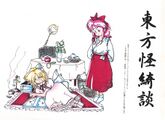 Cover of Mystic Square, featuring Reimu and Alice
 -
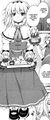 Alice in Strange and Bright Nature Deity
 -
 Alice in Foul Detective Satori
 -
 Alice's fortune slip in Whispered Oracle of Hakurei Shrine
 -
 Alice's cameo in Whispered Oracle of Hakurei Shrine
 -
 Alice's alt outfits in Touhou Hisoutensoku


Misconceptions
Characters Have Flown Through Outerspace
One example of this is believed to be in Touhou 02's Stage 3 Scarlet Dream ~ Scarlet Dream where it displays stars and a space-like effect in the background[558], however this is actually the World of Fantasies, the world that lies between Makai and the human world, with Genji confirming this is definetely not outerspace as Reimu can breathe just fine there[559].
All Characters are Children
This is an argument that spawns from how small the characters look in different works, though this is moreso due to the "moe" artstyle Touhou tries to capture, in many of the manga characters look far older.
Majority of characters in the series are outright shown to drink alcohol on a daily basis[560], where one needs to be at least 20 years old under Japanese law to drink, where Japanese law requires no underaged characters to be shown drinking. This is even acknowledged in the series itself with a note saying alcohol is only for those over 20 years old[561]. Thus if a character is ever seen drinking alcohol in the series, they are an adult.
The only direct non-adults in the series are Sumireko Usami, Chiyuri Kitashirakawa, and Hieda no Akyuu in her first appearance.
Youkai Control the world through both the mental and physical layer
This statement comes from a fan translation that says this in Curiosities of Lotus Asia[562].
While the statement seems clear cut, there is another translation used instead that makes more sense with the sentence.
It instead notes that most youkai concieve of the world through these two layers, which is why they believe the future is pre-determined and history repeats itself[563]. This falls in line with the earlier disucssion of Rinnosuke claiming that he believes the future to be predetermined and Reimu needing to explain to him why that's not the case[546].
|
Songs: |
|
Battle Records
23 - 19 - 0
- Marisa Kirisame - Fight[564]
- Conditions: None.
- Location: Stage 1 Irresponsible Magic Magical Light 1st Day 14:00 Forest of Magic
- Reimu Hakurei - Fight[565]
- Conditions: None.
- Location: Stage 2 Insightful Shrine Maiden Sixth Sense 1st Day 21:00 Hakurei Shrine
- Sakuya Izayoi - Fight[566]
- Conditions: None.
- Location: Stage 3 Moment of ∞ Infinity 2nd Day 13:30 Clock Tower
- Patchouli Knowledge - Fight[567]
- Conditions: None.
- Location: Stage 4 Graveyard of Knowledge Knowledge Box 2nd Day 21:00 Library
- Youmu Konpaku - Fight[568]
- Conditions: None.
- Location: Stage 5 Temperature of a Ghost Compatible Ghost Feast Day 12:00 Netherworld
- Yukari Yakumo - Fight[569]
- Conditions: None.
- Location: Border Line Alice's Youkai Hunt Invisible Magic Feast Day 17:00 Hakurei Shrine
- Suika Ibuki - Fight[570]
- Conditions: None.
- Location: Immaterial and Missing Power Gathering Dreams, Thoughts Pandemoniac Land Feast Day 19:00 Gensokyo
- Wriggle Nightbug - Fight[571]
- Conditions: Marisa teamed up with Alice Margatroid.
- Location: Stage 1 - Where the Fireflies Fly
- Mystia Lorelei - Fight[572]
- Conditions: Marisa teamed up with Alice Margatroid.
- Location: Stage 2 - The Path Where Humans Vanish
- Keine Kamishirasawa - Fight[573]
- Conditions: Marisa teamed up with Alice Margatroid.
- Location: Stage 3 - Memories of the, History Eaters Home
- Keine Kamishirasawa - Fight[574]
- Conditions: Match was a rematch. Marisa teamed up with Alice Margatroid.
- Location: Stage 3 - Memories of the, History Eaters Home
- Reimu Hakurei & Yukari Yakumo - Fight[575]
- Conditions: Marisa teamed up with Alice Margatroid. Reimu teamed up witH Yukari Yakumo.
- Location: Stage 4 - Legend Dreamland
- Note: ZUN has elaborated that canonically, anytime Reimu and the gang are defeated, they challenge again however many times they want, but on the youkai side, they do not challenge again after being defeated and are not attached to the results of winning or losing[525].
- Tewi Inaba - Fight[576]
- Conditions: Marisa teamed up with Alice Margatroid.
- Location: Stage 5 - A Pure Cage in the Filthy World
- Reisen Udongein Inaba - Fight[577]
- Conditions: Marisa teamed up with Alice Margatroid.
- Location: Stage 5 - A Pure Cage in the Filthy World
- Eirin Yagokoro - Fight[578]
- Conditions: Marisa teamed up with Alice Margatroid.
- Location: Final Stage - The Orb in the night sky hiding the Princess
- Kaguya Houraisan - Fight[579]
- Conditions: Marisa teamed up with Alice Margatroid.
- Location: Final Stage - The Orb in the night sky hiding the Princess
- Fujiwara no Mokou - Fight[580]
- Conditions: Marisa teamed up with Alice Margatroid.
- Location: Extra Stage - Doll of Hourai
- Reimu Hakurei - Fight[581]
- Condition: None.
- Location: Stage 1 Omens in Clusters
- Youmu Konpaku - Fight[582]
- Condition: None.
- Location: Stage 2 Snowy Garden of Hakugyokurou
- Patchouli Knowledge - Fight[583]
- Condition: None.
- Location: Stage 3 The Library's Bug
- Sakuya Izayoi - Fight[584]
- Condition: None.
- Location: Stage 4 A Fight Looking Up
- Condition: None.
- Location: Stage 5 Dragon Palace in the Sky
- Tenshi Hinanawi - Fight[586]
- Condition: None.
- Location: Stage Final Daughter of Heaven, Goddess of Earth, Heart of a Human
- Reimu Hakurei - Fight[587]
- Conditions: None.
- Location: Stage 3 Makai ~ Devil's World
- Reimu Hakurei - Fight[588]
- Conditions: Match was a rematch.
- Location: Extra Stage Open the Door of a Picture Book ~ Open Sesame
- Marisa Kirisame - Fight[589]
- Conditions: None.
- Location: Stage 3 Makai ~ Devil World
- Marisa Kirisame - Fight[590]
- Conditions: Match was a rematch.
- Location: Extra Stage Open the Door of a Picture Book ~ Open Sesame
- Yuuka Kazami - Fight[591]
- Conditions: None.
- Location: Stage 3 Makai ~ Devil World
- Yuuka Kazami - Fight[592]
- Conditions: Match was a rematch.
- Location: Extra Stage Open the Door of a Picture Book ~ Open Sesame
- Mima - Fight[593]
- Conditions: None.
- Location: Stage 3 Makai ~ Devil World
- Mima - Fight[594]
- Conditions: Match was a rematch.
- Location: Extra Stage Open the Door of a Picture Book ~ Open Sesame
- Reimu Hakurei - Fight[595]
- Conditions: Match was a rematch.
- Location: Stage 3 Is that it is snowing only this paradise? The paradise was already Alice's playground
- Marisa Kirisame - Fight[596]
- Conditions: Match was a rematch.
- Location: Stage 3 Is that it is snowing only this paradise? The paradise was already Alice's playground
- Youmu Konpaku & Yuyuko Saigyouji - Fight[597]
- Conditions: Youmu teamed up with Yuyuko Saigyouji. Marisa teamed up with Alice Margatroid.
- Location: Stage 4 Powerful - Beneath the Soil that Holds Magic Power
- Note: ZUN has elaborated that canonically, anytime Reimu and the gang are defeated, they challenge again however many times they want, but on the youkai side, they do not challenge again after being defeated and are not attached to the results of winning or losing[525].
- Reimu Hakurei - Fight[598]
- Conditions: None.
- Location: Stage 2 Blood of Magician Inanimation 1st Day 21:00 Forest of Magic
- Sakuya Izayoi - Fight[599]
- Conditions: None.
- Location: Stage 2 Different Doll Darkside 1st Day 21:00 Forest of Magic
- Marisa Kirisame - Fight[600]
- Conditions: None.
- Location: Stage 1 Same Job, Different Species Dog and Monkey 1st Day 14:00 Forest of Magic
- Yukari Yakumo - Fight[601]
- Conditions: None.
- Location: Stage 2 Grape-Coloured Liquor Wine Biscuit Feast Day 13:00 Forest of Magic
- Reimu Hakurei - Fight[602]
- Conditions: None.
- Location: Stage 2 - Pouring Beads of Water
- Remilia Scarlet - Fight[603]
- Conditions: None.
- Location: Doll's Turnabout Trial Stage 3
- Marisa Kirisame - Fight[604]
- Conditions: None.
- Location: Stage 1 Humid Summer
None.
References
| Expand here. |
|---|
|
Versus Threads
None.
None.
None.
- Pages using Tabber parser tag
- Templates
- Characters
- Female Characters
- European Characters
- European Female Characters
- Indie Characters
- Indie Game Characters
- Indie Manga Characters
- Indie Book Characters
- Video Game Characters
- Fighting Game Characters
- Doujin Characters
- Doujinshi Characters
- Doujin Soft Characters
- Playable Characters
- Right-Handed Characters
- Monster Characters
- Evil Characters
- Neutral Evil Characters
- Neutral Characters
- Chaotic Neutral Characters
- Good Characters
- Neutral Good Characters
- 4th Wall Aware Characters
- Supporting Characters
- Alive Characters
- Humanoid Characters
- Primary Antagonists
- Antagonists
- Primary Protagonists
- Protagonists
- Geniuses
- Magicians
- Non-Humans
- Humanoids
- Humans
- Human Achievers
- Youkais
- Adults
- Monsters
- Game Enemies
- Game Bosses
- Street Threats
- ZUN
- ZUN Soft
- Team Shanghai Alice
- Touhou Project (PC-98)
- Touhou Project (Windows)
- Touhou Project
- Regular Tier
- Tier 10
- Low 10-B
- Higher Tier Ability Users
- Longevity Users
- Aura Users
- Invisibility Users
- Non-Standard Damage Users
- Non-Standard Defenses Users
- Absorption Users
- Acausality Users
- Reliance Users
- True Sight Users
- Empowerment Users
- Battlefield Removal Users
- Magic Users
- Extrasensory Perception Users
- Transferal Users
- Transmutation Users
- Holy Users
- Spirit Users
- Explosion Users
- Magnetism Users
- Perception Users
- Logic Users
- Nullification Users
- Erasure Users
- Invulnerability Users
- Cold Users
- Empathic Users
- Portal Users
- Forcefield Users
- Curse Users
- Quantum Users
- Link Users
- Genius Intelligence Users
- Preparation Users
- Immortality Users
- Self-Sustenance Users
- Age Users
- Final Bosses
- Secret Boss
- Human Achievements Users
- Intimidation Users
- Sheer Will Users
- Breaking the Fourth Wall Users
- Cartoon Physics Users
- Non-Standard Interaction Users
- Accelerated Development Users
- Analytical Prediction Users
- Body Puppetry Users
- Large Sized Users
- Familiar Summoning Users
- Shielding Users
- Attack Reflection Users
- Thread Users
- Fire Users
- Flight Users
- Power Modification Users
- Power Nullification Users
- Teleportation Users
- Space-Time Users
- Reality Warping Users
- Curtain Fire Users
- Energy Users
- Energy Projection Users
- Glyph Users
- Ricochet Users
- Elemental Users
- Homing Attack Users
- Ice Users
- Size Users
- Resurrection Users
- Power Manifestation Users
- Supernatural Luck Users
- Statistics Amplification Users
- Luck Users
- Dream Users
- Body Control Users
- Penetration Damage Users
- Summoning Users
- Animal Users
- Door Users
- Superhuman Physical Characteristics Users
- Superhuman Speed Users
- Social Influencing Users
- Alternate Breathing Users
- Reactive Power Level Users
- Ability Optimization Users
- Summoned Power Users
- Destruction Users
- Stasis Users
- Mortality Users
- Natural Weaponry Users
- Boundary Users
- Madness Users
- Heat Users
- Cloth Users
- Animal Taming Users
- Statistics Reduction Users
- Phasing Attacks Users
- Intangibility Users
- Plant Users
- Velocity Users

